UPSC PYQs

Prelims, Mains & Optional PYQs

UPSC Notes

Comprehensive & Short Notes

AI in Disaster Management: Applications, Tools, Challenges and Way Forward

30 Sep 2026

AI in Disaster Management: Applications, Tools, Challenges and Way Forward

Subject: GS Paper 3: Disaster Management

Context: During the recent disaster in Nepal, an AI-powered web portal was widely used to match crowdsourced information on missing persons with official records of the dead and injured. 
  • It also mapped damaged buildings and structures using open-source satellite imagery.

IAS coaching

About AI In Disaster Management

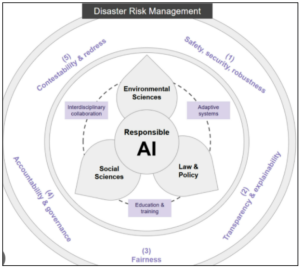
  • AI in disaster management refers to the use of Artificial Intelligence technologies to analyse large volumes of data and support disaster prediction, preparedness, response, rescue, relief, and recovery.
    • It enables faster data processing, early warning, risk assessment and informed decision-making during disasters.
  • Major AI Tools:
    • GraphCast is an AI-based tool used for weather forecasting. 
    • Google Flood Hub uses AI for flood forecasting and early warning. 
    • DisasterAWARE supports disaster monitoring and situational awareness.
    • SKAI uses satellite imagery analysis to assess disaster-affected areas.

Role of AI In Disaster Management

  • Early Warning and Forecasting: AI models analyse large volumes of historical weather data to generate faster and more localised forecasts.
    • AI In Disaster ManagementUseful for predicting extreme rainfall and floods.
    • Google Flood Hub provides flood forecasts and advisories several days in advance.
  • Risk Assessment and Hazard Mapping: AI can combine weather data, satellite imagery, maps, and other datasets to identify vulnerable areas.
    • Helps generate comprehensive risk assessments and early warnings.
  • Search and Rescue: Thermal-camera-equipped drones can identify human-shaped thermal signatures in debris.
    • AI can consolidate crowdsourced information to identify missing persons and survivors.
  • Response and Relief: AI can process large volumes of text, images, videos, and information in local languages.
    • Helps identify affected areas and prioritise food, medical aid and other relief.
  • Post-Disaster Recovery: AI-enabled tools can help:
    • Identify isolated habitations.
    • Assess roads and infrastructure.
    • Identify helicopter landing sites.
    • Support damage assessment and rehabilitation planning

Challenges

  • Data Quality: AI systems depend on accurate, reliable, and adequate data for effective predictions and decision-making.
  • Misinformation: Disasters generate large volumes of unverified and unreliable information, making data validation challenging.
  • Human Oversight: AI-generated outputs require expert verification and human judgment, particularly for critical decisions.
  • Institutional Capacity: Effective deployment requires trained personnel, technical expertise and robust governance frameworks.
  • Digital Divide: Vulnerable and remote communities may have limited access to digital infrastructure, connectivity and AI-enabled services.

Way Forward

  • Strengthen AI-Based Early Warning Systems: Expand AI-based systems for hyperlocal forecasting and timely early warnings for floods, cyclones and extreme rainfall.
  • Integrate Multi-Source Data: Integrate satellite, drone, weather, and crowdsourced data to enable comprehensive and real-time disaster assessment.
  • Ensure Data Verification: Develop robust mechanisms to verify crowdsourced information and minimise the impact of misinformation during disasters.
  • Build Institutional Capacity: Enhance the technical skills and AI capabilities of disaster-management authorities and local governments.
  • Ensure Human Oversight and Inclusion: Maintain human oversight over AI-driven decisions and ensure equitable access to AI-enabled disaster-management services.

Click to Know UPSC Coaching Centres in India

Conclusion

AI can act as a force multiplier in disaster management by enabling faster prediction, better risk assessment, and more efficient rescue and relief. However, strong institutions, human expertise and effective governance remain central to saving lives and building resilience.

News Source: IE

Check Out UPSC CSE Books

Visit PW Store

online store 1

AI in Disaster Management: Applications, Tools, Challenges and Way Forward

Need help preparing for UPSC or State PSCs?

Connect with our experts to get free counselling & start preparing

Free Counselling for UPSC Aspirants

Connect with our experts and take the right next step.

Expert Guidance
Personalized Strategy
100% Free

Book Your Free Session

NEED ASSISTANCE?

Request a Callback

Our counsellor will connect with you and help you choose the right course and centre.

  • Expert Guidance
  • Course & Fee Information
  • Quick Callback Support

Request a Callback

Books
UPSC PYQs
UPSC Notes
Current Affairs
Quick Revise Now !
AVAILABLE FOR DOWNLOAD SOON
UDAAN PRELIMS WALLAH
Comprehensive coverage with a concise format
Integration of PYQ within the booklet
Designed as per recent trends of Prelims questions
हिंदी में भी उपलब्ध
Quick Revise Now !
UDAAN PRELIMS WALLAH
Comprehensive coverage with a concise format
Integration of PYQ within the booklet
Designed as per recent trends of Prelims questions
हिंदी में भी उपलब्ध

<div class="new-fform">


    </div>

    Subscribe our Newsletter
    Sign up now for our exclusive newsletter and be the first to know about our latest Initiatives, Quality Content, and much more.
    *Promise! We won't spam you.
    Yes! I want to Subscribe.