UPSC PYQs

Prelims, Mains & Optional PYQs

UPSC Notes

Comprehensive & Short Notes

MMDR Amendment Bill 2026: Mineral Regulation, Federalism and Mining

17 Aug 2026

MMDR Amendment Bill 2026: Mineral Regulation, Federalism and Mining

Subject: GS 2: Polity & Governance

Context: Recently, the Mines and Minerals (Development and Regulation) Amendment Bill, 2026 was passed by the Parliament. 
  • Purpose: It amends the MMDR Act, 1957 to provide regulatory certainty and long-term stability in the major minerals sector.
    • The Mines and Minerals (Development and Regulation) Act, 1957 (MMDR Act) is the principal central law governing the development and regulation of mines and minerals.
    • The Act allows the central government to regulate mines and mineral development in public interest.

Best Online Coaching for UPSC

Key Features of the MMDR Amendment Bill, 2026

  • Regulation of Mineral Bearing Lands: The amendment empower central government to regulate mineral-bearing lands, strengthening the Union’s regulatory role over the mineral sector.
  • Restrictions on Levies by States: The Bill seeks to regulate the power of States to impose taxes, cesses and other levies on mineral rights and mineral-bearing lands.
  • MMDR Amendment Bill 2026Capping State Levies (New Section 9D): The provision restricts States from using mineral quantity, mineral value or royalty as the basis for specified local levies, thereby seeking to prevent multiple charges on the same mineral activity.
  • Cumulative Levy Framework: The Centre has indicated that the objective is not necessarily to eliminate every existing levy, but to ensure that the overall fiscal burden remains within prescribed limits.
  • Past Dues: The Bill provides for extinguishing certain unpaid or unrecovered dues arising from specified State levies imposed before the new framework comes into force.
  • Fiscal Certainty: By reducing significant variations in mineral-related taxation between States, the amendment seeks to provide mining companies with a more predictable cost structure.

Existing Legal Framework Governing Minerals in India

  • Constitutional Division of Powers: Mineral governance involves an interaction between Union regulatory authority and State taxation powers
    • Entry 54 of the Union List enables Parliament to regulate mines and mineral development, while Entries 49 and 50 of the State List concern taxation of lands and mineral rights respectively.
  • MMDR Act, 1957: The Mines and Minerals (Development and Regulation) Act, 1957 is the principal legislation governing mineral exploration, mining and mineral development.
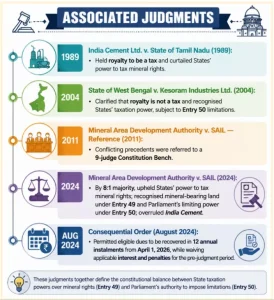
  • Supreme Court’s 2024 Judgment: In Mineral Area Development Authority v. Steel Authority of India, the nine-judge Constitution Bench held by an 8:1 majority that royalty is not a tax and that States possess legislative competence to tax mineral rights.
  • Mineral-Bearing Land: The Court held that mineral-bearing land falls within “lands” under Entry 49 of the State List. It also held that mineral output or royalty could be used as a measure for determining such land tax.
  • Reversal of Earlier Position: The judgment overruled the earlier interpretation in India Cement Ltd. v. State of Tamil Nadu, which had treated royalty as a tax and restricted State taxation of mineral rights.
  • Parliamentary Limitation: Importantly, the 2024 judgment recognised that Entry 50 of the State List permits Parliament to impose limitations on State taxation of mineral rights through legislation relating to mineral development. However, the Court distinguished this from Entry 49, which concerns taxation of land.

Regulation of Major & Minor Minerals: (UPSC CSE Prelims 2019)

  • Constitutional framework: Union List Entry 54 empowers the Centre to regulate mines and mineral development; State List Entry 23 gives States power over mineral development, subject to Union control.
  • Major minerals: Primarily regulated under the Mines and Minerals (Development and Regulation) Act, 1957 (MMDR Act); the Centre determines the broad regulatory framework, while States grant mining leases and collect revenues.
  • Minor minerals: States have greater regulatory autonomy and frame their own concession rules for minerals such as sand, gravel, ordinary clay and building stone.

Significance of the Mines and Minerals (Development and Regulation) Amendment Bill, 2026

  • Fiscal Certainty for the Mining Sector: Mining companies already face royalty, District Mineral Foundation contributions, National Mineral Exploration and Development Trust contributions and various other statutory levies. Rationalising overlapping State-level charges can improve investment predictability and reduce fiscal uncertainty.

About District Mineral Foundation (DMF): (UPSC CSE Prelims 2016)

  • DMF is a non-profit body established in every mining-affected district under the MMDR Act, 1957, to work for the interest and benefit of persons and areas affected by mining.
  • Funding: Mining lease holders contribute to DMF; the contribution is linked to royalty paid and prescribed by the Central Government/State Government framework.
  • Key purpose: Funds are used for livelihoods, healthcare, education, drinking water, sanitation, skill development and environmental protection in mining-affected areas, with priority to directly affected people.
    • DMF does not promote mineral exploration or authorise States to issue exploration licences

UPSC Online Preparation

  • Lower Input-Cost Pressures: Multiple mineral-sector levies can raise the cost of raw materials. A more predictable framework could benefit downstream industries such as steel, cement, power and infrastructure, where mineral inputs are crucial.
  • Strengthening Critical Mineral Security: Uniform and predictable taxation can support the National Critical Mineral Mission (NCMM) by improving the investment environment for exploration and extraction of strategic resources. This is especially important for capital-intensive projects involving critical minerals, offshore resources and deep-sea exploration.
  • Improving Global Competitiveness: A relatively consistent fiscal framework can make India more attractive for domestic and foreign mining investment, while strengthening domestic mineral-based manufacturing and reducing import dependence.
  • Preventing Excessive Fiscal Fragmentation: Different State-level levies may create uneven investment conditions across mining regions. A common framework can promote greater transparency and consistency while preventing excessive cumulative taxation.
  • Balancing Industry and Public Interest: The Bill attempts to reconcile two competing objectives: maintaining competitive mining costs while ensuring that mineral resources continue to contribute to public revenues and national development.

Challenges That Need to be Tackled

  • Centre–State Fiscal Tensions: The principal concern is that greater Union control could reduce the fiscal autonomy of States, particularly mineral-rich States that depend substantially on mining-related revenues.
  • Constitutional Friction: The amendment could generate questions concerning the boundary between Entry 49, Entry 50 and Entry 54. The Supreme Court specifically recognised State competence to tax mineral-bearing land under Entry 49. Any substantial restriction in this domain could therefore invite constitutional scrutiny.
  • Revenue Concerns of Mineral-Rich States: Mineral-producing States bear significant costs associated with environmental degradation, land acquisition, displacement, infrastructure pressure and rehabilitation. Restricting their additional revenue sources without an alternative mechanism could weaken their fiscal capacity.
  • Unequal Distribution of Mineral Benefits: Mining regions may experience environmental and social costs while a substantial share of the economic benefits accrues elsewhere. A purely cost-containment approach could therefore aggravate regional inequalities.
  • Implementation Uncertainty: The effectiveness of the new framework will depend on subsequent rules, thresholds and administrative mechanisms. Excessive Central discretion could itself become a source of uncertainty.
  • Federal Consultation Deficit: Mineral-producing States may perceive unilateral standardisation as weakening cooperative federalism, particularly since several States introduced new levies after the 2024 Supreme Court ruling.

Way Forward

  • Mineral Governance Council: Establish a GST Council-style Mineral Governance Council comprising the Centre and mineral-producing States to jointly deliberate on taxation, royalties, levies and broader mineral policy.
  • Inter-State Mineral Tariff Mechanism: Develop transparent fiscal guardrails for cumulative mineral levies rather than imposing rigid limits without adequate State participation.
  • Revenue-Sharing Mechanism: Where State taxation powers are curtailed, provide an appropriate revenue-sharing or compensation arrangement, especially for resource-rich States.
  • Link Revenue with Environmental Costs: Ensure that mineral revenues contribute adequately to ecological restoration, rehabilitation, tribal welfare and mine-affected communities.
  • Strengthen the 3Fs: Greater devolution of Functions, Funds and Functionaries to local governments in mining regions can improve accountability and ensure that mining benefits reach affected communities.
  • Align with NCMM: The fiscal framework should complement the National Critical Mineral Mission by providing predictable taxation and regulatory conditions for exploration of lithium, cobalt, rare earth elements and other strategic minerals.
  • Improve Cooperative Federalism: Formulation and implementation of the framework should involve State governments, industry, local communities and experts, reducing the likelihood of prolonged political and constitutional disputes.

Click to Explore UPSC Offline Coaching

Conclusion

The MMDR Amendment Bill, 2026 seeks to balance mineral-sector competitiveness with fiscal stability. Its success will depend on preserving reasonable State revenue space, ensuring Centre–State coordination, and strengthening environmental accountability to advance mineral security, industrial growth and cooperative federalism

Check Out UPSC CSE Books

Visit PW Store

online store 1

MMDR Amendment Bill 2026: Mineral Regulation, Federalism and Mining

Need help preparing for UPSC or State PSCs?

Connect with our experts to get free counselling & start preparing

Free Counselling for UPSC Aspirants

Connect with our experts and take the right next step.

Expert Guidance
Personalized Strategy
100% Free

Book Your Free Session

NEED ASSISTANCE?

Request a Callback

Our counsellor will connect with you and help you choose the right course and centre.

  • Expert Guidance
  • Course & Fee Information
  • Quick Callback Support

Request a Callback

Books
UPSC PYQs
UPSC Notes
Current Affairs
Quick Revise Now !
AVAILABLE FOR DOWNLOAD SOON
UDAAN PRELIMS WALLAH
Comprehensive coverage with a concise format
Integration of PYQ within the booklet
Designed as per recent trends of Prelims questions
हिंदी में भी उपलब्ध
Quick Revise Now !
UDAAN PRELIMS WALLAH
Comprehensive coverage with a concise format
Integration of PYQ within the booklet
Designed as per recent trends of Prelims questions
हिंदी में भी उपलब्ध

<div class="new-fform">


    </div>

    Subscribe our Newsletter
    Sign up now for our exclusive newsletter and be the first to know about our latest Initiatives, Quality Content, and much more.
    *Promise! We won't spam you.
    Yes! I want to Subscribe.