Recently, the Assam government introduced the Uniform Civil Code (UCC) Bill, 2026 in the Assembly.
- If passed, Assam would become the first Northeastern state and the third in India after Uttarakhand and Gujarat to enact a UCC law.
UPSC Online Coaching
About Uniform Civil Code (UCC)

- Definition: A UCC refers to a unitary framework of personal laws that applies uniformly to all citizens regardless of their religious affiliation.
- It standardizes civil matters such as marriage, divorce, maintenance, inheritance, adoption, and succession.
- Constitutional Backing: Article 44 under the Directive Principles of State Policy (DPSP) explicitly mandates that the State shall strive to secure a UCC for all citizens throughout the territory of India.
- Judicial Endorsement: The Supreme Court of India has routinely emphasized the necessity of a UCC to secure gender justice, notably in landmark rulings like the Shah Bano case (1985) and the Sarla Mudgal Case (1995).
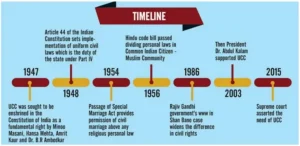 Shah Bano Case (1985): The Supreme Court of India upheld the right of a divorced Muslim woman to claim maintenance under Section 125 CrPC and emphasized the need for a Uniform Civil Code (UCC) to ensure gender justice.
- Sarla Mudgal Case (1995): The Court highlighted the misuse of religious conversion for polygamy and reiterated the importance of a UCC for ensuring legal uniformity and social reform.
Key Provisions of the Assam UCC Bill

- Abolition and Criminalization of Polygamy: The draft law enforces strict monogamy.
- Any violation or practice of polygamy will be prohibited and penalized with imprisonment for up to 7 years.
- Mandatory Registration of Marriages and Divorces:
- Fixed Timelines: It is compulsory to register all marriages and divorces with an appointed sub-registrar within 60 days of the event or judicial decree.
- Standardized Rules: The legal minimum age is set at 21 years for men and 18 years for women, alongside the prohibition of 37 categories of close-blood relationships.
- Legal Regulation of Live-In Relationships:
- Compulsory Intimation: Couples residing in live-in arrangements must formally register with a sub-registrar within one month.
- This clause extends to state residents living outside Assam.
- Penal Framework: Non-compliance or staying unregistered beyond a month attracts up to 3 months of jail time, a fine up to ₹10,000, or both.
- Failing to reply to an official notice can extend jail time to 6 months and fines up to ₹25,000.
- Child Legitimacy & Support: Any child born from a live-in arrangement is legally recognized as fully legitimate.
- Additionally, women abandoned by their live-in partners can legally claim maintenance.
- Gender-Equal Inheritance Rights: The Bill introduces a balanced, uniform order of preference for property distribution when an individual dies intestate (without a will).
- The class-1 heirs equitably include the spouse, children, and parents of the deceased, striking down gender-discriminatory ancestral laws.
- Definitive Tribal Exclusion: To preserve indigenous customary rights, the law will not apply to any Scheduled Tribes (STs) residing in Assam, who account for roughly 12.44% of the state’s population.
The Core Need for a UCC
- Upholding Secularism: A truly secular democratic republic requires a common civil identity for all citizens, ensuring that state-enforced legal rights are decoupled from diverse religious practices.
- Securing Gender Justice: Traditional personal laws often contain deeply entrenched, biased clauses against women regarding property ownership and divorce. A UCC erases these disparities to bring gender parity.
- Fostering National Integration: A uniform law embodies the spirit of “one nation, one law,” preventing fragmented community laws from obstructing cohesive national legal uniformity.
- Simplification and Equality: It streamlines India’s complex, overlapping maze of personal laws, making the legal system highly accessible while giving equal civil status to every citizen.
Challenges to Overcome
- The Privacy Debate: Mandating the registration of live-in relationships under pain of imprisonment faces severe criticism for potentially breaching the Right to Privacy guaranteed under Article 21 (K.S. Puttaswamy judgment).
- Federalism Concerns: Because personal laws fall under the Concurrent List (Entry 5) of the Constitution, a piecemeal, state-by-state passage of UCC bills creates a fragmented legal landscape rather than true national uniformity.
- Asymmetric Exemptions: Applying the law to non-tribal indigenous populations while completely exempting Scheduled Tribes could aggravate social and political anxieties in an ethnically volatile state.
- Religious Freedom Concerns: Since personal laws are deeply linked with religious and community practices, the Bill may face objections under Article 25 of the Constitution, although the right to religious freedom remains subject to public order, morality, health, and other Fundamental Rights.
- Northeast-Specific Sensitivity: Implementation requires caution as the Northeast possesses constitutionally protected customary practices, tribal autonomy arrangements, and deeply rooted community-based legal traditions.
Way Forward
- Build Consensus: State governments should engage in extensive inter-faith and civil society dialogue to alleviate minoritarian fears of cultural erasure.
- Decriminalize Personal Choices: The harsh penal provisions monitoring live-in couples should be replaced with civil guidelines to prevent state overreach and moral policing.
- Formulate a Model National Draft: The Law Commission of India should compile best practices from state bills (Assam, Uttarakhand, Goa) to create a balanced, non-discriminatory national framework.
- Ensure Gender-Neutral Drafting: Provisions relating to maintenance, inheritance, guardianship, and live-in relationships should be framed to safeguard vulnerable individuals while avoiding unnecessary criminalisation of private choices.
Click to Know UPSC OnlyIAS Coaching Centres
Conclusion
The Assam UCC Bill signifies a bold legislative leap toward fulfilling the constitutional dream of Article 44. While its measures on gender-equal property rights and child legitimacy are historic, its ultimate success will depend on how effectively the state balances legal uniformization with individual fundamental freedoms and the unique cultural mosaic of the Northeast.
 27 May 2026