Subject: GS 2: Polity
Context: The Supreme Court is hearing a petition seeking an institutional mechanism for 24×7 judicial accessibility to protect life and personal liberty, particularly in cases involving late-night arrests, demolition drives, deportations, and other urgent executive actions.
- The Supreme Court agreed to consider framing a Standard Operating Procedure (SOP) to allow citizens to access courts beyond office hours.
UPSC Course Fees Online
Background
- A three-judge Bench headed by Chief Justice of India Surya Kant heard a petition filed by Supreme Court advocate Maheravish Rein seeking an institutional mechanism to ensure 24×7 judicial accessibility.
- The petition argued that courts cannot remain inaccessible during nights, weekends, and holidays, especially amid reports of late-night arrests, early-morning demolition drives, deportations, and other urgent executive actions.
- It contended that the absence of a continuous judicial access mechanism could lead to irreversible violations of fundamental rights, particularly the right to life and personal liberty under Article 21.
- The plea emphasized that constitutional protections cannot be constrained by court working hours, stating: “The Constitution cannot fall silent at night, nor can the protection of liberty await the morning bell of the courts.”
| Constitutional Basis:
Article 32(4)
- Article 32(4) provides that the right guaranteed under Article 32 shall not be suspended except as otherwise provided by the Constitution.
Article 226 – Power of High Courts to Issue Writs
- Article 226 empowers every High Court to issue writs (Habeas Corpus, Mandamus, Prohibition, Certiorari, and Quo Warranto) for the enforcement of Fundamental Rights and for any other purpose.
- Its scope is wider than Article 32, as it can also be invoked for the enforcement of legal rights, not just Fundamental Rights
Article 141 – Law Declared by the Supreme Court
- Article 141 provides that the law declared by the Supreme Court shall be binding on all courts within the territory of India.
- It ensures uniformity, consistency, and certainty in the interpretation and application of law across the country through the doctrine of precedent (stare decisis).
|
What is the Right to Life and Personal Liberty?
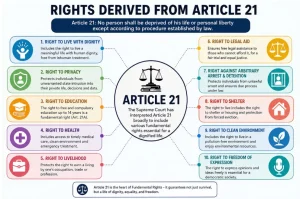
- Article 21 states: “No person shall be deprived of his life or personal liberty except according to procedure established by law.”
- It is available to citizens as well as non-citizens.
- Initially interpreted narrowly, Article 21 has been expansively interpreted to include various rights essential for a life with dignity.
Why is the “After Hours” Continuous Justice Mechanism Important?
- Protects Personal Liberty: Ensures immediate judicial intervention against illegal arrests, arbitrary detention, and custodial violations, safeguarding the Fundamental Right under Article 21 through timely constitutional remedies.
- Prevents Irreparable Harm: Enables courts to stay demolitions, deportations, evictions, or coercive executive actions before irreversible damage occurs, making constitutional relief meaningful.
- Checks Executive Excesses: Provides continuous judicial oversight over urgent state actions, preventing arbitrary exercise of executive power and strengthening the system of checks and balances.
- Strengthens Rule of Law: Reinforces that every executive action remains subject to judicial review at all times, ensuring constitutional supremacy and uninterrupted access to justice.
- Enhances Public Trust: Demonstrates that constitutional remedies remain accessible whenever fundamental rights are threatened, thereby strengthening citizens’ confidence in the judiciary.
Challenges in Ensuring 24×7 Judicial Protection
- Institutional Constraints: Shortage of judges, court staff, and infrastructure, coupled with heavy pendency, makes continuous judicial functioning administratively and financially demanding.
- Absence of Uniform Mechanism: Different High Courts follow varying emergency procedures, leading to inconsistent access to urgent constitutional remedies across the country.
- Risk of Misuse: Routine disputes may be projected as urgent constitutional matters, overburdening emergency benches and delaying relief in genuinely exceptional cases.
- Administrative Burden: Continuous functioning requires 24×7 registries, technical support, security, and judicial staff, increasing operational complexity and resource requirements.
- Balancing Judicial Independence: Emergency hearings must protect life and liberty without compromising judicial efficiency, institutional autonomy, or the quality of reasoned decision-making.
Way Forward
- Frame a Nationwide Standard Operating Procedure (SOP): Develop a uniform SOP for all constitutional courts to ensure consistent emergency judicial access in cases involving life and personal liberty, while allowing flexibility for local administrative needs.
- Establish 24×7 Emergency Judicial Benches: Designate duty judges or emergency benches on a rotational basis to hear urgent constitutional matters outside regular court hours, including nights, weekends and public holidays.
- Create a Digital Emergency Filing Portal: Launch a dedicated online portal with real-time alerts, e-filing and automated case assignment, enabling litigants and lawyers to seek immediate judicial intervention from any location.
- Clearly Define Urgent Categories: Specify eligible cases such as illegal detention, habeas corpus, imminent demolition, deportation, custodial violence and other irreversible executive actions to prevent misuse and ensure timely attention.
- Prescribe Time-Bound Response Standards: Fix clear timelines for judicial response, such as acknowledging emergency petitions within one hour and conducting hearings at the earliest to prevent irreparable harm.
- Strengthen Virtual Hearing Infrastructure: Expand secure video conferencing, e-records and digital communication systems across all High Courts and subordinate courts to facilitate seamless emergency hearings round the clock.
- Respect Federal Autonomy of High Courts: Adopt a common national framework while allowing High Courts to frame region-specific procedures, ensuring uniform access to justice without compromising the federal judicial structure.
UPSC Coaching Classes
Evolution of Article 21: Landmark Supreme Court Judgments
| Year |
Case |
Outcome / Contribution |
| 1978 |
Maneka Gandhi v. Union of India |
Landmark ruling that the procedure under Article 21 must be just, fair and reasonable; linked Articles 14, 19 and 21. |
| 1985 |
Olga Tellis v. Bombay Municipal Corporation |
Recognised the Right to Livelihood as an integral part of the Right to Life. |
| 1996 |
Paschim Banga Khet Mazdoor Samity v. State of West Bengal |
Recognised the Right to Emergency Medical Care as part of Article 21. |
| 1997 |
D.K. Basu v. State of West Bengal |
Issued safeguards against custodial torture and arbitrary arrests; strengthened protection of personal liberty. |
| 2017 |
Justice K.S. Puttaswamy v. Union of India |
Declared the Right to Privacy a Fundamental Right under Article 21. |
| 2018 |
Common Cause v. Union of India |
Recognised the Right to Die with Dignity by permitting passive euthanasia and advance directives. |
| 2018 |
Navtej Singh Johar v. Union of India |
Decriminalised consensual same-sex relations; upheld dignity, privacy and individual autonomy under Article 21. |
| 2026 |
Maniyar Iliyaz @ Shaik Riyaz v. P. Ayyappan & Ors. |
Held that the Right to Walk safely on public footpaths is an integral part of the Right to Life under Article 21. |
Click to Know UPSC OnlyIAS Coaching Centres
Conclusion
The Right to Life and Personal Liberty under Article 21 is the cornerstone of India’s constitutional democracy and cannot remain contingent upon court working hours. Establishing a uniform, technology-enabled 24×7 emergency judicial mechanism, will strengthen the Rule of Law, reinforce constitutional supremacy, and ensure that justice remains available whenever life and liberty are at stake.
 15 Jul 2026