Recently, a Supreme Court Bench set a strict three-month deadline for High Courts to deliver judgments after reserving orders.
- The Court also ordered that bail orders be given almost immediately to protect personal liberty and stop delays in jail releases.
UPSC Online Classes
Key Rules Set by the Supreme Court
The new binding guidelines change how courts must handle reserved judgments and bail processing:
- Three-Month Judgment Deadline: High Courts must pronounce a final judgment within three months from the date they finish hearing the case and reserve the order.
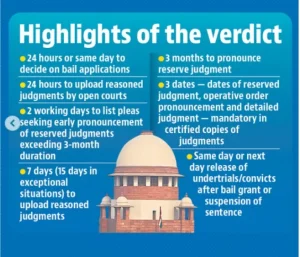 Consequence for Delays: If a Bench fails to deliver the judgment within this time, the case will be taken away and allocated to another Bench to be heard fresh.
- Next-Day Bail Pronouncement: Orders for bail should ideally be spoken out loud in court the very next day after arguments finish.
- Same-Day Jail Communication: Once bail is granted, the order must be sent to the jail on the same day.
- Immediate Release of Undertrials: Prisoners waiting for trial must be set free either the same day or the next day at the latest after bail is communicated.
- Strict Digital Upload Timelines: The main decision (operative part) must be read out in court, and the detailed written reasons must be uploaded online within one week.
- High Court websites must also clearly show the exact date the judgment was reserved.
About Reserved Judgments and Bail Delays
- What is a Reserved Judgment? When a judge finishes hearing arguments from both sides but needs time to review the law and write a detailed final order, they “reserve” the judgment instead of announcing it immediately.
- The Traditional Practice: In India, there has been no strict legal time limit for judges to write their verdicts.
- By old judicial tradition, a “reasonable time” was considered to be two to six months.
- The Reality of Delays: In practice, judges in both High Courts and the Supreme Court have frequently kept judgments reserved for well over a year, leaving litigants in a state of uncertainty.
- The Bail Problem: Even when prisoners are granted bail, slow paperwork and delayed communication to prisons mean that individuals often spend days or weeks stuck in jail unlawfully.
Significance of the Ruling
- Protects Personal Liberty: By forcing courts to process bail and release prisoners within 24 to 48 hours, the ruling guards the constitutional right to freedom.
- Reduces court delays: Fixing a clear deadline prevents cases from remaining pending after hearings are completed.
- Boosts Judicial Transparency: Forcing High Courts to publish the “date of reservation” on their websites lets the public see exactly how long a judge is taking to write a verdict.
- Ensures Accountability: For the first time, judges face a direct consequence—losing their case to another Bench—if they do not finish their work on time.
Concerns and Challenges
- Heavy Judge Workload: Indian High Courts suffer from major vacancies and high caseloads. Forcing strict timelines might lead to rushed judgments or a lack of deep legal analysis.
- Wasted Court Time: If a case is reassigned to a new Bench because of a delay, the entire case has to be argued all over again from scratch, wasting valuable court hours.
- Poor Rural Prison Connectivity: Sending bail orders to remote jails on the exact same day requires flawless digital infrastructure, which many rural prisons still lack.
Related India’s Initiatives for Judicial Reform
- FASTER System (Fast and Secured Transmission of Electronic Records): A digital platform launched by the Supreme Court to securely send e-copies of bail orders directly to jail authorities to stop release delays.
- National Judicial Data Grid (NJDG): An online national database that tracks pending and disposed cases across the country to improve court transparency.
- E-Courts Mission Mode Project: A national initiative aimed at digitizing courtrooms, enabling online case status tracking, and automating legal workflows.
Global Actions & Initiatives
- UN Sustainable Development Goal 16 (SDG 16): A global goal dedicated to peace, justice, and building strong institutions, which includes providing equal access to justice for all and reducing legal delays.
- International Covenant on Civil and Political Rights (ICCPR): A global treaty stating that anyone arrested has the right to a trial within a reasonable time or should be released pending trial.
Way Forward
- Upgrade Court Infrastructure: Ensure all sub-jails and local courts are linked to high-speed networks so bail orders can be verified instantly without paper delays.
- Fill Judicial Vacancies: The government and the judiciary must work together swiftly to appoint more judges, reducing individual workloads so they can meet the three-month deadline.
- Appoint Institutional Court Managers: Introduce professional management staff in High Courts to handle the administrative tracking of reserved judgments, freeing up judges to focus entirely on writing verdicts.
Click to Know UPSC Offline Courses
Conclusion
The Supreme Court’s new guidelines improve judicial accountability by reducing judgment delays and speeding up bail release. Reinforcing the principle that “justice delayed is justice denied,” the ruling promotes greater transparency, efficiency, and protection of citizens’ rights and liberty.
 30 May 2026