National Health Accounts Estimates 2022-23: Rise in Public Health Spending in India

28 May 2026

National Health Accounts Estimates 2022-23: Rise in Public Health Spending in India

Recently, the Union Ministry of Health and Family Welfare released the 10th National Health Accounts Estimates for India, covering the financial year 2022–23

UPSC Coaching Classes

Key Highlights of the NHA Estimates 2022-23

The estimates indicate a gradual shift toward greater public financing of healthcare and reduced financial vulnerability for households between 2013–14 and 2022–23.
  • Rise in Government Health Expenditure: Government Health Expenditure increased nearly threefold from ₹1.30 lakh crore in 2013–14 to ₹3.85 lakh crore in 2022–23. In per capita terms, it rose 2.7 times, from ₹1,042 to ₹2,786.
  • National Health AccountsIncrease in GDP and Budgetary Share: Government Health Expenditure as a share of GDP rose from 1.15% to 1.43%
    • Under the new GDP series with base year 2022–23, it stands at 1.48%
    • Its share in General Government Expenditure also improved from 3.78% to 4.89%.
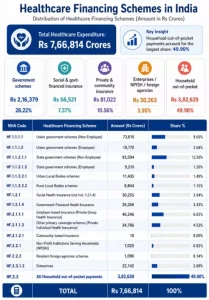
  • Total Macro Health Spend: The Total Healthcare Expenditure (THE) for India in FY 2022-23 is valued at ₹7,66,814 Crores 
  • Rising Role in Total Health Expenditure: The share of Government Health Expenditure in Total Health Expenditure increased from 28.6% to 43.7%, indicating a stronger role of public financing in India’s health sector.
  • Decline in Out-of-Pocket Expenditure: Out-of-Pocket Expenditure as a share of Total Health Expenditure declined from 64.2% in 2013–14 to 43.4% in 2022–23
    • This reflects a reduction in the direct financial burden on households.
  • COVID-19 Effect: During the peak COVID-19 period in 2021–22, emergency public health responses pushed Government Health Expenditure to 1.84% of GDP, while Out-of-Pocket Expenditure fell to a historic low of 39.4%.
  • Greater Focus on Primary Healthcare: Government spending on primary healthcare more than doubled from about ₹0.5 lakh crore in 2013–14 to ₹1.4 lakh crore in 2022–23.
  • Expansion of Social Security and Insurance: Social Security Expenditure on healthcare, including Ayushman Bharat Pradhan Mantri Jan Arogya Yojana (AB PM-JAY), government employee reimbursements and social insurance, increased from 6% to 9.9% of Total Health Expenditure
    • The share of private health insurance also increased from 3.4% to 9.2%.

About National Health Accounts (NHA) Estimates

  • National Health Accounts Estimates provide a systematic picture of healthcare financing in India by tracking sources of funds, financing schemes, providers and health functions.
  • Institutional Framework: The preparation of NHA estimates was institutionalized in 2014 at the National Health Systems Resource Centre (NHSRC), which serves as the National Health Accounts Technical Secretariat (NHATS) for the Ministry of Health and Family Welfare.
  • Methodology: The NHA uses the System of Health Accounts, 2011 (SHA 2011) framework, an internationally accepted standard that allows for global benchmarking of health finances.
  • The Expert Group: To ensure rigorous data collation, the NHA Technical Secretariat works with an expert group comprising representatives from:
    • National Health AccountsMinistry of Statistics and Programme Implementation (MoSPI)
    • NITI Aayog
    • Ministry of Jal Shakti
    • National Health Authority (NHA)
    • Prominent research bodies: National Institute of Public Finance and Policy (NIPFP), National Council of Applied Economic Research (NCAER), and the Institute of Economic Growth (IEG).
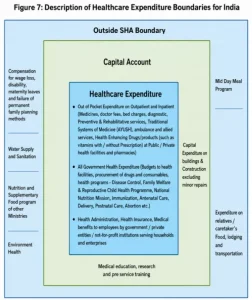
  • System of Health Accounts (SHA 2011) Boundaries: The NHA explicitly demarcates what types of spending fall inside versus outside national tracking limits:
    • Inside the SHA Boundary: Out-of-pocket spending on inpatient/outpatient care (including AYUSH, prescription/non-prescription health products, and diagnostics) , core public health budgets (disease control, immunization, family welfare) , health administration , and medical education, research, and pre-service training.
    • Outside the SHA Boundary: Capital expenditure on building construction/major infrastructure (excluding minor repairs) , environmental health , water supply and sanitation , general nutrition programs of non-health ministries (such as the Mid-Day Meal Program) , and non-medical household costs like patient-relative food, lodging, and transport.

Significance of NHA 2022–23 Estimates

  • Progress Toward Universal Health Coverage: The NHA 2022–23 estimates indicate India’s movement toward Universal Health Coverage through higher public health spending, reduced household financial burden, and greater focus on primary healthcare.
  • Reduced Out-of-Pocket Burden: The decline in Out-of-Pocket Expenditure from 64.2% of Total Health Expenditure in 2013–14 to 43.4% in 2022–23 reflects improved financial protection for households.
  • Strengthening of Public Health Financing: The rise in Government Health Expenditure from 28.6% to 43.7% of Total Health Expenditure shows the expanding role of the state in financing healthcare.
  • Shift Toward Preventive Healthcare: The doubling of government spending on primary healthcare highlights a policy shift toward preventive, promotive, and early-stage healthcare, which can reduce long-term disease burden.
  • Need for Higher Fiscal Commitment: Despite improvement, India’s public health expenditure remains below the National Health Policy, 2017 target of 2.5% of GDP, making sustained fiscal prioritisation of health essential.
  • Centre-State Fiscal Coordination: Since health is largely implemented by states, the rise in Government Health Expenditure must be supported by stronger Centre-State coordination, higher state health budgets, and better utilisation of funds under schemes such as National Health Mission and Ayushman Bharat.
  • Linkage with SDG 3: The decline in Out-of-Pocket Expenditure and increased spending on primary healthcare support India’s progress toward SDG 3- Good Health and Well-being, especially the goal of achieving Universal Health Coverage.

PWOnlyIAS Extra Edge:

Key Terms Related to National Health Accounts (NHA) Estimates 2022–23

  • National Health Accounts (NHA): A systematic accounting framework that measures the flow of financial resources in the health sector, including who spends on healthcare, where the money comes from, and how it is utilized across services, institutions, and programmes.
  • Government Health Expenditure (GHE): The total expenditure incurred by the government on healthcare services and public health activities through Central, State, and local governments. 
    • It includes spending on hospitals, health schemes, vaccination drives, infrastructure, and preventive care.
  • Total Health Expenditure (THE): The aggregate expenditure on healthcare from all public and private sources within a country during a given period. It includes government spending, household expenditure, insurance payments, and external aid.
  • Out-of-Pocket Expenditure (OOPE): The direct payments made by households from their own income for healthcare services at the point of receiving care, excluding reimbursements from insurance or government schemes.
  • Ayushman Bharat Pradhan Mantri Jan Arogya Yojana (AB PM-JAY): A flagship government-funded health assurance scheme that provides cashless hospitalization coverage to economically vulnerable families for secondary and tertiary healthcare services.
  • System of Health Accounts, 2011 (SHA 2011): An internationally standardized framework for tracking and comparing health expenditure data across countries, developed by organizations such as the World Health Organization and the Organisation for Economic Co-operation and Development.
  • Universal Health Coverage (UHC): A healthcare objective under which all individuals receive quality health services they need without facing financial hardship or catastrophic expenditure.
  • National Health Systems Resource Centre (NHSRC): National Health Systems Resource Centre, a technical support institution under the Ministry of Health and Family Welfare that assists in health policy formulation, system strengthening, and preparation of National Health Accounts estimates.
  • National Health Accounts Technical Secretariat (NHATS): The specialized technical body within NHSRC responsible for collecting, compiling, analyzing, and standardizing health expenditure data for preparation of NHA estimates.

Challenges that need to be Tackled

  • Continued Dependence on Private Healthcare: Despite the decline in Out-of-Pocket Expenditure (OOPE), a large section of the population still relies on private hospitals, diagnostics, and medicine purchases, exposing households to financial distress and catastrophic health expenditure.
  • Public Health Spending Below Policy Target: Although government health expenditure has increased significantly, it still remains below the National Health Policy (2017) target of 2.5% of GDP, reflecting the need for sustained fiscal commitment toward healthcare.
  • Quality and Accessibility Gaps: Higher expenditure alone may not translate into improved health outcomes unless accompanied by better doctor-patient ratios, medicine availability, diagnostics, healthcare infrastructure, and quality of care, especially in rural and underserved regions.
  • Inter-State Disparities in Health Outcomes: Significant variations persist across states in terms of health infrastructure, institutional capacity, and service delivery, leading to unequal access to quality healthcare.

Click to Know UPSC OnlyIAS Coaching Centres

Way Forward

  • Increase Public Health Expenditure: India should progressively raise public health spending toward the 2.5% of GDP target, with greater emphasis on primary, preventive, and community healthcare systems.
  • Strengthen Primary Healthcare Ecosystem: Greater investment is needed in Ayushman Arogya Mandirs, Primary Health Centres (PHCs), telemedicine, immunisation, screening programmes, and frontline healthcare workers to ensure affordable and accessible care.
  • Reduce Household Financial Burden: The government should lower healthcare costs by expanding insurance coverage, regulating private healthcare pricing, ensuring affordable medicines, and improving access to low-cost diagnostics.
  • Enhance State-Level Health Capacity: States should strengthen health infrastructure, recruit trained medical personnel, improve fund utilisation efficiency, and develop robust local monitoring systems for better healthcare delivery and outcomes.
  • Focus on Preventive and Digital Healthcare: Expanding digital health platforms, electronic health records, disease surveillance, and preventive healthcare awareness can improve efficiency, early diagnosis, and long-term public health resilience.

Check Out UPSC CSE Books

Visit PW Store

online store 1

National Health Accounts Estimates 2022-23: Rise in Public Health Spending in India

Explore UPSC Foundation Course

Need help preparing for UPSC or State PSCs?

Connect with our experts to get free counselling & start preparing

Aiming for UPSC?

Download Our App

      
Quick Revise Now !
AVAILABLE FOR DOWNLOAD SOON
UDAAN PRELIMS WALLAH
Comprehensive coverage with a concise format
Integration of PYQ within the booklet
Designed as per recent trends of Prelims questions
हिंदी में भी उपलब्ध
Quick Revise Now !
UDAAN PRELIMS WALLAH
Comprehensive coverage with a concise format
Integration of PYQ within the booklet
Designed as per recent trends of Prelims questions
हिंदी में भी उपलब्ध

<div class="new-fform">


    </div>

    Subscribe our Newsletter
    Sign up now for our exclusive newsletter and be the first to know about our latest Initiatives, Quality Content, and much more.
    *Promise! We won't spam you.
    Yes! I want to Subscribe.