Subject: GS 2: Health
Context: During the International Sickle Cell Day event at Omkareshwar (Madhya Pradesh), the Indian President announced that India is on track to eliminate sickle cell anaemia well before its original target year of 2047, driven by the success of the world’s largest genetic screening drive.
UPSC Online Classes
- Developing a gene therapy using CRISPR has been part of India’s mission to eradicate sickle cell disease by 2047.
- World Sickle Cell Day is celebrated on June 19 to raise awareness about this genetic blood disorder and to educate people about how to manage their lifestyles.
About Sickle Cell Disease
- It is a group of inherited single-gene red blood cell disorders passed from parents to offspring.
- Red blood cells use a protein called hemoglobin to distribute oxygen throughout the body.
- Structural Warping: Healthy red blood cells are flexible, smooth, and round. In individuals with Sickle Cell Disease, genetic mutations produce faulty hemoglobin variants that warp the cells into stiff, sticky, C-shaped sickle structures.
- Clinical Complications:
- Anaemia: Misshapen cells become fragile and die prematurely, causing a persistent shortage of functioning red blood cells.
- Vaso-occlusion (Blockage): The sticky sickle cells clump together inside microscopic blood vessels, choking off normal blood flow. This leads to sudden pain crises, chronic tissue damage, stroke risks, and vital organ failure (particularly targeting the heart and kidneys).
- The Transmission Categories:
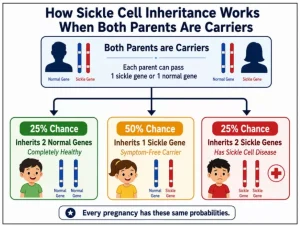
- Sickle Cell Trait (Carrier State): Occurs when a person inherits one copy of the altered gene. Carriers live normal, symptom-free lives but can transmit the trait to their children.
- Sickle Cell Disease (Active State): Occurs when an individual inherits two copies of the mutated gene (one from each parent), displaying full clinical symptoms.
- The Tribal Selection Link: The disorder exhibits a disproportionately high prevalence among India’s Scheduled Tribes.
- This concentration stems from an evolutionary survival adaptation against malaria, which was historically endemic to tribal forest environments.
- Over generations, carrying a single mutated sickle cell gene provided natural protection against fatal malaria strains, causing the mutation to persist within these isolated genetic pools.
India’s Initiatives & Actions
- National Sickle Cell Anaemia Elimination Mission: Introduced in the Union Budget (2023), this programmatic mission targets full elimination of genetic transmission by 2047 under the overarching framework of the National Health Mission (NHM).
- Inter-Departmental Operations: For unified execution, the strategy uses a unique joint operational model binding the Ministry of Health and Family Welfare and the Ministry of Tribal Affairs (MoTA).
- Mass Screening Drive: The programe has successfully completed screening for 7 crore (70 million) individuals aged 0 to 40 years across 17 high-focus states, identifying approximately 2.5 lakh active sufferers and over 20 lakh genetic carriers.
- Classified Genetic Status Cards: The state distributes color-coded diagnostic cards to citizens under 40. These function as pre-marital counselling indicators to prevent structural matches between two carriers, breaking the hereditary transmission chain.
- SCD Support Corner: A digital, patient-driven repository launched by the Ministry of Tribal Affairs that logs patient status while bridging the tracking gap between rural communities and centralized clinical networks.
- National Council on Sickle Cell Disease: A specialized central advisory panel created to oversee medical procurement, direct state-level execution, and organize specialized Centres of Excellence for advanced treatment.
Global Actions
- World Sickle Cell Disease Day: Observed annually on June 19 following a resolution by the United Nations General Assembly to generate international public health awareness and combat systemic healthcare disparities.
- World Health Organization (WHO) Frameworks: The World Health Organization drive integrates Sickle Cell Disease management directly into primary local healthcare systems.
- This includes promoting preventive solutions like routine vaccinations (such as pneumococcal shots), folic acid management, and distribution of cost-effective disease-modifying therapies like Hydroxyurea to curb pain crises.
- The PEN (Package of Essential Noncommunicable Disease Interventions)-Plus Model: Supported by the World Health Organization, this regional strategy focuses on reducing premature death rates among economically vulnerable children and young adults by offering integrated treatment for severe, non-communicable blood conditions.
- World Coalition on Sickle Cell Disease: An international public-private alliance designed to secure resources, coordinate scientific research, and deploy clinical toolkits in Low- and Middle-Income Countries (LMICs) where the genetic burden is highest.
- Advanced Bio-Therapeutic Breakthroughs:
- CRISPR-Cas9 Gene Therapies: Novel permanent cures deploy Nobel Prize-winning CRISPR-Cas9 (Clustered Regularly Interspaced Short Palindromic Repeats – CRISPR Associated Protein 9) genetic scissors to alter defective DNA strands.
- Casgevy: A specialized treatment that modifies the BCL11A gene within harvested bone marrow stem cells, triggering the body to restart production of functional fetal hemoglobin to override the sickle deformity.
- Lyfgenia: An alternate cellular engineering method that utilizes a modified viral casing (lentivirus) to deliver fully functional, healthy hemoglobin-producing genes straight into patient cells.
Click to Know UPSC Coaching Centres in India
About CRISPR-Cas9
- CRISPR stands for ‘Clustered Regularly Interspaced Short Palindromic Repeats’.
- Cas9 stands for CRISPR-associated protein 9, & is the nuclease part that cuts the DNA.
- CRISPR is the DNA-targeting part of the system which consists of an RNA molecule, or ‘guide’, designed to bind to specific DNA bases through complementary base-pairing.
- The CRISPR-Cas9 system was originally discovered in bacteria that use this system to destroy invasions.
- It is the most common, cheap & efficient system used for genome editing.
|
 20 Jun 2026