Subject: GS 2: Polity & Governance
Context: In the case of Maniyar Iliyaz @ Shaikh Riyaz v. P. Ayyappan, the Supreme Court ruled that the right to walk on safe, demarcated footpaths is a Fundamental Right.
- The case came up after a five-year-old boy died in a road accident while walking to school. The Court held that walking must come before cars and trucks.
UPSC Online Preparation
Key Judicial Pronouncements
- Walkers Come First: Walking on well-maintained footpaths is now a fundamental right under Part III of the Constitution. This right is primary and has priority over motor vehicles.
- Compulsory Duty for Government: If a road exists, the government has a strict correlative duty (a matching legal duty) to build and look after footpaths.
- Who is Responsible: The court listed the “duty-bearers” who must build and protect footpaths:
- Urban Development Authorities
 Municipal Corporations and Municipalities (city governments)
- Gram Panchayats (village governments)
- Right to Money for Harm: If this right is broken, citizens can use legal routes to get restitution and compensation (money for loss or harm) directly from local governments. This track is separate from the Motor Vehicles Act.
Associated Constitutional & Legal Perspectives
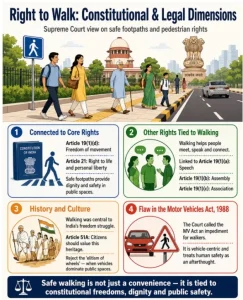
- Connected to Core Rights: The right to walk is part of Article 19(1)(d) (freedom of movement) and Article 21 (right to life and personal liberty), as safe paths provide dignity and safety in public spaces.
- Other Rights Tied to Walking: Walking helps people meet and talk. Therefore, it links to Articles 19(1)(a), 19(1)(b), and 19(1)(c) (expressive and associational freedoms like speech, assembly, and making groups).
- History and Culture: Walking was a big part of India’s freedom struggle. The court used Article 51A (Fundamental Duties) to say citizens must value this history and reject the “elitism of wheels” where vehicles take over public spaces.
- Flaw in the Motor Vehicles (MV) Act, 1988: The Court called the MV Act an impediment (barrier) because it is vehicle-centric and treats human safety as an afterthought.
Directives Issued by the Supreme Court
To fix the total lack of laws for walkers, the Supreme Court ordered these steps:
- Action by Ministries: Sent the order to three central ministries—Housing and Urban Affairs (MoHUA), Road Transport and Highways (MoRTH), and Rural Development—to start making a new statutory framework (legal system).
- Law Commission Help: Asked the Law Commission of India to help draft a clear law that names who is responsible and sets fast legal fixes for problems.
- A New Watchdog Body: Suggested a full-time independent regulatory body with specialists to plan, look after, and enforce the right to walk across India.
Significance of the Judgment
- Expansion of Fundamental Rights: Broadens the scope of Article 21 (Right to Life and Personal Liberty) by recognizing safe pedestrian movement as an essential component of a dignified life.
- Reinforces the constitutional principle that public infrastructure must serve people before vehicles.
- Strengthens Freedom of Movement: Gives substantive content to Article 19(1)(d) by ensuring citizens can move safely and freely on public roads.
- Promotes accessibility for children, women, elderly persons, and persons with disabilities.
- Enhances Government Accountability: Imposes a positive obligation on governments and local bodies to construct and maintain footpaths.
- Shifts the focus from mere road construction to pedestrian-centric urban planning.
- Promotes Road Safety: Addresses India’s high rate of pedestrian fatalities and injuries.
- Encourages safer and more inclusive transportation systems.
- Supports Sustainable Urban Mobility: Encourages walking and non-motorized transport, reducing congestion, fuel consumption, and pollution.
- Aligns with goals of sustainable and livable cities.
- Protects Constitutional Values: Links pedestrian rights with freedom of speech, assembly, and association by facilitating public interaction in shared spaces.
Challenges that need to be Tackled
- Lack of Comprehensive Legal Framework: India lacks a dedicated national law governing pedestrian rights and footpath standards.
- Responsibilities remain fragmented among multiple agencies.
- Poor Urban Infrastructure: Many cities suffer from encroached, damaged, discontinuous, or non-existent footpaths.
- Urban planning often prioritizes vehicles over pedestrians.
- Conflict with Street Vending: Balancing the right to livelihood under Article 19(1)(g) with the right to walk under Article 21 remains a complex challenge.
- Arbitrary eviction drives can adversely affect informal workers.
- Weak Implementation of the Street Vendors Act, 2014: Delayed formation of Town Vending Committees and inadequate demarcation of vending zones continue to create conflicts between pedestrian rights and street vendors’ livelihoods.
- Weak Capacity of Urban Local Bodies: Municipal bodies frequently face shortages of funds, manpower, and technical expertise.
- Maintenance of pedestrian infrastructure remains inadequate.
- Motor Vehicle-Centric Development: Transport policies historically focused on expanding road capacity for vehicles rather than improving pedestrian infrastructure.
- Enforcement Deficit: Existing planning guidelines are often poorly implemented.
- Lack of monitoring mechanisms results in continued encroachments and unsafe pedestrian environments.
Way Forward
- Enact a Dedicated Pedestrian Rights Law: Develop a comprehensive national framework defining rights, responsibilities, standards, and accountability mechanisms for pedestrian infrastructure.
- Pedestrian-Centric Urban Planning: Make continuous, barrier-free, universally accessible footpaths mandatory in all urban and rural road projects.
- Integrate pedestrian mobility into Smart Cities and urban development plans.
- Strengthen Local Governance: Provide greater financial and technical support to Municipalities, Urban Development Authorities, and Gram Panchayats for footpath creation and maintenance.
- Balance Livelihood and Mobility: Effectively implement the Street Vendors (Protection of Livelihood and Regulation of Street Vending) Act, 2014 through functional Town Vending Committees (TVCs) and scientifically demarcated vending zones.
- Establish an Independent Regulatory Mechanism: Create a dedicated national or state-level authority to monitor pedestrian infrastructure, safety standards, and grievance redressal.
- Promote Behavioural Change: Conduct awareness campaigns emphasizing road-sharing, pedestrian rights, and responsible driving behaviour.
- Encourage a shift away from the “vehicle-first” mindset toward people-centric mobility.
- Leverage Technology and Data: Use GIS mapping, mobility audits, and pedestrian safety assessments to identify infrastructure gaps and prioritize investments.
Click to Explore UPSC Offline Coaching
Conclusion
The Supreme Court’s recognition of the Right to Walk marks a transformative shift from a vehicle-centric to a human-centric vision of urban governance. However, realizing this right requires dedicated legislation, inclusive urban planning, empowered local bodies, and balanced protection of both pedestrian rights and street vendors’ livelihoods.
 20 Jun 2026