UPSC PYQs

Prelims, Mains & Optional PYQs

UPSC Notes

Comprehensive & Short Notes

Internet Shutdowns in India: Legal Framework, Rights & Supreme Court

23 Jul 2026

Internet Shutdowns in India: Legal Framework, Rights & Supreme Court

Subject: GS 2: Polity & Governance

Context: The Union Ministry of Home Affairs temporarily suspended mobile Internet services in parts of Central Delhi during the ‘Chalo Sansad’ protest organised by the Cockroach Janta Party (CJP), citing public order and safety concerns. 
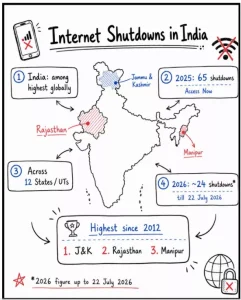
  • The move has reignited debate over the legality, necessity, and proportionality of Internet shutdowns in India.

UPSC Online Preparation

What is an Internet Shutdown?

Internet Shutdowns

  • An Internet shutdown is the intentional disruption or suspension of Internet or electronic communication services by the government, making them inaccessible or effectively unusable for a specific population or geographical area for a limited period. Forms include:
    • Complete network shutdowns
    • Throttling (slowing speeds)
    • Platform-specific blocking

Legal Framework Governing Internet Shutdowns

  • Telecommunications Act, 2023: The legal framework governing Internet shutdowns is now provided under Section 20(2)(b) of the Telecommunications Act, 2023.

Constitutional Framework:

Although the Constitution of India does not expressly recognise a Right to Internet, access to the Internet has become closely linked with the exercise of several Fundamental Rights.

  • Article 19(1)(a) guarantees the Freedom of Speech and Expression, which includes the freedom to communicate and receive information through digital platforms.
  • Article 19(1)(g) guarantees the Freedom to practise any profession or carry on any occupation, trade or business, many aspects of which now depend upon uninterrupted Internet access.
  • Article 21 guarantees the Right to Life and Personal Liberty, which increasingly encompasses access to education, healthcare, financial services, and digital governance through the Internet.

  • The Act provides that:
    • Telecommunication services may be suspended only upon the occurrence of a public emergency or in the interest of public safety.
    • A protest, by itself, does not constitute a valid legal ground for suspending Internet services. Every suspension order must:
      • Record reasons in writing.
      • Be issued by the competent authority.
      • Be confined to the minimum geographical area and duration necessary.
      • Be published to ensure transparency and accountability.
  • Telecommunications (Temporary Suspension of Services) Rules, 2024: 
    • Rule 3(2) — mandates publication of suspension orders with date, time, duration, and specific area of suspension.
    • The publication of such Internet suspension orders is necessary and mandatory for ensuring transparency, accountability and proportionality, as required by Rule 3(2) of the Telecommunications (Temporary Suspension of Services) Rules, 2024,

Judicial Safeguards

  • Anuradha Bhasin v. Union of India (2020): The Supreme Court laid down the constitutional principles governing Internet shutdowns.
    • The Court held that:
    • Access to the Internet is integral to the exercise of the Fundamental Rights guaranteed under Articles 19(1)(a) and 19(1)(g).
    • Internet shutdowns cannot be imposed indefinitely.
    • Every shutdown must satisfy the constitutional tests of:
      • Legality
      • Legitimate objective
      • Necessity
      • Proportionality
  • Faheema Shirin v. State of Kerala (2019): The Kerala High Court held that access to the Internet forms part of the Right to Education and the Right to Privacy under Article 21, thereby recognising its growing significance in the exercise of constitutional freedoms.

Can Internet Services be Suspended During a Protest?

  • The law does not permit the suspension of Internet services merely because a protest is taking place.
  • The government must establish that:
    • A public emergency exists or public safety is genuinely threatened.
    • The shutdown is necessary to achieve a legitimate objective.
    • The restriction is proportionate to the threat involved.
    • No less restrictive alternative is available.
  • Accordingly, every Internet shutdown during a protest is subject to judicial review on the touchstones of legality, necessity, proportionality, and procedural fairness.

Click to Explore UPSC Offline Coaching

Can Internet Shutdown Orders be Challenged?

  • Yes. Any affected individual may challenge an Internet shutdown:
    • Before the High Court under Article 226, or
    • Before the Supreme Court under Article 32, where a Fundamental Right is directly violated.

Check Out UPSC CSE Books

Visit PW Store

online store 1

Internet Shutdowns in India: Legal Framework, Rights & Supreme Court

Explore UPSC Foundation Batches

Need help preparing for UPSC or State PSCs?

Connect with our experts to get free counselling & start preparing

Free Counselling for UPSC Aspirants

Connect with our experts and take the right next step.

Expert Guidance
Personalized Strategy
100% Free

Book Your Free Session

NEED ASSISTANCE?

Request a Callback

Our counsellor will connect with you and help you choose the right course and centre.

  • Expert Guidance
  • Course & Fee Information
  • Quick Callback Support

Request a Callback

Books
UPSC PYQs
UPSC Notes
Current Affairs
Quick Revise Now !
AVAILABLE FOR DOWNLOAD SOON
UDAAN PRELIMS WALLAH
Comprehensive coverage with a concise format
Integration of PYQ within the booklet
Designed as per recent trends of Prelims questions
हिंदी में भी उपलब्ध
Quick Revise Now !
UDAAN PRELIMS WALLAH
Comprehensive coverage with a concise format
Integration of PYQ within the booklet
Designed as per recent trends of Prelims questions
हिंदी में भी उपलब्ध

<div class="new-fform">


    </div>

    Subscribe our Newsletter
    Sign up now for our exclusive newsletter and be the first to know about our latest Initiatives, Quality Content, and much more.
    *Promise! We won't spam you.
    Yes! I want to Subscribe.