UPSC PYQs

Prelims, Mains & Optional PYQs

UPSC Notes

Comprehensive & Short Notes

Cotton in India: Production, Challenges and Government Initiatives

23 Jul 2026

Cotton in India: Production, Challenges and Government Initiatives

Subject: GS 3: Agriculture

Context: India, the world’s largest cotton cultivator and second-largest producer and consumer, has launched the Mission for Cotton Productivity (2026–31) to enhance productivity, quality, and global competitiveness. 
UPSC Coaching Classes

About Cotton

Cotton

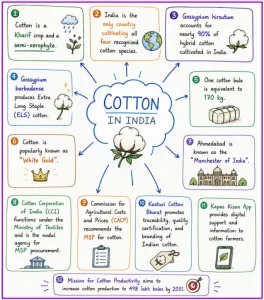
  • Cotton is a Kharif cash crop and one of the world’s most important natural fibre crops. Owing to its significant contribution to agriculture, industry, employment, and exports, it is popularly known as “White Gold”.
  • Characteristics: Cotton is a semi-xerophytic crop that is well adapted to tropical and subtropical climates.
  • Agro-climatic Requirements: Cotton grows best at temperatures of 21–27°C, requires 50–100 cm of rainfall, at least 210 frost-free days, and performs well in well-drained black (regur) or alluvial soils.
  • Cotton Species: India is the only country in the world cultivating all four recognised cotton species:
    • Gossypium arboreum (Asian cotton)
    • Gossypium herbaceum (Asian cotton)
    • Gossypium hirsutum (American/Upland cotton), which accounts for nearly 90% of hybrid cotton production and all Bt cotton hybrids cultivated in India.
    • Gossypium barbadense (Egyptian/Sea Island/Peruvian cotton), which produces Extra Long Staple (ELS) fibre.
  • Staple Classification: Cotton is classified into Short, Medium, Medium Long, Long, and Extra Long Staple (ELS) varieties based on fibre length, with ELS cotton preferred for premium textile manufacturing.
  • Major Uses: Cotton is the principal raw material for the textile, apparel, technical textiles, edible oil, and livestock feed industries.

Status of the Cotton Sector in India

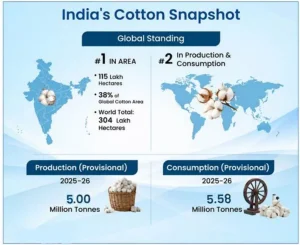
  • Global Position: India ranks first in area under cotton cultivation and second in cotton production and consumption. It contributes nearly 19% of global fibre production and accounts for around 38% of the world’s cotton cultivation area.
  • CottonProduction: Cotton production is estimated at 290.91 lakh bales during 2025–26, while domestic consumption is estimated at 328 lakh bales.
  • Cultivation Pattern: Cotton is cultivated over 114.84 lakh hectares, with around 62% of the cultivated area being rain-fed, making production highly dependent on the monsoon. 
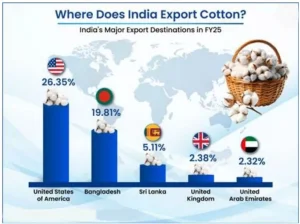
  • Trade Performance: India exported cotton worth USD 11.49 billion during FY25, accounting for approximately 3.37% of global cotton exports.
  • Major Producing Regions: Cotton cultivation is concentrated across three agro-climatic zones:
    • Northern Zone: Punjab, Haryana and Rajasthan.
    • Central Zone: Gujarat, Maharashtra and Madhya Pradesh.
    • CottonSouthern Zone: Telangana, Andhra Pradesh and Karnataka.
    • Cotton is also cultivated in Odisha and Tamil Nadu.
  • Economic Importance: Cotton supports the livelihoods of nearly 6 million farmers and provides employment to around 40–50 million people across the textile value chain, from cultivation to garment manufacturing.
  • Historical Significance: Cotton cultivation in India dates back to the Indus Valley Civilization. During the freedom struggle, it became a symbol of Swadeshi and self-reliance, while Ahmedabad emerged as the “Manchester of India.”

Associated Government Initiatives

  • Mission for Cotton Productivity (2026–31): Launched with an outlay of ₹5,659.22 crore, the Mission aims to increase cotton production to 498 lakh bales by 2031 by promoting high-yielding, climate-resilient, and pest-resistant varieties, improving fibre quality, encouraging cultivation of Extra Long Staple (ELS) cotton, and enhancing farmers’ incomes. 
    • The Mission covers 24 lakh hectares, 140 districts, and 14 cotton-producing States, benefiting nearly 32 lakh farmers, and supports the Government’s 5F Vision—Farm, Fibre, Factory, Fashion and Foreign.
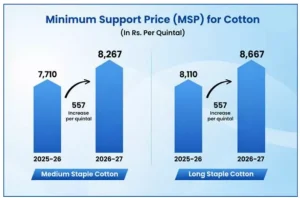
  • CottonMinimum Support Price (MSP): The Commission for Agricultural Costs and Prices (CACP) recommends MSP separately for Medium Staple and Long Staple cotton, while the Cotton Corporation of India (CCI) undertakes procurement to protect farmers from distress sales.
  • Special Project on Cotton under NFSM: Implemented under the National Food Security Mission (NFSM) since 2023–24, the project promotes High Density Planting System (HDPS), Closer Spacing Planting System (CSPS), and improved production technologies for Extra Long Staple (ELS) cotton.
  • Kasturi Cotton Bharat: This initiative seeks to establish Indian cotton as a globally recognised premium brand through quality certification, traceability, and standardisation.
  • Digital and Technology Initiatives: The Government is promoting digital procurement, blockchain-based traceability, technology demonstrations, and the Kapas Kisan App to improve productivity, transparency, quality assurance, and farmer outreach.

Click to Know UPSC OnlyIAS Coaching Centres

Challenges in the Cotton Sector

  • Low Productivity: Cotton yields remain below the global average because of irregular rainfall, limited mechanisation, inadequate adoption of improved agronomic practices, and heavy dependence on rain-fed cultivation.
  • Climate Vulnerability: Increasing frequency of droughts, erratic rainfall, and extreme weather events adversely affect cotton productivity.
  • Pest Infestation: Pink Bollworm and other pests continue to reduce yields and increase cultivation costs despite the adoption of Bt cotton.
  • Quality Constraints: Limited production of Extra Long Staple (ELS) cotton and inconsistent fibre quality reduce India’s competitiveness in premium international markets.
  • Market Risks: Price volatility, rising input costs, and inadequate post-harvest infrastructure continue to affect farmers’ incomes.
  • Value Addition: A large share of exports still comprises raw cotton and intermediate products, highlighting the need for greater value addition in the textile sector.

Check Out UPSC CSE Books

Visit PW Store

online store 1

Cotton in India: Production, Challenges and Government Initiatives

Explore UPSC Foundation Batches

Need help preparing for UPSC or State PSCs?

Connect with our experts to get free counselling & start preparing

Free Counselling for UPSC Aspirants

Connect with our experts and take the right next step.

Expert Guidance
Personalized Strategy
100% Free

Book Your Free Session

NEED ASSISTANCE?

Request a Callback

Our counsellor will connect with you and help you choose the right course and centre.

  • Expert Guidance
  • Course & Fee Information
  • Quick Callback Support

Request a Callback

Books
UPSC PYQs
UPSC Notes
Current Affairs
Quick Revise Now !
AVAILABLE FOR DOWNLOAD SOON
UDAAN PRELIMS WALLAH
Comprehensive coverage with a concise format
Integration of PYQ within the booklet
Designed as per recent trends of Prelims questions
हिंदी में भी उपलब्ध
Quick Revise Now !
UDAAN PRELIMS WALLAH
Comprehensive coverage with a concise format
Integration of PYQ within the booklet
Designed as per recent trends of Prelims questions
हिंदी में भी उपलब्ध

<div class="new-fform">


    </div>

    Subscribe our Newsletter
    Sign up now for our exclusive newsletter and be the first to know about our latest Initiatives, Quality Content, and much more.
    *Promise! We won't spam you.
    Yes! I want to Subscribe.