As of April 2026, the Ministry of Food Processing Industries has shared that the Production-Linked Incentive Scheme (PLISFPI) has performed exceptionally well.
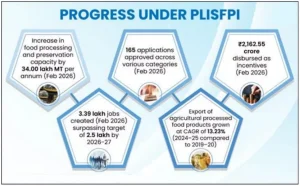
- It has created about 3.39 lakh jobs, significantly higher than the original target of 2.5 lakh, proving that this sector is a major engine for employment generation.
UPSC Online Coaching
What is Food Processing?
- Refers: At its simplest, food processing is the link that connects the farmer’s field to the consumer’s plate.
- It involves taking raw materials like grains, fruits, milk, or fish and turning them into products that last longer and are easier to eat.
- Primary Level: Basic activities like cleaning, grading, and sorting crops.
- Secondary Level: Changing raw crops into ingredients, like grinding wheat into flour.
- Tertiary Level: Making ready-to-eat meals or snacks that require almost no extra cooking.
About Production-Linked Incentive Scheme for the Food Processing Industry (PLISFPI)
- The PLISFPI is a flagship initiative designed to transform India into a global food manufacturing hub.
- Approved in March 2021 with a budget of ₹10,900 crore, the scheme rewards food processing companies for increasing their production and sales.
- Core Objectives of the Scheme:
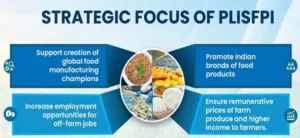
- Global Champions: To support the creation of global Indian food brands.
- Employment: To generate large-scale employment for the rural and urban youth.
- Value Addition: To ensure farmers get better prices by processing raw crops into high-value products.
- Export Growth: To increase the share of Indian processed foods in international markets.
- Strategic Alignment: It aligns with flagship initiatives like Atmanirbhar Bharat and Make in India, aiming to transform India into a global food processing hub.
How the PLISFPI Scheme Works
The PLISFPI scheme is designed into three categories to support different parts of the ecosystem:
- The PLISFPI is designed into three categories to support different parts of the ecosystem:
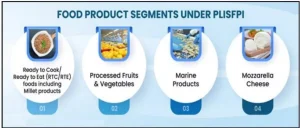
- Category I (Large Manufacturing): Focuses on large-scale production of Ready-to-Eat (RTE) and Ready-to-Cook (RTC) foods (including millet-based products), processed fruits & vegetables, marine products, and mozzarella cheese.
- Category II (MSME & Innovation Focus): Encourages MSMEs to develop innovative and organic food products, including niche segments like free-range eggs and poultry products.
- Category III (Global Branding): Supports branding and marketing abroad, helping Indian food products become global brands.
- Dedicated Millet Promotion Initiative:
- Special Millet Sub-Scheme: A dedicated scheme called the Production-Linked Incentive Scheme for Millet-Based Products (PLISMBP) was launched in 2022-23 with an outlay of ₹800 crore.
- Nutritional and Economic Push: It promotes the use of millets (Shree Anna) in RTE and RTC products, boosting nutrition security, value addition, and farmer incomes.
- Incentive Design and Eligibility:
- Performance-Based Incentives: Companies receive incentives based on incremental sales over the base year (2019-20).
- Investment Requirement: To qualify, companies must invest in plant & machinery, infrastructure, and technology upgradation.
- Branding Support: The government reimburses up to 50% of branding and marketing expenses abroad, subject to a cap of 3% of annual sales or ₹50 crore per year, whichever is lower.
- Minimum Commitment: Companies must spend at least ₹5 crore over five years on global branding to ensure serious participation.
- Helping Small Businesses:
- Strong MSME Participation: Out of the approved applicants, 69 are MSMEs, and an additional 40 MSMEs are connected through contract manufacturing, showing deep value chain integration.
- Targeted Financial Support: Incentives have already been disbursed to several MSMEs, helping them upgrade technology, improve quality, and scale operations.
UPSC Online Preparation
Recent Growth and Achievements
The sector has seen a massive transformation over the last decade, moving from a small-scale activity to a major industrial force:
- Economic Value: The total value added by this sector to the economy rose from ₹1.34 lakh crore a decade ago to ₹2.24 lakh crore recently.
- Value Addition in Exports: The share of processed food in agricultural exports has increased from about 13.7% in 2014-15 to over 20.4% in 2024-25, reflecting India’s shift towards high-value food exports.
- Private Investment: The government’s support has encouraged private companies to invest over ₹9,200 crore into new factories and machinery.
- Massive Capacity: India can now process and preserve an additional 34 lakh metric tonnes of food every year compared to previous years.
 Institutional Expansion and Financial Progress:
-
- Institutional Expansion: Under the scheme, 165 applications have been approved, covering 274 project locations across the country, showing widespread industrial participation.
- Financial Support Delivered: So far, incentives worth ₹2,162.55 crore have been disbursed to companies, ensuring timely support for capacity expansion.
- Export Growth and Global Presence:
- Export Performance: The export of processed agricultural food products has grown at a strong Compound Annual Growth Rate (CAGR) of 13.23% between 2019-20 and 2024-25.
- Export Scale: The total export sales of companies supported under the scheme have crossed ₹89,000 crore, strengthening India’s global food market presence.
About Production-Linked Incentive (PLI) Scheme
- Vision and Launch: Launched in April 2020, the Production-Linked Incentive (PLI) Scheme aims to strengthen domestic manufacturing by offering performance-based financial incentives.
- It is a key pillar of Atmanirbhar Bharat and Make in India, focused on enhancing self-reliance, competitiveness, and global integration.
- Core Principle: The PLI Scheme follows a performance-linked model, not upfront subsidies.
Incentives are provided based on incremental sales over a base year (2019–20), ensuring that public funds are linked to actual production and growth.
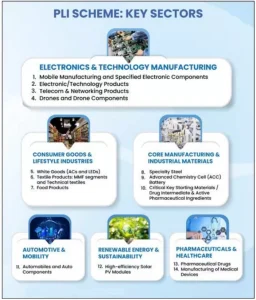
- Expansion and Coverage: Initially introduced for sectors like mobile manufacturing, pharmaceuticals (APIs), and medical devices, the scheme has now expanded to 14 strategic sectors.
- With a total outlay of ₹1.97 lakh crore, it supports industries ranging from food processing to electronics, solar modules, and specialty steel.
- Creating Global Champions: The scheme encourages firms to achieve economies of scale by mandating minimum investment thresholds in plant, machinery, and technology.
- This enables Indian companies to reduce costs, improve quality, and compete globally.
- Employment Generation: By boosting large-scale manufacturing, the scheme generates significant employment opportunities.
- For instance, in the food processing sector alone, it has created over 3.3 lakh jobs, including direct factory employment and indirect jobs in logistics and supply chains.
- Ecosystem Development: PLI creates a multiplier effect by linking large anchor firms with MSMEs.
- Small businesses contribute through components, packaging, and supply inputs, enabling their integration into global value chains and technology upgradation.
|
Why India has a Huge Advantage
India is uniquely positioned to become the “Food Basket of the World” because of several natural and social factors:
- Massive Production: India is the second-largest producer of fruits and vegetables globally, providing an endless supply of raw materials.
- Urban Lifestyles: As more people move to cities and lead busy lives, the demand for convenient, ready-to-cook meals is skyrocketing.
- The Millet Revolution: With global interest in health, India’s millets (Shree Anna) are in high demand as a nutritional superfood.
- Technological Shift: New methods like fast-freezing and specialized packaging are helping to keep food fresh for months without losing taste.
Click to Explore UPSC Offline Coaching
Implementation and Governance Mechanism
- Project Management Agency (PMA): The scheme is implemented by Industrial Finance Corporation of India Limited, a government-owned financial institution.
- Transparent Application Process: Applications are invited through an Expression of Interest (EOI) system via an online portal, ensuring transparency and accessibility.
- Digital Monitoring: A web-based Management Information System (MIS) tracks project progress in real time, ensuring accountability and timely implementation.
Challenges Still to Overcome
While progress is fast, several bottlenecks still slow down the sector:
- Food Wastage: Because of a lack of refrigerated trucks and cold storage, a huge amount of fruits and vegetables still spoil before reaching the factory.
- Stringent Global Rules: Many Indian products face rejection abroad because they don’t meet the strict health and safety standards of foreign countries.
- Expensive Credit: Small business owners often find it difficult to get cheap loans to buy the advanced machines needed for high-quality processing.
- Broken Supply Chains: There are too many middlemen between the farmer and the factory, which increases the price and reduces the quality.
Way Forward
To reach the goal of a Viksit Bharat (Developed India) by 2047, the focus must shift to:
- Setting up Clusters: Building food processing hubs right next to farming areas to reduce transport time and spoilage.
- Smart Logistics: Using digital tracking and artificial intelligence to monitor food quality as it moves from the farm to the store.
- Eco-Friendly Packaging: Moving away from plastic and using sustainable packaging to appeal to environmentally conscious global buyers.
- Skilled Workforce: Training rural youth in technical skills so they can operate modern food-processing machinery.
Click to Know UPSC OnlyIAS Coaching Centres
Conclusion
The food processing sector is more than just an industry; it is a way to double farmer incomes and reduce rural poverty. By turning raw harvests into high-value products, India is ensuring that its “Make in India” mission provides food security and economic growth for the entire world.
 23 Apr 2026