Scientists at CSIR – National Institute for Interdisciplinary Science and Technology (NIIST) in Thiruvananthapuram, Kerala, have developed a “designer rice”.
- During the technology transfer ceremony held recently titled “CSIR-NIIST Tech Connect: From Lab to Market”, the rice was officially released.
- The technology is also officially transferred to TATA Consumer Products Limited and SS Soul Foods, Tamil Nadu.
Best Online Coaching for UPSC
About Designer Rice
- Designer rice is a re-engineered rice grain created by transforming broken rice into flour, enriching it with protein and micronutrients, and reshaping it into grains that closely resemble natural rice in taste, texture, and appearance.
Technology Behind Designer Rice
Extrusion Technology
- Designer rice is produced using extrusion technology, a modern food-processing technique that allows restructuring of food materials into desired shapes.
- In this process, broken rice grains are first milled into fine flour, which serves as the base material.
- The rice flour is then mixed uniformly with protein and a micronutrient premix such as iron, folic acid, and Vitamin B12 to enhance its nutritional value.
- This fortified mixture is subsequently passed through an extruder machine under controlled temperature and pressure, which shapes it into grain-like structures resembling natural rice.
- The final product is dried and processed to ensure it closely matches the texture, appearance, and cooking behavior of conventional rice.
Key Features of Designer Rice
- Non-GMO Innovation: Designer rice is developed using food-processing rather than genetic modification, which ensures greater consumer acceptance and avoids concerns related to GM crops.
- For example, it is similar to fortified foods where nutrients are added without altering the genetic structure of the crop.
- High Protein Content: Designer rice contains more than 20% protein compared to the 6–8% protein content in regular rice, thereby helping to address protein deficiency in populations dependent on rice as a staple food.
- Fortified with Essential Nutrients: The rice is enriched with essential micronutrients such as iron, folic acid, and Vitamin B12, which helps in reducing anemia and improving overall nutritional status.
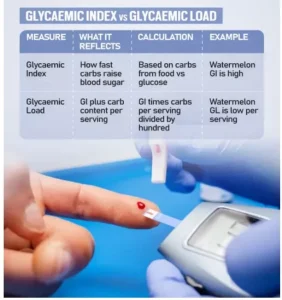
- Low Glycaemic Index (GI): Designer rice has a glycaemic index below 55, which means it releases glucose slowly into the bloodstream and helps prevent sudden spikes in blood sugar levels.
- It is similar to low-GI foods like oats and whole grains that are recommended for diabetic patients and weight management.
Benefits of the Designer rice
- Supports Sustainable and Inclusive Nutrition: By utilizing broken rice (a by-product), it promotes a circular economy and reduces food wastage.
- It also provides an affordable and scalable solution to malnutrition in developing countries like India.
- Promotes Better Metabolic Health: Due to its low GI and high nutrient content, it supports improved insulin sensitivity and overall metabolic health.
- It can aid in weight management and prevention of lifestyle diseases.
- Suitable for Public Health Programmes: It can be effectively integrated into mid-day meals, PDS, and other welfare schemes to improve nutrition at scale.
- It ensures better nutrient intake without changing dietary habits.
- Helps Combat Anaemia: The presence of iron and folic acid directly contributes to reducing anaemia.
- It is especially useful for women and children, who are more vulnerable to iron deficiency.
UPSC Online Coaching
Limitations of Designer Rice
- High Cost and Affordability Issues: The production of designer rice involves advanced processing technologies, which makes it costlier than conventional rice, especially in the initial stages.
- This may limit its accessibility for low-income populations who are the primary target group for nutritional interventions.
- Compared to subsidized rice distributed through PDS, designer rice may initially be priced higher, affecting large-scale adoption.
- Low Consumer Awareness and Acceptance: Many consumers may be hesitant to adopt designer rice due to lack of awareness and misconceptions about processed or re-engineered foods.
- Cultural preference for traditional, natural grains can also slow its acceptance.
- Similar resistance was observed initially with fortified foods like iodized salt and fortified wheat flour.
- Challenges in Scaling Up Production: Large-scale production requires specialized infrastructure, machinery (extruders), and skilled manpower, which may not be readily available.
- Expanding production capacity to meet national demand will require significant investment and coordination.
- Setting up extrusion units across multiple states for continuous supply can be capital-intensive.
- Policy and Regulatory Gaps: There is a need for clear regulatory standards, quality control mechanisms, and labeling guidelines for designer rice.
- Absence of well-defined policies may delay its integration into government nutrition programmes.
- Unlike fortified rice, which has defined norms by regulatory authorities, designer rice still requires standardized guidelines.
- Overlap with Existing Fortification Programmes: Designer rice may face competition from existing fortified rice initiatives, which are already being implemented at scale.
- This could create policy confusion and duplication of efforts in addressing malnutrition.
- Government schemes distributing fortified rice under welfare programmes may need to decide between continuing current models or shifting to designer rice.
- Dependence on Processing Technology: Designer rice production is highly dependent on advanced machinery like extruders and continuous processing systems, making it technology-intensive.
- Any disruption in machinery or supply chains can affect production consistency.
- Rural or small-scale mills may not be able to adopt such technologies easily due to high costs and technical requirements.
- Limited Long-Term Impact Data: Since designer rice is a relatively new innovation, there is limited long-term clinical and population-level evidence on its health impacts.
- Policymakers may be cautious in adopting it widely without robust data on efficacy and safety over time.
- Large-scale nutrition interventions usually require years of field data before being fully integrated into national programmes.
- Nutrient Stability and Shelf Life Concerns: Maintaining the stability of added nutrients (especially Vitamin B12 and folic acid) during storage, transport, and cooking can be challenging.
- Loss of nutrients over time may reduce the intended health benefits.
- Similar issues are observed in fortified foods where improper storage leads to micronutrient degradation.
Way Forward
- Integration with Welfare Schemes: Designer rice should be gradually introduced into major government programmes such as the Public Distribution System (PDS), Integrated Child Development Services (ICDS), and mid-day meal schemes to improve nutritional outcomes at scale.
- This will ensure that vulnerable sections receive enhanced nutrition without changing their staple diet.
- Similar to fortified rice distribution in welfare schemes, designer rice can be supplied to school children and low-income households.
- Public Awareness and Behavioural Change Campaigns: There is a need to educate the public about the health benefits, safety, and non-GMO nature of designer rice to build trust and acceptance.
- Awareness campaigns can help overcome misconceptions about processed foods.
- Campaigns like those for iodized salt successfully improved public acceptance through sustained awareness efforts.
- Strengthening Public-Private Partnerships (PPP): Collaboration between research institutions and private companies such as Tata Consumer Products Limited can help in scaling up production, distribution, and commercialization.
- PPP models can ensure efficient supply chains and market penetration.
- Private sector expertise in food processing and logistics can accelerate nationwide availability.
- Cost Reduction and Affordability Measures: Efforts should be made to optimize production technology and achieve economies of scale to reduce costs.
- Government subsidies or incentives may be provided to make designer rice affordable for low-income groups.
- Similar cost reductions were achieved in fortified food products through large-scale production and policy support.
- Continuous Research and Innovation: Ongoing research is required to improve the nutritional composition, taste, and shelf life of designer rice.
- It should also be tailored to regional dietary preferences and nutritional needs.
- Future versions may include additional nutrients like zinc or Vitamin A based on regional deficiencies.
- Development of Clear Regulatory Framework: The government should establish clear standards, quality control norms, and labeling guidelines to ensure safety and uniformity in designer rice production.
- This will build consumer confidence and facilitate large-scale adoption.
- Similar regulatory frameworks exist for fortified foods, which define nutrient levels and quality standards.
- Strengthening Supply Chain and Infrastructure: Efficient procurement of broken rice, processing units, storage, and distribution networks must be developed to ensure consistent supply.
- Investment in modern food-processing infrastructure is essential for nationwide reach.
- Setting up regional extrusion units near rice-producing areas can reduce logistics costs and improve efficiency.
- Pilot Projects and Evidence-Based Expansion: Before nationwide rollout, pilot projects should be conducted in selected regions to evaluate effectiveness, acceptance, and impact on health indicators.
- Data from these pilots can guide policy decisions and scaling strategies.
- Introducing designer rice in selected districts under mid-day meal schemes can help assess improvements in nutrition levels before expansion.
Click to Know UPSC Offline Courses
Designer Rice vis- i-vis Fortified Rice
| Aspect |
Designer Rice |
Fortified Rice |
| Nature |
Reconstructed grain |
Normal rice with added nutrients |
| Nutrient Type |
Macro + micronutrients |
Mainly micronutrients |
| Protein Content |
High (~20%) |
Normal |
| GI |
Low |
Usually high |
| Process |
Full grain restructuring |
Mixing fortified kernels |
| Objective |
Comprehensive nutrition |
Micronutrient supplementation |
Agro-Climatic Conditions for Rice Cultivation
- Climate Requirements: Rice requires a hot and humid climate for its proper growth and development.
- A temperature range of 20°C to 37.5°C is considered ideal for optimum yield.
- Water Availability: The crop requires abundant water supply, making it suitable for regions with high rainfall or assured irrigation.
- Continuous water availability is essential, especially during the growing and flowering stages.
- Soil Conditions: Rice grows best in alluvial soil, which is rich in nutrients and formed by the deposition of silt by rivers.
- River flood plains are among the most productive areas for rice cultivation due to fertile soil and water availability.
- Cropping Seasons: Rice is primarily grown during the kharif season (southwest monsoon).
- It is also cultivated in the rabi season (winter-spring) in regions with sufficient irrigation facilities.
- Varieties of Rice Based on Cultivation Season
- Aus (Autumn Crop)
- Sown before monsoon and harvested early.
- Grown mainly in eastern India.
- Aman (Winter Crop)
- The main rice crop, grown during monsoon season.
- Depends heavily on rainfall.
- Boro (Summer Crop)
- Grown in winter and harvested in summer.
- Requires irrigation facility
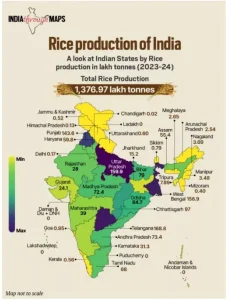
- Rice Production Estimates: As of January 2026 with the production of around 150 million metric tonnes of rice, India has surpassed China which produces 145.28 million tonnes to become the world’s largest rice producer in 2024-25.
|
 23 Apr 2026