Recently, the government has approved a phased replacement of the Wholesale Price Index (WPI) with the Producer Price Index (PPI) by 2031, with revised index series based on the new 2022–23 base year to improve inflation measurement accuracy.
- Revised Wholesale Price Index and New Producer Price Indices Scheduled for Release on June 15.
UPSC Online Preparation
Key Highlights of Recent Changes
The update goes beyond changing the base year. It fundamentally improves how data is gathered and calculated to make price measurement more accurate:
- Larger Item Basket: The number of items tracked in WPI has increased from 697 to 957 to reflect India’s modern industrial footprint.
- Green Energy Inclusion: Solar energy, wind energy, and nuclear electricity have been added under the ‘Electricity’ group to match India’s green energy transition.
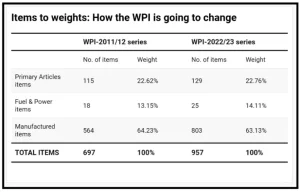 Better Energy Grouping: Crude petroleum and natural gas have moved from ‘Primary Articles’ to ‘Fuel and Power’.
 -
- This keeps all energy products (coal, electricity, oil) in one integrated group.
- Gross Value of Output (GVO) for Weights: The old series calculated item weights using Net Traded Value (GVO+Imports−Exports).
- The new series uses pure GVO (the total value of goods produced domestically before trade adjustments). This reflects domestic production and its true value to local producers.
- Chain-Based Method: The index will use a short-term, chain-based calculation method (comparing prices of the current month to the immediate previous month and linking them) instead of the rigid, long-term formula used in the past.
- Targeted Mean Imputation: Missing price data will now be estimated using Targeted Mean Imputation (a statistical method that uses prices of similar items to estimate the missing value) instead of just carrying forward the last known price.
- Linking Factor: To help compare old data with new data, a Linking Factor has been created using the geometric mean of prices from the financial year 2024-25.
About the Producer Price Index (PPI)
The new PPI framework measures changes in prices received by producers before products and services reach consumers. Its weights are derived from the Supply and Use Tables of India’s National Accounts. It features three separate indices:
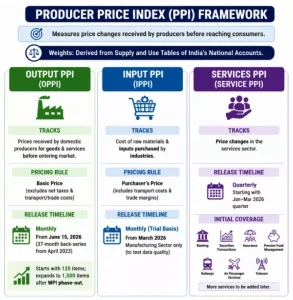
- Output Producer Price Index (OPPI):
- What it tracks: The average change in prices that domestic producers receive for their goods and services before they enter the market.
- Pricing Rule: Measured at Basic Price (excludes net taxes and transport/trade costs).
- Release Timeline: Released monthly starting June 15, 2026 (including a 37-month back-series from April 2023). It starts with 125 items and will expand to 1,500 items once WPI is discontinued.
- Trial Input Producer Price Index (IPPI):
- What it tracks: The cost of raw materials and inputs bought by industries.
- Pricing Rule: Measured at Purchaser’s Price (includes transport costs and trade margins since businesses buy inputs from the open market).
- Release Timeline: Published monthly on an experimental trial basis for the Manufacturing Sector only starting March 2026 to test data quality.
- Services Producer Price Index (Service PPI):
- What it tracks: Price changes in the services sector, plugging a major loophole in India’s inflation tracking.
- Release Timeline: Published on a quarterly basis (starting with the January-March 2026 quarter).
- Initial 7 Services Covered: Banking, Securities Transactions, Insurance, Pension Fund Management, Railways, Air Passenger Services, and Telecommunications. More services will be added later.
Why the Transition is Needed (Limitations of WPI)
The WPI has been India’s legacy supply-side inflation metric for over eight decades. However, it has several structural limitations that make it unsuitable for a modern economy:
- Exclusion of Services: WPI only tracks physical goods. In an economy where the services sector contributes over 50% of India’s GDP, WPI fails to capture a massive portion of economic activity.
- Double Counting: Because WPI measures prices at intermediate wholesale distribution points, the price of the same raw material can be counted multiple times as it moves down the supply chain.
- Price Distortions: WPI includes trade and transport margins rather than the pure cost of production, which skews the actual picture of factory-gate inflation.
Significance of the Reform
- Macroeconomic Policy and Data Precision:
- Accurate National Accounting: Currently, the government uses a rough mix of WPI and CPI to deflate Nominal GDP into Real GDP.
- The International Monetary Fund (IMF) has long advised using a PPI because Output PPI serves as the ideal GDP Deflator, accurately calculating the Gross Value Added (GVA) of industries.
- Better Policy Framing: By comparing Input PPI with Output PPI, policymakers can see exactly how rising raw material costs affect factory-gate prices.
- This tracks the pass-through effect of supply-side inflation, helping the RBI spot industrial stress points before they hit retail consumers (CPI).
- Global Comparability: Most developed economies (G-20 nations like the US, China, Japan, Germany, and France) already use PPI systems, making international economic comparisons easier.
- Broader Data Modernization: This shift aligns with parallel updates across India’s central statistics ecosystem, including the recent base-year revisions of the Index of Industrial Production (IIP) to 2022-23 by the Ministry of Statistics and Programme Implementation (MoSPI).
- Microeconomic and Real-World Contractual Adjustments: While the RBI uses the CPI for its monetary policy decisions, WPI remains vital for businesses.
- It is commonly used as an indexing tool in price-escalation clauses for long-term construction, raw material supply, and infrastructure contracts to adjust terms for future price variations.
- To prevent financial and legal disruption during the statistical shift, the government has created a safety framework:
- The 5-Year Parallel Run: The government will publish both WPI and PPI together until 2031 to let existing commercial contracts finish smoothly.
- Ministry of Finance Directive: The Department of Expenditure will issue a circular advising all public and private entities that any new long-term contracts extending past 2031 must be linked to PPI instead of WPI.
- This gives the industry a predictable transition window to adapt to the distortion-free economic data.
Click to Know UPSC OnlyIAS Coaching Centres
Conclusion
The shift from WPI to PPI ensures accurate factory-gate and service-sector prices, improves GDP deflation, strengthens policy precision, enhances global comparability, and provides a predictable framework for contracts, marking a major step in India’s economic data modernization.
PWOnlyIAS Extra Edge:
Important Key Terms
- Core Inflation & Price Indices:
- Wholesale Price Index (WPI): The Wholesale Price Index (WPI) measures changes in the prices of goods traded in bulk at the wholesale level before they reach consumers. It mainly tracks inflation in fuel, manufactured products, and primary articles.
- Producer Price Index (PPI): The Producer Price Index (PPI) measures changes in prices received by producers for goods and services before they reach consumers. It reflects factory-gate inflation more accurately by excluding retail-level costs like transport margins and taxes.
- Consumer Price Index (CPI): The Consumer Price Index (CPI) measures changes in retail prices paid by consumers for goods and services such as food, fuel, housing, and transport, reflecting consumer-level inflation.
- Inflation: Inflation refers to a sustained rise in the general price level of goods and services over time, reducing the purchasing power of money.
- Factory-Gate Inflation: Factory-Gate Inflation refers to price changes at the producer or manufacturing level before goods enter wholesale or retail markets.
- Key Economic & National Accounting Terms:
- Base Year: A base year is the reference year against which price changes and economic indices are compared. It is assigned a standard value (usually 100) for measuring inflation and growth over time.
- Gross Domestic Product (GDP): Gross Domestic Product (GDP) is the total monetary value of all final goods and services produced within a country during a specific period. It is the main indicator of a country’s economic size and growth.
- Nominal GDP: Nominal GDP measures the value of goods and services using current market prices, without adjusting for inflation.
- Real GDP: Real GDP measures the value of goods and services after adjusting for inflation, showing the actual growth in production.
- GDP Deflator: The GDP Deflator is an inflation index that measures changes in prices of all domestically produced goods and services, helping convert Nominal GDP into Real GDP.
- Gross Value Added (GVA): Gross Value Added (GVA) measures the value created by producers after subtracting the cost of intermediate inputs from total output. It shows the contribution of different sectors to the economy.
- Gross Value of Output (GVO): Gross Value of Output (GVO) refers to the total monetary value of goods and services produced within an economy before adjusting for exports, imports, taxes, or trade margins.
- National Accounts: National Accounts are official records of a country’s economic activities, including production, income, consumption, investment, and savings.
- PPI Framework & Components:
- Output Producer Price Index (OPPI): The Output Producer Price Index (OPPI) measures changes in prices received by domestic producers for goods and services before they are sold in the market.
- Input Producer Price Index (IPPI): The IPPI measures changes in the prices of raw materials, fuel, and industrial inputs purchased by businesses.
- Services Producer Price Index (Services PPI): The Services Producer Price Index (Services PPI) measures changes in prices of services such as banking, insurance, telecom, and transport.
- Basic Price: Basic Price refers to the amount received by producers excluding product taxes, transport costs, and trade margins.
- Purchaser’s Price: Purchaser’s Price is the final amount paid by buyers, including transport charges, taxes, and trade margins.
- Statistical & Technical Terms:
- Chain-Based Method: The Chain-Based Method compares current prices with prices of the immediately previous period and links them together, making inflation measurement more flexible and updated.
- Targeted Mean Imputation: Targeted Mean Imputation is a statistical method used to estimate missing price data using prices of similar products instead of repeating the previous value.
- Linking Factor: A Linking Factor is a conversion tool used to connect old and new index series with different base years for smooth comparison of data.
- Geometric Mean: The Geometric Mean is a mathematical average used in price indices because it reduces the effect of extreme values and reflects proportional changes more accurately.
- Double Counting: Double Counting occurs when the value of the same product or raw material is counted multiple times at different production or distribution stages.
- Broader Economic Concepts:
-
- Services Sector: The Services Sector includes activities that provide intangible services such as banking, transport, insurance, telecom, healthcare, and tourism. It contributes more than half of India’s GDP.
- Manufacturing Sector: The Manufacturing Sector includes industries that convert raw materials into finished or semi-finished goods using labour and machinery.
- Pass-Through Effect: The Pass-Through Effect refers to the process by which higher input costs faced by producers are transferred to consumers through higher prices.
- Monetary Policy: Monetary Policy refers to actions taken by the Reserve Bank of India (RBI) to control inflation, money supply, interest rates, and credit conditions.
- Price-Escalation Clause: A Price-Escalation Clause is a contract provision that allows prices to be revised in long-term agreements when inflation or input costs change significantly.
|
 3 Jun 2026