Subject GS 3: Economy
Context: Brazil’s successful transition to ethanol-based transportation fuel offers important lessons for India, which is rapidly increasing ethanol blending in petrol to reduce crude oil imports and carbon emissions.
UPSC Coaching Classes
Brazil’s Ethanol Journey
| Aspect |
Brazil |
| Beginning of ethanol policy |
Ethanol blending law introduced in 1931 (E5). |
| Major policy push |
Proálcool Programme (1975) after the global oil crisis. |
| Current blending |
E30 is mandated from 2025 under the Fuel of the Future Law (2024). |
| Vehicle ecosystem |
Nearly 90% of cars are Flex-Fuel Vehicles (FFVs). |
| Consumer choice |
Motorists can choose between E27 petrol and E100 ethanol. |
Why Brazil’s Ethanol Programme Succeeded?
- Phased and Predictable Policy Framework: Brazil adopted a gradual and well-sequenced approach to ethanol blending over several decades with clearly defined milestones, giving fuel suppliers, automobile manufacturers, and consumers sufficient time to adapt while encouraging long-term investment.
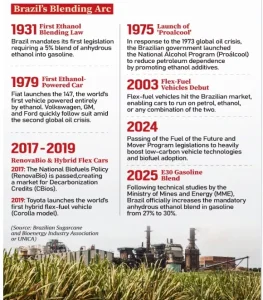 Vehicle Ecosystem Readiness: The government promoted Flex-Fuel Vehicles (FFVs) capable of operating on multiple ethanol blends and supported automobile manufacturers with adequate time and policy certainty to develop ethanol-compatible vehicles.
- Consumer Choice and Flexibility: Consumers can choose between blended petrol (E27) and pure hydrous ethanol (E100) at fuel stations. The widespread adoption of FFVs allows motorists to switch to the more economical fuel depending on market prices.
- Competitive Pricing and Fiscal Incentives: Ethanol is typically 25–35% cheaper than petrol, supported by government pricing policies and incentives that make biofuels financially attractive and encourage widespread consumer adoption.
- Strong Institutional and Policy Support: Consistent government commitment, regulatory certainty, and close coordination with the automobile, sugar, and energy industries ensured sustained growth of the ethanol ecosystem, culminating in long-term legislative support through the Fuel of the Future Law (2024).
India’s Ethanol Programme: Current Status
- Ethanol Blended Petrol (EBP) Programme: Launched in 2003 to promote blending of ethanol with petrol and reduce dependence on imported fossil fuels.
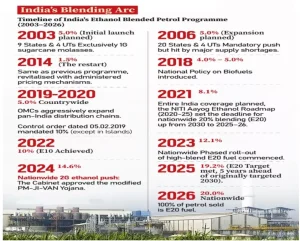 E10 Milestone: India achieved 10% ethanol blending (E10) in 2022, five months ahead of the target.
- E20 Rollout: 20% ethanol-blended petrol (E20) was rolled out nationwide by 2025, advancing the original target year of 2030.
- Future Roadmap: The Government is exploring higher blends such as E25 and E85–E100, alongside the promotion of Flex-Fuel Vehicles (FFVs).
Challenges in India’s Ethanol Transition
- Rapid Implementation: The transition from E10 to E20 was completed within a short timeframe, leaving limited time for automobile manufacturers, fuel retailers, and consumers to adapt.
- Limited Flex-Fuel Vehicle Ecosystem: India has only a handful of Flex-Fuel Vehicle (FFV) models, while most existing vehicles are not designed to efficiently operate on higher ethanol blends.
- Reduced Fuel Efficiency: Since ethanol has a lower energy density than petrol, higher ethanol blends result in reduced mileage, raising concerns among consumers.
- Limited Consumer Choice: With E20 becoming the standard petrol in many regions, consumers have limited flexibility to choose fuels compatible with older vehicles.
- Inadequate Consumer Awareness: Limited public communication regarding vehicle compatibility, mileage implications, and maintenance requirements has created confusion among vehicle owners.
- Infrastructure Constraints: The production, storage, transportation, and retail infrastructure required for higher ethanol blends and FFVs is still evolving.
Importance of Ethanol for India
- Enhances Energy Security: Reduces dependence on imported crude oil and strengthens India’s resilience against global energy price shocks.
- Supports Climate Goals: Lower lifecycle greenhouse gas emissions contribute to India’s commitments under the Paris Agreement and its net-zero pathway.
- Boosts Farmers’ Income: Creates additional demand for sugarcane, maize, damaged food grains, and agricultural residues, improving rural livelihoods.
- Promotes Circular Economy: Encourages the conversion of agricultural waste and surplus biomass into clean transportation fuel.
- Reduces Oil Import Bill: Substituting imported petrol with domestically produced ethanol improves the current account balance and foreign exchange savings.
UPSC Online Preparation
Lessons from Brazil for India
- Adopt a Phased Transition: Increase ethanol blending gradually with clearly defined milestones to allow industries and consumers adequate time to adjust.
- Expand Flex-Fuel Vehicle Ecosystem: Scale up the manufacturing and availability of FFVs before introducing higher ethanol blends nationwide.
- Preserve Consumer Choice: Ensure the availability of multiple fuel options such as petrol, E20, and E85 during the transition period.
- Provide Price Incentives: Use fiscal support and pricing mechanisms to make ethanol-based fuels economically attractive for consumers.
- Strengthen Consumer Awareness: Conduct sustained public awareness campaigns on fuel compatibility, mileage, maintenance, and environmental benefits.
- Develop Robust Infrastructure: Expand ethanol production capacity, storage facilities, transportation networks, and fuel dispensing infrastructure.
- Diversify Feedstocks: Reduce reliance on sugarcane by promoting maize, damaged food grains, agricultural residues, and second-generation (2G) ethanol.
Click to Know UPSC OnlyIAS Coaching Centres
Way Forward
- Synchronise Fuel, Vehicle, and Infrastructure Policies: Ensure coordinated development of ethanol production, vehicle technology, and fuel distribution networks.
- Promote Second-Generation (2G) Ethanol: Accelerate production of ethanol from crop residues and agricultural waste to minimise food-versus-fuel concerns.
- Scale Up Flex-Fuel Vehicles: Encourage automobile manufacturers through supportive policies and incentives to expand the FFV market.
- Improve Consumer Information: Introduce clear fuel labelling and awareness campaigns to help consumers make informed choices.
- Ensure Sustainable Biofuel Expansion: Balance ethanol production with food security, water conservation, and environmental sustainability to achieve long-term energy security.
 10 Jul 2026