Subject: GS 3: Economy
Context: The Union Government has released an updated series of the Index of Core Industries (ICI) by revising its base year from 2011–12 to 2022–23.
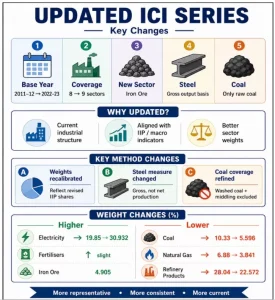
- The new series replaces the existing 2011–12 series and aligns the ICI with other key macroeconomic indicators such as GDP, Wholesale Price Index (WPI), and the Index of Industrial Production (IIP), all of which now use 2022–23 as the common base year.
UPSC Online Coaching
Key Features of the Updated Index of Core Industries (ICI) Series

- Revised Base Year: The base year has been revised from 2011–12 to 2022–23, making the index more representative of the current industrial structure and ensuring consistency with other macroeconomic indicators.
- Expanded Sectoral Coverage: The number of core industries has been increased from eight to nine with the inclusion of Iron Ore, recognising its critical role as a major input for industrial production, particularly in the steel industry.
- Revised Weight Structure: The weights assigned to individual sectors have been recalibrated to reflect their updated shares in the IIP and the evolving industrial composition of the economy.
- Methodological Improvements: Steel production is now measured on a gross production basis instead of net production to ensure methodological consistency with the IIP.
- Refined Coal Coverage: The revised series retains only raw coal while excluding washed coal and coal middling to eliminate double counting, as both are derived from raw coal.
Changes in Sectoral Weights
- Sectors with Higher Weight: The electricity sector has recorded the largest increase in weight from 19.85% to 30.932%, while the fertilisers sector has witnessed a marginal increase.
- The newly added iron ore sector has been assigned a weight of 4.905%.
- Higher weight reflects increasing electrification, expansion of manufacturing, digital economy, EV ecosystem and rising power demand.
- Sectors with Lower Weight: The weights of coal (10.33% to 5.596%), natural gas (6.88% to 3.841%), and refinery products (28.04% to 22.572%) have been reduced to reflect the revised sectoral composition.
- The reduced weight of the coal and refinery sectors reflects:
- the diversification of India’s industrial structure,
- the growing contribution of manufacturing and services,
- the transition towards cleaner energy, and
- the revision of sectoral production shares under the updated Index of Industrial Production (IIP).
About the Index of Core Industries (ICI)
- The Index of Core Industries (ICI) is a monthly production volume index that measures the combined as well as individual performance of India’s core infrastructure industries.
- Purpose: The ICI serves as a leading indicator of industrial activity and provides an early assessment of trends in the Index of Industrial Production (IIP).
- Coverage: The revised index now covers nine core industries—Coal, Crude Oil, Natural Gas, Refinery Products, Fertilisers, Steel, Cement, Electricity, and Iron Ore.
- Weight in IIP: The nine core industries together account for 32.88% of the IIP, compared with 40.27% under the 2011–12 series, reflecting the revised industrial composition.
- Nodal Agency: The index is compiled and released monthly by the Office of the Economic Adviser (OEA) under the Department for Promotion of Industry and Internal Trade (DPIIT), Ministry of Commerce and Industry.
- Related Index: The Index of Industrial Production (IIP) is compiled and released by the Ministry of Statistics and Programme Implementation (MoSPI) to measure the overall industrial performance of the economy.
Impact of the Revised Series
- Monthly Growth Estimates: The revised methodology has resulted in changes to monthly growth estimates. For instance, core industries growth for May 2026 has been revised from 0.5% under the previous series to 3.2% under the updated series.
- Recent Performance: According to the revised series, core industries recorded a five-month high growth of 5% in June 2026.
- Overall Growth Trend: The revision has not materially altered the long-term industrial growth trajectory, as the full-year growth for 2025–26 has changed only marginally from 1.1% to 1.0%.
Click to Know UPSC OnlyIAS Coaching Centres
Significance of the Updated ICI
- Enhanced Statistical Accuracy: The revised series provides a more accurate and contemporary measure of industrial activity by reflecting the present structure of the economy.
- Improved Data Harmonisation: The adoption of a common base year (2022–23) across GDP, WPI, IIP, and ICI improves consistency and comparability among India’s key macroeconomic indicators.
- Better Economic Assessment: The updated series will facilitate more reliable industrial analysis, policy formulation, economic forecasting, and investment planning through improved measurement of core sector performance.