Subject: GS 3: Economy
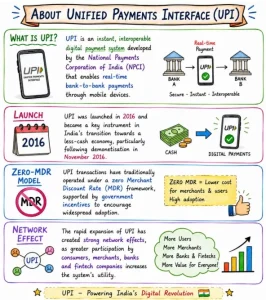
Context: The government has proposed amending Section 10A of the Payment and Settlement Systems Act, 2007, to allow a Merchant Discount Rate (MDR) of 0.25–0.5% on UPI transactions above ₹2,000.
- Introduced via the Taxation and Other Laws (Amendment) Bill, 2026.
- Amends Section 10A of the Payment and Settlement Systems Act, 2007, giving the government legal power to notify charges on specified electronic payment modes.
UPSC Course Fees Online
About Merchant Discount Rate (MDR)
- It is a fee charged to merchants by banks or payment service providers for processing digital payment transactions, usually calculated as a percentage of the transaction value.
Payment and Settlement Systems Act, 2007
- It provides the legal framework for regulating payment systems in India, ensuring their safety, security and efficiency; it also establishes the Reserve Bank of India’s regulatory oversight over payment systems.
- Regulator: Empowers the Reserve Bank of India (RBI) to authorise, regulate and supervise payment systems.
- Scope: Covers payment systems, clearing houses, payment instruments and settlement mechanisms.
- Significance: Provides the statutory foundation for India’s evolving digital payments ecosystem, including UPI.
|
- Transaction Impact: The threshold is expected to cover around 5% of UPI transactions by volume, but these account for approximately 65% of transaction value.
Why was UPI’s Zero-MDR Policy Adopted?

- Promoting Digital Payments: Zero MDR reduced the cost of accepting digital payments and encouraged merchants and consumers to shift from cash to electronic payments.
- Financial Inclusion: UPI enabled small merchants and low-income users to participate in the formal digital financial ecosystem without significant transaction costs.
- Formalisation of the Economy: Digital transactions create a traceable financial trail, supporting financial transparency, tax compliance and formalisation.
- Digital Credit: Digital transaction histories can help assess cash flows and creditworthiness, particularly for small businesses lacking conventional financial records.
Who Ultimately Bears the Cost of MDR?
- Two-Sided Market: UPI operates as a two-sided market, connecting consumers and merchants through banks, payment service providers and fintech companies.
- Merchant: MDR is formally imposed on the merchant side of the payment ecosystem.
- Consumers: Merchants may pass part of the additional cost to consumers through higher prices or transaction charges, depending on market conditions.
- Banks and Fintechs: If merchants cannot absorb or pass on the cost, banks, payment service providers and fintech companies may bear it through reduced margins.
- Innovation Risk: Lower margins could weaken investment in payment infrastructure, cybersecurity, fraud prevention and innovation.
Why is the Proposal a Concern?
- Policy Reversal: The proposal represents a potential reversal of the zero-MDR policy that helped establish UPI as a mass-market payment platform.
- Risk to Adoption: Even a modest charge could influence choices between UPI, cash, cards and other payment instruments, particularly for businesses with thin margins.
- Threat to Financial Inclusion: Higher transaction costs could discourage some merchants and users from shifting from cash to digital payments.
- Formalisation Concerns: Reduced UPI usage could slow the growth of traceable digital transactions, affecting economic formalisation and tax compliance.
- Investment Disincentive: Lower returns could reduce incentives to invest in innovation, reliability, fraud prevention and underserved markets.
- Policy Credibility: Frequent changes in digital-payment incentives could create policy uncertainty for banks, fintech companies and merchants.
- Policy Inconsistency: India already imposes 18% GST on credit card interest and fees — unusual internationally, since most countries treat consumer credit interest as a private cost, not a taxable service.
Way Forward
- Evidence-Based Pricing: Any change in MDR should be preceded by an assessment of its impact on merchant behaviour, consumer adoption, fintech investment and financial inclusion.
- Protect Small Merchants: The policy should protect small businesses and low-value transactions from disincentives.
- Maintain Ecosystem Incentives: The system should preserve incentives for banks, fintech companies and payment service providers to invest in reliability, cybersecurity and innovation.
- Ensure Policy Stability: A predictable payments policy framework is essential for long-term investment and ecosystem confidence.
- Explore Alternative Revenue Sources: The government could explore alternative revenue mechanisms that do not undermine UPI adoption and its network effects.
Click to Know UPSC Offline Courses
Conclusion
UPI has evolved into a critical pillar of India’s financial inclusion, formalisation and Digital Public Infrastructure. Any MDR must balance revenue needs with affordability, innovation, adoption and ecosystem sustainability, ensuring that a decade of policy support is not undermined by a sudden policy reversal.