UPSC PYQs

Prelims, Mains & Optional PYQs

UPSC Notes

Comprehensive & Short Notes

Epigenetic Inheritance: DNA Methylation and Traits Across Generations

11 Aug 2026

Epigenetic Inheritance: DNA Methylation and Traits Across Generations

Subject: GS 3: Science and Technology

Context: A recent study by researchers at Johns Hopkins School of Medicine, published in Nature Genetics, found several non-Mendelian patterns of inheritance in mice.
  • Methodology: Researchers used nanopore sequencing, which can detect DNA methylation by identifying changes in electrical signals as DNA passes through a microscopic nanopore.

Best Online Coaching for UPSC

About DNA (deoxyribonucleic acid)

Epigenetic Inheritance

  • Genetic Information: DNA contains genetic information in the form of four bases — A, T, G and C — whose sequence determines the instructions carried by genes.
  • Gene Switching: Genes need to be switched ‘ON’ or ‘OFF’ depending on the requirements of the cell.
  • Epigenetic Regulation: Gene activity can be regulated through epigenetic modifications, which alter gene expression without changing the underlying DNA sequence.
    • DNA Sequence: What genetic information is present.
    • Epigenetics: How that genetic information is regulated and expressed.

About DNA Methylation: Epigenetic Mechanism

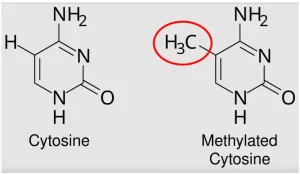
  • Methylation of DNA: A methyl group (–CH₃) attaches to specific locations on DNA, particularly cytosines.
  • Methylation and Gene Silencing: Methylated cytosines generally suppress gene expression, while removal of the methyl group can allow the gene to be expressed.
  • Epigenetic patterns differ across tissues: The same DNA can have different epigenetic patterns in tissues such as the liver and muscle, allowing them to perform different functions.
  • Epigenetic marks are reset between generations: Many epigenetic marks are erased during the formation of sperm and eggs, helping reset gene regulation for the next generation.

Key Findings of the Study

  • Heritable Information Extends Beyond DNA Sequence: The study suggests that heritable information may not be confined to the DNA sequence.
    • Chemical modifications of the genome can influence gene expression and, in some cases, pass across generations.
    • This challenges the conventional understanding that inheritance is determined primarily by changes in DNA sequence.
  • Evidence of Epigenetic Inheritance: Around 7% of the 7,600 genomic regions studied showed non-Mendelian patterns of epigenetic inheritance, indicating that some chemical modifications can escape normal resetting and pass across generations.
  • Inheritance Can Differ by Sex: In 305 liver regions, DNA methylation differed between male and female mice, with females showing greater methylation in 304 regions, highlighting the role of sex in epigenetic regulation.
  • Paramutation Observed: The study reported the first naturally occurring paramutation in a mammal.
    • Paramutation is an epigenetic phenomenon in which the epigenetic state of one allele alters another allele, with the change potentially persisting across generations.
  • Ancient Viral DNA May Play a Role: Some regions involved in paramutation were linked to remnants of ancient viruses embedded in the genome, suggesting that these sequences may help preserve epigenetic changes across generations.

Broader Implications of the Study

  • Possible Relevance to Human Traits: Although conducted in mice, the findings may help explain unusual inheritance patterns that cannot be fully understood through DNA sequence alone, such as father-to-son transmission observed in conditions like hypertrichosis pinnae auris.
  • Limitations of DNA-Based Genetic Studies: The findings suggest that GWAS, which primarily focuses on DNA sequence variants, may miss some heritable variation arising from epigenetic modifications.
  • Role of EWAS: The study highlights the potential importance of Epigenome-Wide Association Studies (EWAS) in identifying disease-associated epigenetic variations that may be missed by conventional DNA sequence-based studies.

Key Terms: 

  • GWAS is a genetic research method used to identify DNA sequence variations associated with particular diseases or traits.
    • It compares the genomes of people with a particular trait/disease with those without it to find genetic variants that occur more frequently in one group.
  • Epigenome-Wide Association Studies (EWAS)
    • EWAS is a research approach that studies epigenetic changes across the genome, particularly DNA methylation, to identify their association with diseases or traits.
    • It can complement Genome-Wide Association Studies (GWAS), which mainly examine DNA sequence variations.

Click to Know UPSC Coaching Centres in India

Conclusion

If DNA is the genetic “instruction manual”, epigenetics may represent its “second volume” — revealing how genes are regulated and showing that some of this regulatory information can also influence inheritance. 

Check Out UPSC CSE Books

Visit PW Store

online store 1

Epigenetic Inheritance: DNA Methylation and Traits Across Generations

Need help preparing for UPSC or State PSCs?

Connect with our experts to get free counselling & start preparing

Free Counselling for UPSC Aspirants

Connect with our experts and take the right next step.

Expert Guidance
Personalized Strategy
100% Free

Book Your Free Session

NEED ASSISTANCE?

Request a Callback

Our counsellor will connect with you and help you choose the right course and centre.

  • Expert Guidance
  • Course & Fee Information
  • Quick Callback Support

Request a Callback

Books
UPSC PYQs
UPSC Notes
Current Affairs
Quick Revise Now !
AVAILABLE FOR DOWNLOAD SOON
UDAAN PRELIMS WALLAH
Comprehensive coverage with a concise format
Integration of PYQ within the booklet
Designed as per recent trends of Prelims questions
हिंदी में भी उपलब्ध
Quick Revise Now !
UDAAN PRELIMS WALLAH
Comprehensive coverage with a concise format
Integration of PYQ within the booklet
Designed as per recent trends of Prelims questions
हिंदी में भी उपलब्ध

<div class="new-fform">


    </div>

    Subscribe our Newsletter
    Sign up now for our exclusive newsletter and be the first to know about our latest Initiatives, Quality Content, and much more.
    *Promise! We won't spam you.
    Yes! I want to Subscribe.