Subject: GS 03: Environment
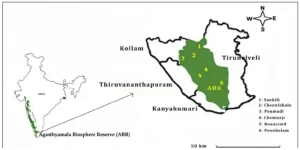
Context: The Forest Department of Tamil Nadu issued eviction notices to thousands of households in the Agasthyamalai Biosphere Reserve.
UPSC Online Preparation
Background

- In March 2025, the Supreme Court ordered the Central Empowered Committee to survey the Agasthyamalai landscape to identify illegal non-forest activities and directed time-bound eviction of encroachments, rehabilitation of eligible people and action against wilful violators.
- However, eviction must be preceded by proper verification of forest rights under the Forest Rights Act, 2006, as genuine forest-right holders should not be wrongly treated as encroachers.
Forest Rights Act, 2006 (FRA), 2006
- It is officially known as the Scheduled Tribes and Other Traditional Forest Dwellers (Recognition of Forest Rights) Act, 2006.
- Purpose: It recognises the historical rights of forest-dwelling communities over forest land and resources.
- Nodal Ministry: Ministry of Tribal Affairs. (UPSC CSE Prelims 2021)
- Provisions:
-
- The Forest Rights Act, 2006 follows a bottom-up, community-based process for determining forest rights:
- Gram Sabha: The starting point of the process. It receives and verifies claims through the Forest Rights Committee, passes a resolution and forwards the claims to the higher-level committee.
- Sub-Divisional Level Committee: Examines the Gram Sabha’s recommendations, prepares records of recognised rights and considers appeals against Gram Sabha decisions.
- District Level Committee: Headed by the District Collector, it examines the claims and provides final approval. Its decisions are final under the FRA.
- Community Forest Resource: Communities can protect, manage and conserve traditionally used forest areas.
- Livelihood security: Provides rights to use forest resources for livelihood and basic needs.
- Conservation: Empowers local communities to participate in forest and biodiversity conservation.
- Eviction: Eviction should not take place until the recognition and verification process is completed.
About Agasthyamalai Biosphere Reserve
- It is a transboundary biosphere reserve located in the Western Ghats of Kerala and Tamil Nadu.
- Name: It is named after Agasthyamalai Peak (1,868 metres).
- Established: 2001 under UNESCO’s Man and the Biosphere (MAB) Programme.
- UNESCO’s Man and the Biosphere (MAB) Programme, launched in 1971, promotes biodiversity conservation, sustainable development and harmony between people and nature.
- Landscape: Includes evergreen forests, moist deciduous forests, grasslands and montane ecosystems.
- Biodiversity: Rich in endemic and threatened species, including several medicinal plants.
- Protected areas: Includes parts of Neyyar, Peppara and Shendurney Wildlife Sanctuaries in Kerala and Kalakad–Mundanthurai Tiger Reserve in Tamil Nadu.
- Tribal communities: Home to indigenous communities such as the Kani, who have traditionally depended on forest resources.
Click to Explore UPSC Offline Coaching