Subject: GS 3: Economy
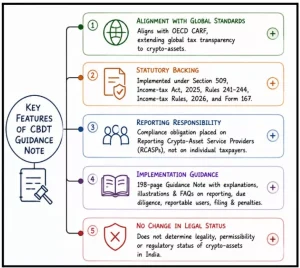
Context: The Central Board of Direct Taxes (CBDT) has aligned India’s crypto-asset reporting regime with the Organisation for Economic Co-operation and Development (OECD)’s Crypto-Asset Reporting Framework (CARF) to strengthen tax transparency and cross-border exchange of tax information.
UPSC Online Preparation
About Crypto-Asset Reporting Framework (CARF)
- It is a global reporting framework developed by the OECD to facilitate the automatic exchange of tax-related information on crypto-assets between participating jurisdictions.
- Objective: To improve tax transparency, prevent cross-border tax evasion, and address reporting gaps arising from the increasing use of crypto-assets.
- Coverage: The framework requires Reporting Crypto-Asset Service Providers (RCASPs) to identify users, undertake due diligence, and report specified crypto-asset transactions to tax authorities.
- Global Evolution:
-
- The framework was developed by the OECD in 2022 under the mandate of the G20.
- It was endorsed by the G20 Bali Leaders’ Declaration (2022).
- During India’s G20 Presidency (2023), member countries supported a coordinated implementation timeline, with most jurisdictions favouring rollout from 2027.
About the Central Board of Direct Taxes (CBDT)
- The CBDT is a statutory body constituted under the Central Boards of Revenue Act, 1963.
- Administrative Ministry: It functions under the Department of Revenue, Ministry of Finance.
- Functions: It administers the Income-tax Act, formulates direct tax policies, issues rules, notifications, and guidelines, and supervises the functioning of the Income-tax Department.
About the Organisation for Economic Co-operation and Development (OECD)
- The OECD is an intergovernmental organisation established in 1961 to promote economic cooperation, policy coordination, and sustainable development.
- Headquarters: Paris, France.
- Membership: It comprises 38 member countries.
- India’s Association: Although India is not an OECD member, it actively participates in several OECD initiatives, including the G20/OECD Inclusive Framework on Base Erosion and Profit Shifting (BEPS) and the Crypto-Asset Reporting Framework (CARF).
|
Why was the Framework Developed?
- Addressing Tax Evasion: The rapid growth of crypto-assets has enabled cross-border transactions outside the traditional financial system, increasing the risk of tax evasion and undisclosed income.
- Bridging Reporting Gaps: Existing information-sharing mechanisms, such as the Common Reporting Standard (CRS) and the Foreign Account Tax Compliance Act (FATCA), do not comprehensively capture crypto-asset transactions.
- Strengthening Global Tax Transparency: A common reporting standard facilitates the automatic exchange of information (AEOI) among jurisdictions, enabling tax authorities to identify offshore crypto holdings and transactions.
- Protecting Government Revenue: Improved reporting helps safeguard the tax base by reducing opportunities for tax avoidance through digital assets.
Reporting Obligations for Crypto-Asset Service Providers
- Customer Due Diligence: RCASPs are required to conduct Know Your Customer (KYC) verification and determine the tax residency of users before reporting transactions.
- Collection of Taxpayer Information: Service providers must obtain prescribed taxpayer information and valid self-certification from users.
- Maintenance of Transaction Records: RCASPs must maintain detailed records of reportable crypto transactions and preserve supporting documentation.
- Annual Reporting: Service providers are required to furnish annual transaction information in the prescribed format through Form 167.
- Transition Timeline: Due diligence for new users is mandatory at onboarding, while verification of pre-existing users as of 31 December 2025 must be completed within 12 months from 1 January 2026.
Implications for Taxpayers
- No Additional Compliance Burden: The Guidance Note does not impose any new filing requirements on individual taxpayers.
- Greater Tax Transparency: Tax authorities will gain access to transaction-level information, including transactions undertaken through offshore crypto exchanges.
- Enhanced Scrutiny: The availability of detailed transaction data will enable data-driven verification and improve the detection of undisclosed crypto income.
- Need for Accurate Record-Keeping: Taxpayers should maintain proper records of purchases, sales, wallet transfers, exchange statements, and supporting documents to ensure consistency with reported information.
- Improved Tax Compliance: Crypto income should continue to be reported under the applicable provisions of the Income-tax Act, with greater emphasis on accurate disclosure.
Click to Know UPSC Offline Courses
Significance of the Framework
- Strengthening Tax Administration: The framework enhances the ability of tax authorities to detect tax evasion, improve voluntary compliance, and strengthen tax administration.
- Promoting International Tax Cooperation: Automatic exchange of crypto transaction data strengthens cooperation among tax administrations and supports the global fight against tax evasion.
- Improving Transparency in the Digital Economy: Standardised reporting requirements enhance transparency and accountability in the rapidly growing crypto-asset ecosystem.
- Supporting Evidence-Based Enforcement: Access to reliable transaction data enables more effective risk assessment, data analytics, and targeted tax enforcement.
- Aligning India with Global Best Practices: Adoption of the OECD framework reinforces India’s commitment to international standards on tax transparency and financial integrity.
 28 Jul 2026