UPSC PYQs

Prelims, Mains & Optional PYQs

UPSC Notes

Comprehensive & Short Notes

Plurilateral Agreements in WTO: India’s Stand & Key Issues

24 Jul 2026

Plurilateral Agreements in WTO: India’s Stand & Key Issues

Subject: GS 3: Economy

Context: During India’s Trade Policy Review at the WTO, several members urged India to reconsider its opposition to plurilateral agreements as part of WTO reforms. 
  • India maintained that such agreements weaken the WTO’s consensus-based multilateral trading system

Best Online Coaching for UPSC

What are Plurilateral Agreements?

Plurilateral Agreements

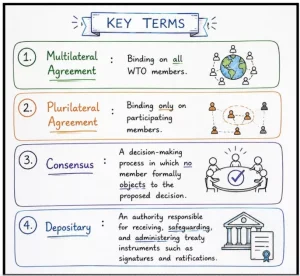
  • Plurilateral agreements are trade agreements negotiated and implemented by a subset of WTO members, rather than by all members of the organization.
  • Major Proponents: United States (US), European Union (EU), and China are among the leading supporters of plurilateral agreements to advance sector-specific trade liberalisation
  • Membership: Only countries that voluntarily sign and ratify the agreement are legally bound by its provisions, unlike multilateral agreements that apply to all WTO members.
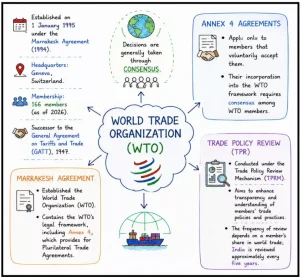
  • Legal Basis: Under the Marrakesh Agreement, plurilateral agreements are incorporated under Annex 4, which requires consensus of all WTO members for their inclusion in the WTO legal framework.
  • Objective: These agreements seek to advance negotiations on emerging trade issues where consensus among all WTO members is difficult to achieve.

Plurilateral Agreements

Major Plurilateral Initiatives under the WTO

  • Investment Facilitation for Development (IFD): Aims to improve the investment climate by enhancing transparency, streamlining administrative procedures, and facilitating foreign investment.
  • Agreement on Electronic Commerce (ECA): Seeks to establish global rules for digital trade, including the prohibition of customs duties on electronic transmissions among participating members.
  • Fossil Fuel Subsidy Reform Initiative: Promotes the rationalisation of inefficient fossil fuel subsidies.
  • Dialogue on Plastics Pollution and Environmentally Sustainable Plastics Trade: Focuses on reducing plastic pollution and promoting sustainable trade in plastics.

India’s Stand on Plurilateral Agreements

  • Protection of Multilateralism: India argues that the WTO is fundamentally a member-driven, consensus-based multilateral institution, and plurilateral agreements should not dilute this principle.
  • Consensus Requirement: India maintains that incorporating plurilateral agreements into Annex 4 without the consensus of all WTO members would violate the Marrakesh Agreement.
  • Opposition to IFD: At MC14 (14th Ministerial Conference) in Yaoundé, Cameroon, India was the sole country opposing incorporation of the Investment Facilitation for Development (IFD) Agreement into the WTO’s Annex 4 framework. 
  • Challenge to Interim Arrangements: India questioned the legal basis for designating the WTO Director-General as the depositary of the Agreement on Electronic Commerce (ECA) through interim arrangements, arguing that such arrangements circumvent established WTO procedures.
  • Institutional Concerns: India believes that expanding the WTO’s mandate through plurilateral agreements without consensus could weaken the organization’s institutional credibility and undermine the interests of developing countries.

Arguments in Favour of Plurilateral Agreements

  • Facilitating WTO Reform: Supporters argue that plurilateral agreements provide a practical mechanism for advancing negotiations when consensus among all members is difficult.
  • Addressing Emerging Issues: They enable the WTO to develop rules on new areas such as digital trade, investment facilitation, environmental sustainability, and e-commerce.
  • Flexible Participation: Countries may voluntarily participate according to their development priorities without imposing obligations on non-signatories.
  • Enhancing Global Trade: Supporters contend that common rules improve predictability, transparency, and investor confidence, thereby facilitating international trade and investment.
  • Broad International Support: Major economies such as the United States, the European Union, and China support plurilateral negotiations, while 129 WTO members have backed the Investment Facilitation for Development (IFD) Agreement.

Click to Know UPSC Coaching Centres in India

Check Out UPSC CSE Books

Visit PW Store

online store 1

Plurilateral Agreements in WTO: India’s Stand & Key Issues

Explore UPSC Foundation Batches

Need help preparing for UPSC or State PSCs?

Connect with our experts to get free counselling & start preparing

Free Counselling for UPSC Aspirants

Connect with our experts and take the right next step.

Expert Guidance
Personalized Strategy
100% Free

Book Your Free Session

NEED ASSISTANCE?

Request a Callback

Our counsellor will connect with you and help you choose the right course and centre.

  • Expert Guidance
  • Course & Fee Information
  • Quick Callback Support

Request a Callback

Books
UPSC PYQs
UPSC Notes
Current Affairs
Quick Revise Now !
AVAILABLE FOR DOWNLOAD SOON
UDAAN PRELIMS WALLAH
Comprehensive coverage with a concise format
Integration of PYQ within the booklet
Designed as per recent trends of Prelims questions
हिंदी में भी उपलब्ध
Quick Revise Now !
UDAAN PRELIMS WALLAH
Comprehensive coverage with a concise format
Integration of PYQ within the booklet
Designed as per recent trends of Prelims questions
हिंदी में भी उपलब्ध

<div class="new-fform">


    </div>

    Subscribe our Newsletter
    Sign up now for our exclusive newsletter and be the first to know about our latest Initiatives, Quality Content, and much more.
    *Promise! We won't spam you.
    Yes! I want to Subscribe.