Subject: GS 2: Polity & Governance
Context: Following the cancellation of NEET-UG 2026 over allegations of a large-scale paper leak, the Supreme Court has sought inputs from the Nandan Nilekani-led High-Powered Task Force on transitioning NEET-UG to a Computer-Based Test (CBT) to enhance the security, transparency, and integrity of public examinations.
Best Online Coaching for UPSC
Background
- Cancellation of NEET-UG 2026: The Union Government and the National Testing Agency (NTA) cancelled NEET-UG 2026, conducted on 3 May 2026, following allegations of widespread question paper leaks.
- Judicial Intervention: A petition before the Supreme Court sought comprehensive reforms in the conduct of NEET, including the transition from an offline examination to a Computer-Based Test (CBT).
- Need for Systemic Reforms: The Court observed that extraordinary measures, such as deploying the Indian Air Force for transporting question papers, are only temporary solutions and cannot replace long-term institutional reforms.
Key Observations of the Supreme Court
- Institutional Reforms are Essential: The Court emphasized that public examinations require permanent institutional safeguards rather than temporary administrative arrangements to ensure their integrity.
- Cybersecurity is Integral to Digital Examinations: The Court observed that any transition to CBT must be supported by robust measures relating to encryption, database security, cybersecurity, and secure data storage.
- A Comprehensive Reform Roadmap is Necessary: The Court directed the Union Government to submit an additional affidavit detailing the proposed cybersecurity framework, implementing agency, and safeguards against data breaches.
- Expert Consultation is Necessary: The Court decided to seek recommendations from the High-Powered Task Force regarding the feasibility of CBT and the safeguards required for its secure implementation.
Why is the Transition to Computer-Based Testing Being Considered?
- Preventing Paper Leaks: A Computer-Based Test (CBT) eliminates vulnerabilities associated with the printing, transportation, storage, and distribution of physical question papers, thereby significantly reducing the possibility of organized paper leaks.
- Enhancing Examination Integrity: Digital examinations strengthen fairness, transparency, credibility, and accountability by creating secure audit trails and minimizing opportunities for human interference.
- Improving Administrative Efficiency: CBT enables faster evaluation, timely declaration of results, better resource management, and lower logistical costs while ensuring uniform examination standards.
- Strengthening Technology-Driven Governance: The transition supports the objectives of Digital India, e-Governance, and technology-enabled public service delivery by modernizing examination management.
- Enabling Advanced Security Measures: Digital platforms can integrate end-to-end encryption, multi-factor authentication, randomized question papers, AI-based monitoring, and real-time threat detection to strengthen examination security.
About High-Powered Task Force on Public Examination Reforms
- Composition: Chaired by Nandan Nilekani, the Task Force brings together experts from digital public infrastructure, cybersecurity, intelligence, higher education, school education, and public administration to recommend comprehensive reforms in India’s public examination system.
- Mandate:
- Leak-Proof Examination System: Recommend measures to establish a secure, transparent, technology-driven, and tamper-resistant public examination ecosystem.
- Transition to Computer-Based Testing (CBT): Develop a phased roadmap for shifting national-level examinations to Computer-Based Testing (CBT) while ensuring accessibility, equity, and reliability.
- Cybersecurity & Data Protection: Strengthen encryption, secure databases, cybersecurity, data protection, and cyber resilience to safeguard examination processes.
- Institutional & Governance Reforms: Recommend reforms to modernise examination governance, enhance transparency, accountability, operational efficiency, and public trust in competitive examinations.
UPSC Coaching Classes
Challenges in Implementing Computer-Based Testing
- Digital Infrastructure Gaps: A nationwide CBT requires adequate computer infrastructure, reliable electricity, high-speed internet connectivity, and standardized examination centres across the country.
- Cybersecurity Risks: Online examinations remain vulnerable to hacking, malware, ransomware, insider threats, and unauthorised access unless protected through a robust cybersecurity framework.
- Digital Divide: Unequal access to digital infrastructure, varying levels of computer literacy, and regional disparities may disadvantage candidates from rural and economically weaker backgrounds.
- Data Privacy Concerns: Large-scale collection and storage of candidates’ personal information necessitate strong safeguards for data protection, privacy, and secure digital governance.
- Technical Disruptions: Server failures, software glitches, and network outages may compromise the smooth conduct and fairness of examinations if adequate contingency mechanisms are not established.
Way Forward
- Adopt a Phased Transition: The shift to Computer-Based Testing should be implemented gradually after ensuring adequate digital infrastructure and institutional preparedness across all regions.
- Institutionalise Robust Cybersecurity: Examination systems should incorporate end-to-end encryption, multi-factor authentication, AI-enabled threat detection, regular security audits, and disaster recovery mechanisms.
- Bridge the Digital Divide: The Government should expand digital infrastructure, conduct mock CBT examinations, and strengthen digital literacy to ensure equitable participation.
- Strengthen Institutional Oversight: Independent technical audits, continuous monitoring, and transparent grievance redress mechanisms should be established to maintain the credibility of public examinations.
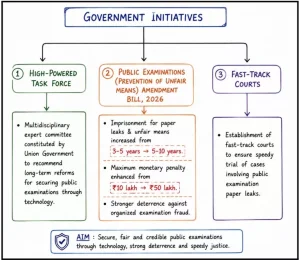
- Promote Legal and Administrative Reforms: Strong implementation of the anti-cheating law, swift prosecution through fast-track courts, and continuous institutional review should complement technological reforms.
Click to Know UPSC OnlyIAS Coaching Centres
Conclusion
The transition to Computer-Based Testing (CBT) can strengthen the security, transparency, and integrity of public examinations, provided it is supported by robust cybersecurity, digital inclusion, institutional accountability, and effective legal safeguards.
 28 Jul 2026