Subject: GS 3: Science & Technology
Context: As Artificial Intelligence (AI) rapidly transforms economies and workplaces, ensuring its benefits reach informal women workers, who form the majority of India’s female workforce, is essential for achieving inclusive growth and the vision of Viksit Bharat 2047.
IAS coaching
Why is AI Inclusion for Informal Women Workers Important?
- Supports the Majority of Women Workers: Around 82% of working women in India are employed in the informal sector (ILO, 2018), making AI essential for inclusive economic growth.
- Improve Agricultural Productivity and Livelihoods: According to the Periodic Labour Force Survey (PLFS) 2023–24, approximately 76.9% of rural women are engaged in agriculture.
- AI-powered technologies can support women farmers by providing precision farming solutions, real-time weather forecasts, crop health monitoring, optimized input usage, pest management, and market intelligence, thereby improving productivity and incomes.
- Proven Positive Impact: A 2024 Farmer. Chat study across 12 States found that 61% of women users reported improved quality of life within 45 days, with women engaging 2–3 times more than men when AI tools were designed around their needs.
Recent Key Data: AI Inclusion & Informal Women Workers (2025–26):
- Gendered AI Exposure: 28% of women’s jobs globally are exposed to Artificial Intelligence, compared to 21% of men’s jobs (United Nations Gender Snapshot 2025).
- Digital Readiness: India Skills Report 2026 shows 56.35% employability, with women surpassing men in job readiness for the first time.
- AI Adoption Gap: Women continue to adopt Generative Artificial Intelligence at lower rates due to limited digital literacy, affordability, language barriers, and online safety concerns.
- Algorithmic Bias: Women remain underrepresented in Artificial Intelligence datasets, development, and governance, leading to persistent gender bias in Artificial Intelligence systems.
- Policy Imperative: With over 90% of India’s workforce in the informal sector, inclusive, multilingual, affordable, and women-centric Artificial Intelligence is essential to ensure equitable digital transformation.
|
Challenges in Ensuring Inclusive AI Adoption
- Algorithmic Bias Can Reinforce Existing Gender Inequalities: AI systems are frequently trained on datasets that underrepresent women, resulting in biased outcomes in areas such as credit assessment, employment, insurance, welfare delivery, and digital financial services.
 The Digital Divide Continues to Limit Women’s Access to AI: Many informal women workers have limited access to smartphones, affordable internet connectivity, digital devices, and digital literacy, preventing them from fully utilizing AI-enabled services.
-
- Language barriers further reduce the accessibility of AI applications for women in rural and underserved regions.
- Limited AI Literacy Restricts Meaningful Participation: The absence of structured AI literacy programmes prevents many women from effectively using AI tools to improve their livelihoods, access government services, or participate in digital markets.
- Digital Safety Risks: The increasing misuse of AI through deepfakes, online harassment, identity theft, and non-consensual synthetic content creates an unsafe digital environment for women.
- Such threats discourage women from participating confidently in digital platforms and online economic activities.
- Lack of Transparency Weakens Trust in AI Systems: Many AI systems operate through opaque or “black-box” algorithms, making it difficult for affected individuals to understand or challenge automated decisions.
- This reduces public trust and limits accountability, particularly in sectors involving welfare, employment, and financial inclusion.
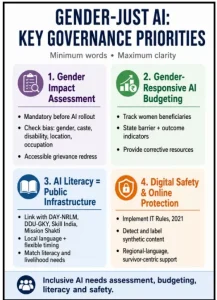
Key Governance Priorities
- Institutionalise Gender Impact Assessments: AI systems that influence employment opportunities, credit access, welfare delivery, healthcare, education, or public services should undergo mandatory Gender Impact Assessments before deployment.
- These assessments should evaluate whether AI systems produce differential outcomes across gender, caste, disability, geographical location, and occupational status, while also ensuring accessible grievance redress mechanisms.
- Integrate Gender-Responsive Budgeting into AI Investments: Public expenditure on AI should be assessed through a Gender-Responsive Budgeting framework to ensure that investments generate measurable benefits for women.
- Treat AI Literacy as Essential Public Infrastructure: AI literacy programmes should be integrated with existing government initiatives such as Deen Dayal Antyodaya Yojana–National Rural Livelihoods Mission (DAY-NRLM), Deen Dayal Upadhyaya Grameen Kaushalya Yojana (DDU-GKY), Skill India Mission, and Mission Shakti.
- Strengthen Digital Safety: Effective implementation of the Information Technology (Intermediary Guidelines and Digital Media Ethics Code) Rules, 2021, along with mechanisms for detecting and labeling AI-generated synthetic content, is essential to protect women from online abuse.
- Strengthen grievance redressal in regional languages.
Government Initiatives Supporting Inclusive AI:
- 2021 – Information Technology (Amendment) Rules, 2021: Mandate grievance redress mechanisms for online intermediaries to address harmful digital content, including technology-enabled abuse.
- 2023 – BHASHINI (Bhasha Interface for India): Serves as India’s multilingual Digital Public Infrastructure (DPI), enabling Artificial Intelligence-based services in multiple Indian languages to improve digital accessibility and inclusion.
- 2024 – IndiaAI Mission: Approved with an outlay of ₹10,371.92 crore, the Mission aims to build a robust national Artificial Intelligence ecosystem through computing infrastructure, datasets, innovation, startup support, skilling, and AI research.
- 2025 – India AI Governance Guidelines: Establish principles of fairness, equity, transparency, accountability, privacy, safety, and reliability, providing the foundation for responsible Artificial Intelligence governance.
- 2025 – Ministry of Electronics and Information Technology (MeitY) Initiative: Proposed mandatory labelling of Artificial Intelligence-generated synthetic content to improve transparency and curb the misuse of deepfakes and manipulated media.
- 2025 – National Commission for Women (NCW) Recommendations: Reviewed India’s cyber laws and recommended stronger legal and institutional safeguards to address technology-facilitated gender-based violence, including deepfakes and online harassment.
|
Way Forward
- Inclusive AI Datasets: India should develop inclusive, representative, and bias-free datasets to ensure that Artificial Intelligence systems produce equitable outcomes across different sections of society.
- Gender Impact Assessment: Mandatory Gender Impact Assessments should be institutionalised for all high-risk Artificial Intelligence applications affecting livelihoods, welfare, financial services, and public administration.
- AI Literacy & Digital Inclusion: Artificial Intelligence literacy should be expanded through Self-Help Groups (SHGs), Panchayati Raj Institutions, Krishi Vigyan Kendras (KVKs), Common Service Centres (CSCs), and community-based organisations to improve last-mile digital inclusion.
- Multilingual AI Ecosystem: Artificial Intelligence applications should be developed in regional languages through platforms such as BHASHINI, ensuring that language does not become a barrier to access.
- Transparent & Accountable AI Governance: Artificial Intelligence systems used in governance and public service delivery should be transparent, explainable, and accountable, supported by effective grievance redress mechanisms.
- Legal & Cyber Safety Framework: The legal framework should be strengthened to address deepfakes, Artificial Intelligence-enabled cybercrime, online harassment, and digital gender-based violence through coordinated inter-ministerial action.
- Gender-Responsive AI Investments: Artificial Intelligence procurement policies should incorporate gender-responsive budgeting and measurable inclusion indicators to ensure that public investments generate equitable outcomes.
Click to Explore UPSC Offline Coaching
Conclusion
Artificial Intelligence can drive inclusive growth only if it is accessible, gender-responsive, transparent, and safe, enabling informal women workers to participate in and benefit from India’s journey towards Viksit Bharat 2047.
 28 Jul 2026