Subject: GS 2: Polity and Governance
Context: The Cauvery Water Management Authority (CWMA) upheld the Cauvery Water Regulation Committee’s (CWRC) order directing Karnataka to release water to Tamil Nadu.
- This sparked widespread farmer protests across Karnataka’s Cauvery basin and escalated the long-standing inter-state water dispute.
Best Online Coaching for UPSC
| The CWMA is the apex body that monitors the implementation of water release by the upper riparian States as per the Supreme Court’s verdict. |
What are Inter-State River Waters?
- Inter-state river waters refer to the waters of rivers, streams and river valleys that flow through or form boundaries between two or more States.
- Since natural river basins do not follow political boundaries, their utilisation requires inter-state coordination, negotiated agreements and, where necessary, constitutional and statutory dispute-resolution mechanisms.
Major Issues in the Present Context:
- Cauvery Water Sharing: Tamil Nadu has emphasised the need for the timely release of Cauvery water in accordance with agreements, tribunal awards and judicial directions.
- Mekedatu Project: Tamil Nadu has opposed the proposed Mekedatu reservoir project in Karnataka, apprehending that it could affect its downstream water interests.
- Mullaperiyar Dam: Tamil Nadu has sought measures to raise the water level of the Mullaperiyar reservoir, making the issue relevant to its irrigation needs and inter-state water relations with Kerala.
- Anaimalaiyar and Nallar Projects: Tamil Nadu has proposed pursuing these projects as part of efforts to strengthen regional water availability and long-term water security.
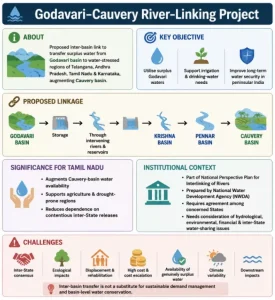
- Godavari-Cauvery Link: The proposed river-linking project has been highlighted as a potential mechanism for augmenting water availability in water-stressed regions, subject to ecological, technical and inter-state considerations.
|
Why Do Inter-State River Water Disputes Matter?
- Agricultural Dependence: States depend on predictable river flows for irrigation and agricultural livelihoods, particularly during monsoon variability.
 Drinking Water Security: Inter-state rivers are also important sources of urban and rural drinking water, making disputes directly relevant to human security.
- Federal Relations: Disagreements over river waters can generate political tensions between States and test the functioning of cooperative federalism.
- Climate Change: Increasing droughts, irregular rainfall and extreme precipitation are making historical water-sharing arrangements more difficult to implement.
- Developmental Competition: Upstream States may prioritise dams, irrigation, hydropower and urban requirements, while downstream States seek assured flows based on existing agreements and legal entitlements.
Major Legal and Institutional Mechanisms
- Inter-State River Water Disputes Act, 1956: Provides for the adjudication of inter-state water disputes through water dispute tribunals when negotiations between States fail.
Associated Constitutional Framework:
- Article 262: Provides the constitutional framework for adjudicating disputes relating to the use, distribution or control of waters of inter-state rivers and river valleys.
- Article 262(1): Empowers Parliament to provide by law for the adjudication of such disputes.
- Article 262(2): Enables Parliament to provide that neither the Supreme Court nor any other court shall exercise jurisdiction over such disputes or complaints.
- Seventh Schedule, Entry 17 of State List: Places water, irrigation, canals, drainage, water storage and water power primarily within the State domain, subject to the provisions relating to inter-state rivers.
- Seventh Schedule, Entry 56 of Union List: Empowers Parliament to provide for the regulation and development of inter-state rivers and river valleys when declared necessary in the public interest.
|
UPSC Course Fees Online
- Water Disputes Tribunal: The Central Government may constitute an ad hoc tribunal when it forms the opinion that a water dispute cannot be settled through negotiations.
- Binding Tribunal Awards: Tribunal decisions are given statutory force and are intended to provide a final and binding determination of the water-sharing dispute, subject to the legal framework governing their implementation.
- River Boards Act, 1956: Provides for the establishment of River Boards for the regulation and development of inter-state rivers and river valleys.
- River Basin Approach: River Boards were envisaged as instruments for integrated river-basin management, including irrigation development, flood control and soil conservation.
Major Challenges
- Upstream-Downstream Conflict: Upstream development projects can generate apprehension in downstream States regarding reduced or altered water flows.
- Implementation Deficit: Even after tribunal awards or judicial directions, disputes may persist because actual water releases depend on rainfall, reservoir levels, administrative coordination and political cooperation.
- Climate Uncertainty: Traditional water-sharing formulas may become increasingly difficult to apply under changing rainfall and hydrological patterns.
- Institutional Weakness: The limited use of mechanisms such as the River Boards has restricted the development of effective basin-wide governance.
- Growing Water Demand: Rising requirements for agriculture, cities, industry and energy are intensifying competition over finite water resources.
Way Forward
- Strengthen Cooperative Federalism: States should move from adversarial claims towards cooperative river-basin management, recognising that rivers are ecological systems rather than political assets.
- Improve Data Sharing: A transparent system for sharing rainfall, reservoir storage, inflow, outflow and water-use data can reduce disputes over actual water availability.
- Strengthen Basin-Level Institutions: Existing inter-state mechanisms should be made more technically capable, transparent and responsive.
- Adopt Climate-Resilient Agreements: Water-sharing arrangements should incorporate drought-year protocols and climate variability rather than relying solely on historical hydrological assumptions.
- Promote Demand-Side Management: Micro-irrigation, crop diversification, wastewater reuse and water-efficient agriculture can reduce pressure on inter-state rivers.
- Ensure Timely Compliance: Tribunal awards and judicial directions should be implemented through effective institutional mechanisms and predictable monitoring systems.
Click to Know UPSC Coaching Centres in India
Conclusion
Inter-state river disputes test cooperative federalism, requiring a shift from State-centric claims to river-basin cooperation, backed by constitutional mechanisms, scientific data and climate-resilient water management.
 10 Aug 2026