UPSC PYQs

Prelims, Mains & Optional PYQs

UPSC Notes

Comprehensive & Short Notes

Supreme Court (Number of Judges) Amendment Bill 2026: Key Provisions

4 Aug 2026

Supreme Court (Number of Judges) Amendment Bill 2026: Key Provisions

Subject: GS 2: Polity & Governance

Context: Recently, the Lok Sabha has passed the Supreme Court (Number of Judges) Amendment Bill, 2026, replacing an Ordinance that increased the sanctioned strength of the Supreme Court from 34 to 38 judges, including the Chief Justice of India (CJI)

Best Online Coaching for UPSC

About the Supreme Court (Number of Judges) Amendment Bill, 2026

Supreme Court (Number of Judges) Amendment Bill

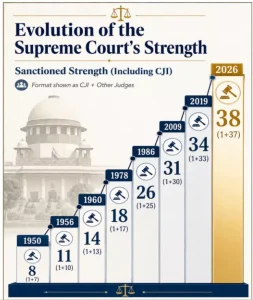
  • The Bill amends the Supreme Court (Number of Judges) Act, 1956 by increasing the number of puisne (ordinary) judges from 33 to 37. Including the Chief Justice of India, the Court’s sanctioned strength rises from 34 to 38.
  • Objective: To strengthen the adjudicatory capacity of the Supreme Court by increasing its sanctioned judicial strength.

Why Was the Increase Considered Necessary?

  • Rising Pendency: As of 1 January 2026, over 92,100 cases were pending before the Supreme Court.
  • Gap Between Institution and Disposal: During 2025, the Court received over 75,400 fresh cases but disposed of only about 65,600 cases, resulting in a growing backlog.
  • Supreme Court (Number of Judges) Amendment BillGrowing Litigation: Increasing constitutional, commercial, civil, criminal, and public interest litigation has significantly expanded the Court’s workload.
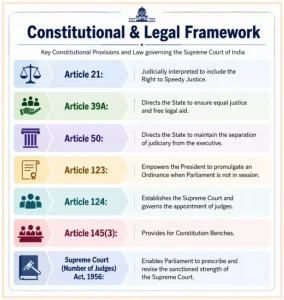
  • Need for Speedy Justice: The increase seeks to improve the Court’s disposal capacity and strengthen the constitutional guarantee of speedy justice under Article 21.

How is the Strength of the Supreme Court Increased?

  • Constitutional Basis
    • Article 124(1): Empowers Parliament to determine the sanctioned strength of the Supreme Court through an Act of Parliament.
    • Supreme Court (Number of Judges) Amendment BillHigh Courts: Under Article 216, the President determines the number of High Court judges.
  • Process
    • Recommendation by the CJI: Based on factors such as case pendency, rising workload, or the need for more Constitution Benches.
    • Government Review: Examined by the Ministry of Law & Justice in consultation with the Ministry of Finance, followed by Union Cabinet approval.
    • Parliamentary Approval: The Supreme Court (Number of Judges) Amendment Bill is passed by both Houses by a simple majority.
    • Appointment of Judges: Additional vacancies are filled under Article 124(2) through the Supreme Court Collegium’s recommendation, with appointments made by the President.

Supreme Court of India- Key Facts at a Glance

Evolution & Establishment:

  • 1774: Supreme Court of Judicature at Fort William (Calcutta) established under the Regulating Act, 1773.
  • 1937: Federal Court of India established under the Government of India Act, 1935.
  • 26 January 1950: Supreme Court of India established under Article 124, replacing the Federal Court and the Judicial Committee of the Privy Council.
  • 28 January 1950: Supreme Court formally inaugurated.

Composition & Appointment:

  • Original Strength (1950): 1 Chief Justice + 7 Puisne Judges (8 Judges).
  • Present Strength (2026): 1 Chief Justice + 37 Puisne Judges (38 Judges).
  • Appointment: Judges are appointed by the President under Article 124(2) through the Collegium System.
  • Retirement Age: 65 years.
  • Removal: By the President after an address by both Houses of Parliament on grounds of proved misbehaviour or incapacity (Articles 124(4) & 124(5)).

Jurisdiction & Powers:

  • Original Jurisdiction (Article 131): Disputes between the Union and States or between States.
  • Writ Jurisdiction (Article 32): Issues Writs for the enforcement of Fundamental Rights.
  • Appellate Jurisdiction (Articles 132–136): Hears appeals in constitutional, civil, and criminal matters, including Special Leave Petitions (SLPs) under Article 136.
  • Review Jurisdiction (Article 137): Reviews its own judgments to correct errors.
  • Advisory Jurisdiction (Article 143): Advises the President on questions of law or public importance.
  • Court of Record (Article 129): Judgments are binding precedents and the Court can punish for contempt.
  • Constitution Benches (Article 145(3)): Minimum five judges hear cases involving substantial constitutional questions.

Major Powers: (UPSC CSE Prelims 2021)

  • Judicial Review: Strikes down unconstitutional laws and executive actions.
  • Judicial Activism: Expands constitutional rights through progressive interpretation.
  • Public Interest Litigation (PIL): Enables public-spirited persons to seek justice for public causes.
  • Protection of Fundamental Rights: Enforces Fundamental Rights, primarily under Article 32.
  • Constitutional Interpretation: Final interpreter and guardian of the Constitution.
  • Complete Justice (Article 142): Passes orders necessary to ensure complete justice.
  • Contempt of Court: Punishes civil and criminal contempt to uphold judicial authority.
  • Any retired judge of the Supreme Court of India can be called back to sit and act as a Supreme Court judge by the Chief Justice of India with the prior permission of the President of India.

Click to Explore UPSC Offline Coaching

Check Out UPSC CSE Books

Visit PW Store

online store 1

Supreme Court (Number of Judges) Amendment Bill 2026: Key Provisions

Need help preparing for UPSC or State PSCs?

Connect with our experts to get free counselling & start preparing

Free Counselling for UPSC Aspirants

Connect with our experts and take the right next step.

Expert Guidance
Personalized Strategy
100% Free

Book Your Free Session

NEED ASSISTANCE?

Request a Callback

Our counsellor will connect with you and help you choose the right course and centre.

  • Expert Guidance
  • Course & Fee Information
  • Quick Callback Support

Request a Callback

Books
UPSC PYQs
UPSC Notes
Current Affairs
Quick Revise Now !
AVAILABLE FOR DOWNLOAD SOON
UDAAN PRELIMS WALLAH
Comprehensive coverage with a concise format
Integration of PYQ within the booklet
Designed as per recent trends of Prelims questions
हिंदी में भी उपलब्ध
Quick Revise Now !
UDAAN PRELIMS WALLAH
Comprehensive coverage with a concise format
Integration of PYQ within the booklet
Designed as per recent trends of Prelims questions
हिंदी में भी उपलब्ध

<div class="new-fform">


    </div>

    Subscribe our Newsletter
    Sign up now for our exclusive newsletter and be the first to know about our latest Initiatives, Quality Content, and much more.
    *Promise! We won't spam you.
    Yes! I want to Subscribe.