‘Bank in a Box’
Context: Recently, the Union Minister of Cooperation launched ‘Bank in a Box’, a Security Operations Centre for Urban Cooperative Banks.
About Bank in a Box
Bank in a Box is an integrated technology platform launched to help small, single-branch Urban Cooperative Banks (UCBs) offer world-class banking services without heavy tech investment.
UPSC Online Courses
Key features
- Core banking services (Sahkar CBS)
- Digital payments – shared payment services
- Cloud infrastructure – Sahkar Cloud
- AI-based fraud prevention
- Group cyber insurance
- Aadhaar-based services
- Automated regulatory compliance
- Security Operations Centre (SOC) – 24×7 cyber monitoring/security support for member UCBs
- NFSU partnership – affordable access to cybersecurity training, digital forensics, and research capabilities
Indian Navy–US Navy EOD Exercise 2026
Context: The Indian Navy-US Navy Explosive Ordnance Disposal (EOD) Exercise 2026 is being conducted at Southern Naval Command, Kochi, Kerala.
Key Points
- India and the US have been conducting joint Salvage and EOD exercises since 2005.
- This is the 8th edition of the specialised bilateral training exercise.
- Location: Southern Naval Command, Kochi, Kerala
- Significance: The Defence Ministry said the bilateral exercise aims to enhance interoperability and strengthen professional cooperation between the specialist diving and EOD teams of the two navies.
E-Samudra
Context: The Union Minister for Ports, Shipping and Waterways launched E-Samudra.
About E-Samudra
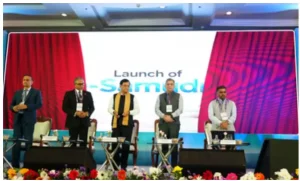
- It is a comprehensive digital platform to integrate services for maritime stakeholders.
- Nodal Ministry: Ministry of Ports, Shipping, and Waterways
- Aim: To transform maritime governance by bringing services for seafarers, shipping companies, ports and other stakeholders under a single digital window.
- It shifts maritime administration from office-based services to an integrated digital system, enabling Digital-First and Faceless Governance.
- Services offered: It allows seafarers onboard vessels to access government services easily from anywhere. It offers end-to-end workflows, online payments, real-time tracking and digitally issued certificates.
Amboseli National Park
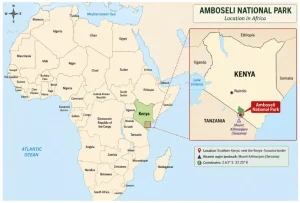
Context: Recently, 15 elephants died of suspected cyanide poisoning in Kenya’s Amboseli National Park after consuming tomatoes.
About Amboseli National Park
- History & Name: Amboseli has been home to wildlife and Maasai pastoralists for centuries.
- Maasai are an indigenous ethnic community of East Africa, mainly living in Kenya and Tanzania.
- Location: It is located in southern Kenya near the Kenya-Tanzania border.
- Landscape: It comprises open savannah grasslands, wetlands, woodlands and seasonal lakes.
- Wildlife: The park is renowned for its large herds of African elephants.
- It also supports lions, cheetahs, giraffes, zebras, wildebeest and numerous bird species.
- Key Feature: The park’s wetlands are mainly fed by underground water from Mount Kilimanjaro, supporting wildlife during dry periods.
About Cyanide Poisoning
- Cyanides: Cyanides refer to any compounds that comprise the carbon-nitrogen bond in their structure.
- It is a fast-acting, deadly chemical and a commonly known poison.
- Properties:
- It can exist as a colorless gas, such as cyanogen chloride or hydrogen cyanide.
- Alternatively, it can be in a crystal form, such as potassium cyanide or sodium cyanide.
- Applications of Cyanide
- Mining: Sodium cyanide is used in the extraction of gold and silver through the cyanidation process.
- Electroplating: Used in some industrial processes for metal plating.
- Chemical industry: Used as a raw material in manufacturing certain chemicals, plastics and synthetic materials.
- Metallurgy: Used in certain processes involving metal treatment and recovery.
India’s first invasive-fish removal programme
Context: Bombay Natural History Society (BNHS) has launched India’s first community-driven removal and native-restocking programme for the invasive species in Ujani Reservoir, Maharashtra.
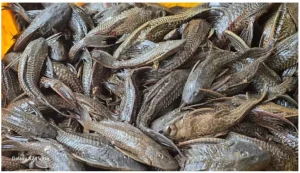
- Ujani Reservoir is facing an ecological crisis due to invasive alien fish species such as suckermouth catfish, Tilapia and African catfish.
About Invasive alien species
- Invasive alien species are animals, plants or other organisms that are introduced by humans, either intentionally or accidentally, into places outside of their natural range.
- They negatively impact native biodiversity, ecosystem services or human economy and well-being.
Major Invasive Fish Species
1. Suckermouth Catfish
- Scientific group: Loricariidae (armoured catfishes)
- It is sometimes referred to locally as “Helicopter Fish” because of its distinctive large dorsal fin and body shape.
- Native to: It is a freshwater fish native to South America, particularly the Amazon and other South American river systems.
- Introduction in India: Mainly through the aquarium trade.
- Features: Has a suckermouth adapted to attach to surfaces and an armoured body.
- Threats:
- Competes with native bottom-feeding fish.
- Feeds on fish eggs.
- Burrows into riverbanks, causing erosion.
- Can damage earthen embankments and dam structures.
UPSC Online Classes
2. Tilapia
- Scientific group: Oreochromis spp.
- Native to: Africa and the Middle East.
- Introduction in India: Introduced mainly for aquaculture and fisheries.
- Threats:
- Competes with native fish for food and habitat.
- Can dominate freshwater ecosystems.
- May reduce populations of native fish through competition and predation.
3. African Catfish
- Scientific name: Clarias gariepinus
- Native to: Africa.
- Introduction in India: Mainly linked to aquaculture/fish farming.
- Threats:
- Predates on native fish and other aquatic organisms.
- Competes with native catfish.
- Can disturb aquatic food chains.
- Its farming has been prohibited in India because of its ecological risks, although illegal culture continues in some areas.
About Ujani Reservoir
- Location: Maharashtra, India, on the Bhima River.
- Type: A major multipurpose reservoir created by the Ujani Dam.
- Fisheries: Traditionally known for its rich freshwater fish resources.
- Importance: Supports irrigation, fisheries, water supply and local livelihoods.
|
Typhoon Dolphin
Context: Typhoon Dolphin made landfall near Yuhuan in Zhejiang Province of eastern China.
About Typhoon Dolphin
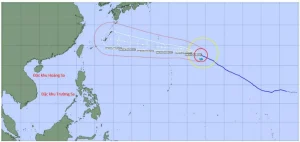
- It is a powerful tropical cyclone in the western North Pacific.
- Name: “Dolphin” is the name assigned to the tropical cyclone under the Western North Pacific cyclone-naming system.
- The name has been contributed by Hong Kong.
- Names are maintained through a regional system coordinated by the World Meteorological Organization.
- Intensity: It had maximum sustained winds of about 151 km/h at landfall, making it the strongest tropical cyclone to hit China in 2026.
- Development: The 2026 Typhoon Dolphin developed over the Western North Pacific, initially as a tropical system east of the Philippines/Japan region.
- It strengthened over warm tropical ocean waters, where high sea-surface temperatures and favourable atmospheric conditions supported intensification.
- It subsequently moved westward and affected Taiwan and eastern China and made landfall in Zhejiang province.
About Typhoon
- Typhoons are tropical cyclones that form in the western Pacific Ocean.
- If such a phenomenon occurs in the eastern Pacific, it is called a hurricane.
Factors necessary for the formation of a typhoon
- Warm Sea Surface Temperature: Sea surface temperature generally needs to be above 26–27°C.
- Warm water increases evaporation and moisture supply, promoting cloud formation and releasing latent heat that strengthens the typhoon.
- Low Vertical Wind Shear:: A low difference in wind speed and direction with height allows the storm’s convection to remain vertically organised.
- High Relative Humidity: High humidity in the lower and middle troposphere provides sufficient moisture for sustained cloud formation and prevents the system from weakening.
- Pre-existing Atmospheric Disturbance: A tropical wave or low-pressure disturbance provides the initial rotational and convective system around which a tropical typhoon can develop.
- Coriolis Force: The Coriolis force provides the necessary rotation to the developing typhoon.
- It is very weak at the Equator and increases towards the poles.
Click to Know UPSC Coaching Centres in India
Impact on the Indian Monsoon: Pacific typhoons frequently alter atmospheric circulation patterns across Asia:
- Monsoon Break: Strong typhoons in the Northwest Pacific often draw moisture and atmospheric energy eastward away from the Bay of Bengal.
- This can temporarily disrupt the cross-equatorial flow of the Southwest Monsoon, causing a “monsoon break” or rainfall deficits over central and northern India.
- Bay of Bengal Lows: Conversely, when Pacific typhoon remnants travel westward across Southeast Asia, their low-pressure systems often seed fresh depressions in the Bay of Bengal, aiding monsoon rainfall.
Glueball
Context: Recently, the Chinese-led team’s research has provided evidence of glueballs using the Beijing Electron Positron Collider II.
About Glueball

- It is a rare form of matter made entirely of force.
- Composition: It is formed from gluons, the particles that carry the strong nuclear force.
- Theory: It is predicted by Quantum Chromodynamics.
- It describes glueball as a strong interaction.
- Quantum Chromodynamics is the theory of strong interactions i.e. the force field that binds quarks in protons and neutrons.
- Formation: Unlike photons, gluons carry colour charge, so they can interact and bind with one another to potentially form a particle.
- Nature: Expected to be highly unstable and decay rapidly into other particles.
About Beijing Electron Positron Collider II
- It is a high-energy particle accelerator and collider in Beijing, China.
- Commissioned: It was commissioned in 2008.
- Purpose: Produces high-energy collisions between electrons and positrons to study fundamental particles and their interactions.
 10 Aug 2026