Subject: GS 3: Economy
Context: Recently, the Ministry of Labour & Employment is developing an EPFO-led contributory pension scheme under EPFO 3.0 reforms to expand social security coverage for formal, unorganised and gig workers through a flexible retirement savings framework.
UPSC Coaching Classes
About EPFO 3.0
- EPFO 3.0 is the next-generation digital modernisation initiative of the Employees’ Provident Fund Organisation (EPFO) aimed at delivering paperless, transparent and citizen-centric provident fund and pension services.
- Digital Transformation: It is built on the Centralised IT Enabled Services (CITES) platform, which has migrated all member records to a single national database, replacing the earlier decentralised system.
- Digital Service Delivery: Enables paperless PF withdrawals, online claim settlement, automatic PF transfers, and digital grievance resolution.
- Allows members to view EPF passbooks, interest credited, eligible withdrawal amounts, and respond to online queries during claim processing.
- Technology Integration: Integrates UPI and UPI-enabled ATMs for faster fund transfers to linked bank accounts.
- Supports Face Authentication Technology (FAT) through the UMANG App for UAN generation, activation, and authentication.
- Facilitates automatic PF account portability through Aadhaar-linked Universal Account Numbers (UANs) when employees change jobs.
- Ease of Access & Efficiency: Enhances the auto-claim settlement limit from ₹1 lakh to ₹5 lakh for faster processing of eligible claims.
- Reduces processing time, improves transparency, and enables anywhere-anytime service delivery through a centralised national database.
- Coverage & Future Vision: Serves EPF subscribers nationwide and lays the foundation for expanding social security coverage to gig, platform, and unorganised sector workers under future labour reforms.
|
Key Highlights

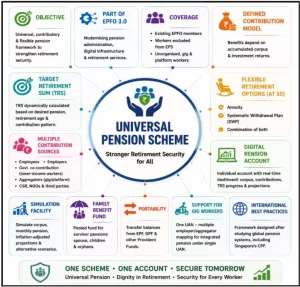
- The proposed scheme aims to create a universal, contributory and flexible pension framework to strengthen retirement security and expand social security coverage.
- Part of EPFO 3.0: The initiative forms part of the EPFO 3.0 reforms, which seek to modernise pension administration, digital infrastructure and retirement services.
- Coverage: The scheme is proposed to cover:
- Existing EPFO members.
- Workers excluded from the Employees’ Pension Scheme (EPS).
- Unorganised sector, gig and platform workers.
- Defined Contribution Model: The scheme is likely to adopt a defined contribution framework, where retirement benefits depend on the accumulated corpus and investment returns.
- Target Retirement Sum (TRS): Each member will have a Target Retirement Sum (TRS), dynamically calculated based on the desired pension amount, retirement age, and contribution pattern.
- Multiple Contribution Sources: Contributions may come from:
- Employees.
- Employers.
- Government co-contributions (for lower-income workers).
- Aggregators (for gig and platform workers).
- CSR, NGOs and third-party contributors.
- Flexible Retirement Options: At 55 years, members may choose how to utilise their retirement corpus through:
- Annuity.
- Systematic Withdrawal Plan (SWP).
- A combination of both.
- Digital Pension Account: Every member will have an individual pension account with a real-time dashboard displaying corpus, contributions, TRS progress, and retirement projections.
- Simulation Facility: The system will enable members to simulate retirement corpus, monthly pension, inflation-adjusted projections, and alternative contribution scenarios.
- Family Benefit Fund: The proposal includes a pooled Family Benefit Fund to provide survivor pensions for spouses, children, and orphans.
- Portability: Members of EPF, GPF and other Provident Funds may be allowed to transfer balances into the new pension scheme.
- Support for Gig Workers: The scheme proposes one UAN–multiple employer/aggregator mapping, enabling workers with multiple employers to receive integrated pension contributions under a single Universal Account Number (UAN).
- International Best Practices: The framework is being designed after studying international pension systems, including Singapore’s Central Provident Fund (CPF).
About Employees’ Provident Fund Organisation (EPFO)
- EPFO was established in 1952 under the Employees’ Provident Funds and Miscellaneous Provisions Act, 1952.
- Administrative Ministry: It functions under the Ministry of Labour & Employment.
- Nature: It is a statutory organisation and one of the world’s largest social security organisations.
- Objective: To provide retirement income security through provident fund, pension, and insurance benefits.
- Major Schemes Administered:
- Employees’ Provident Fund Scheme (EPF), 1952.
- Employees’ Pension Scheme (EPS), 1995.
- Employees’ Deposit Linked Insurance Scheme (EDLI), 1976.
Click to Know UPSC OnlyIAS Coaching Centres
EPFO vs NPS
| Parameter |
EPFO (Proposed Pension Scheme) |
National Pension System (NPS) |
| Nature |
- Defined contribution with government-backed returns
|
- Defined contribution with market-linked returns
|
| Retirement Benefit |
- Flexible annuity/Systematic Withdrawal Plan (SWP)
|
- Primarily annuity-based with partial lump-sum withdrawal
|
| Investment Risk |
- Low, largely government-backed
|
- Market-linked investment risk
|
| Target Corpus |
- Based on Target Retirement Sum (TRS)
|
- Based on individual investment accumulation
|
| Coverage |
- Formal, unorganised, gig and platform workers (proposed)
|
- Open to all Indian citizens on a voluntary basis (with mandatory coverage for certain government employees)
|
| Administered By |
- Employees’ Provident Fund Organisation (EPFO)
|
- Pension Fund Regulatory and Development Authority (PFRDA)
|