Subject: GS 3: Economy
Context: The Reserve Bank of India (RBI) has issued the Guidance on Regulatory Expectations for Data Governance for banks and Regulated Entities (REs).
About the RBI’s Data Governance Guidance Framework
- Objective: To strengthen data governance, improve data quality, enhance operational resilience and ensure compliance with the Digital Personal Data Protection (DPDP) Act, 2023 and other applicable laws.
Best Online Coaching for UPSC
About Data Governance
- It is the framework of policies, processes, standards, roles, and controls that ensures data is managed securely, accurately, consistently, and responsibly throughout its lifecycle.
|
- Applicability: Applicable to all Regulated Entities (REs) supervised by the RBI, including banks and other regulated financial institutions.
- Risk-Based Approach: Requires each RE to adopt a Data Governance Framework (DGF) proportionate to its size, complexity, business model and technological infrastructure.
- A Regulated Entity (RE) is any financial institution that falls under the direct supervision, monitoring, and regulatory purview of the RBI.
- Comprehensive Coverage: Covers the entire data lifecycle, including data collection, storage, processing, sharing, retention, archival and secure disposal.
- Annual Review: Mandates annual review of the Data Governance Framework, or earlier whenever significant changes occur.
Key Provisions of the Framework
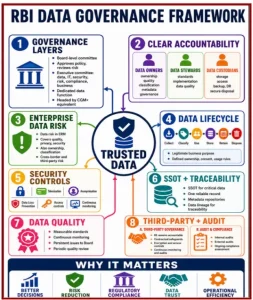
- Governance Structure: Requires a Board-level Data Governance Committee (or an existing Board committee) to oversee implementation, approve policies, review governance practices and monitor data-related risks.
- Executive Oversight: Mandates an Executive-level Data Governance Committee comprising representatives from data management, information technology, information security, risk management, compliance and business functions.
- Dedicated Data Function: Requires a dedicated data management function headed by a senior executive not below the rank of Chief General Manager (CGM) or equivalent.
 Defined Accountability: Clearly assigns responsibilities to:
-
- Data Owners: Data ownership, quality, classification, metadata and governance.
- Data Stewards: Implementation of governance standards and maintenance of data quality.
- Data Custodians: Technical controls, storage, access management, backup, disaster recovery and secure disposal.
- Enterprise Data Risk Management: Integrates data risks into the Enterprise Risk Management (ERM) framework, covering data quality, privacy, security, ownership, classification, cross-border processing and third-party risks.
- Data Lifecycle Management: Requires data to be collected only for legitimate business purposes, with clearly defined ownership, consent, classification and usage requirements throughout its lifecycle.
- Security Controls: Mandates safeguards such as encryption, tokenisation, anonymisation and data loss prevention mechanisms.
- Single Source of Truth (SSOT): Requires establishment of a Single Source of Truth (SSOT) for all critical data elements.
- Metadata and Data Lineage: Mandates maintenance of metadata repositories and data lineage records to ensure traceability.
- Data Quality Management: Requires measurable data quality standards, continuous monitoring and periodic reporting of persistent quality issues to the Board.
- Third-Party Data Governance: Holds REs accountable for customer data shared with service providers or group entities, requiring contractual safeguards, encryption, access controls, continuous monitoring and periodic audits.
- Audit and Compliance: Requires continuous assessment through periodic internal and external audits.
Need for the Framework
- Rapid Digitalisation: Growing digital banking and technology-driven financial services have made data a critical strategic asset.
- Managing Data Risks: Weak data governance can lead to financial, operational, legal, compliance and reputational risks.
- Regulatory Compliance: Ensures compliance with the Digital Personal Data Protection (DPDP) Act, 2023 and other regulatory requirements.
- Enhancing Operational Resilience: Strengthens secure data management and business continuity.
- Supporting Better Decision-Making: High-quality data improves risk management, supervision, regulatory reporting and business decisions.
About the Digital Personal Data Protection (DPDP) Act, 2023
- Objective: To regulate the processing of digital personal data while balancing the right to privacy with the need to process data for lawful purposes.
- Applicability: Applies to the processing of digital personal data within India and, in certain cases, outside India where goods or services are offered to individuals in India.
- Key Features:
-
- Consent-based processing of personal data.
- Rights of Data Principals, including access, correction and grievance redressal.
- Obligations of Data Fiduciaries regarding lawful processing, security safeguards and breach reporting.
- Establishment of the Data Protection Board of India for enforcement and adjudication.
|
Click to Know UPSC Coaching Centres in India
Conclusion
The RBI’s Data Governance Guidance Framework is a significant step towards a secure, accountable and resilient data governance ecosystem. By strengthening data quality, privacy, governance and risk management, it will enhance operational resilience, regulatory compliance, customer trust and the stability of India’s digital banking ecosystem.
 17 Jul 2026