Subject: GS 3: Science & Technology
Context: Recently, NITI Aayog has released the report ‘Roadmap for Building India as a Leading BioEconomy Powerhouse by 2035’, proposing a ₹50,000 crore BioEconomy Growth Fund and mission-mode reforms to transform India into a global biotechnology leader.
UPSC Online Preparation
Key Highlights of the Roadmap
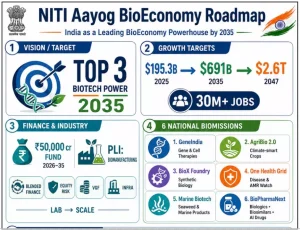
- Vision: To position India among the world’s top three biotechnology powers by 2035.
- Targets:
- It targets expanding India’s bioeconomy from US$195.3 billion in 2025 to US$691 billion by 2035 and US$2.6 trillion by 2047.
- Over 30 million high-value jobs to be generated.
- Financial and Industrial Support: The report proposes the creation of a ₹50,000 crore BioEconomy Growth Fund for the period 2026–2035 to bridge the funding gap between laboratory research and commercial-scale manufacturing.
- The report identifies the biotechnology sector’s “valley of death”—the critical gap between proof-of-concept research and commercial-scale manufacturing.
- The proposed fund will provide blended finance, equity-risk instruments, viability gap funding, and infrastructure support.
- It also recommends introducing a dedicated Production Linked Incentive (PLI) Scheme to accelerate domestic biomanufacturing and reduce import dependence.
- Six National BioMissions Proposed:
| Mission |
Focus Area |
| GeneIndia |
Affordable gene and cell therapies |
| AgriBio 2.0 |
Climate-resilient gene-edited crops, biological farm inputs |
| BioX Foundry |
Commercialising synthetic biology |
| One Health Grid |
Integrated surveillance of infectious diseases & AMR |
| Marine Biotechnology |
Seaweed cultivation, marine bio-products |
| BioPharmaNext |
Biologics, biosimilars, AI-enabled drug discovery |
- New Institutional Architecture proposed:
-
- Empowered Committee on National BioMissions
- National BioData Council (biological & health data governance)
- BioEconomy Investment and Policy Forum
- BioIP and Innovation Evaluation Agency
- Other Recommendations:
- Fast-track regulatory approval for cell/gene therapy, synthetic biology, AI-designed drugs
- Modernisation of the Central Drugs Standard Control Organisation (CDSCO)
- Five integrated bio-innovation clusters with shared manufacturing and HPC facilities under the National Supercomputing Mission
- Biotechnology to be treated as national infrastructure, on par with digital public infrastructure (DPI) and energy systems
PWOnlyIAS Extra Edge:
- About Bioeconomy:
- Bioeconomy refers to an economy that uses renewable biological resources, including plants, animals, microorganisms and biomass, to produce food, feed, bio-based products, bioenergy, chemicals and pharmaceuticals through biotechnology and sustainable biological processes.
- The Department of Biotechnology (DBT) defines bioeconomy as the economic value generated from the sustainable and innovative use of biological resources, biological knowledge and biotechnology-based products and services.
- Scope: It integrates biotechnology, agriculture, healthcare, industrial manufacturing, energy and environmental sustainability to promote economic growth while reducing dependence on fossil-based resources.
- Status of Bioeconomy:
- Global Market Size: The global bioeconomy is estimated to be valued at over US$4 trillion and is emerging as a major driver of sustainable and innovation-led economic growth.
- Status of India’s Bioeconomy:
- Rapid Expansion: India’s bioeconomy has expanded from US$10 billion in 2014 to US$195.3 billion in 2025, making it one of the fastest-growing biotechnology sectors globally.
- Future Growth: According to NITI Aayog’s Roadmap for Building India as a Leading BioEconomy Powerhouse by 2035, India’s bioeconomy is projected to reach US$691 billion by 2035 and US$2.6 trillion by 2047.
- Policy Support: The Government has launched the Biotechnology for Economy, Environment and Employment (BioE3) Policy to promote high-performance biomanufacturing, innovation and sustainable economic growth.
|
Click to Explore UPSC Offline Coaching
 17 Jul 2026