UPSC PYQs

Prelims, Mains & Optional PYQs

UPSC Notes

Comprehensive & Short Notes

Embodied AI: Features, Applications, Embodied AI vs Neuromorphic AI

21 Jul 2026

Embodied AI: Features, Applications, Embodied AI vs Neuromorphic AI

Subject: GS 3: Science & Technology

Context: Embodied AI has gained prominence with Boston Dynamics’ Spot robot integrating Google DeepMind’s Gemini Robotics-ER 1.6, enabling autonomous decision-making, spatial reasoning, and continuous learning in real-world environments.
UPSC Online Coaching

What is Embodied AI?

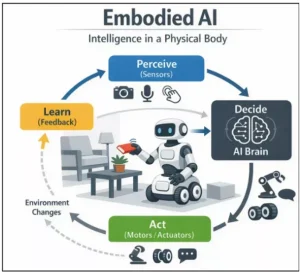
  • Embodied AI is a branch of Artificial Intelligence where intelligence is integrated with a physical body (robot), enabling it to perceive, interact, learn, and act in the real world through sensors, actuators, and continuous feedback.
  • Embodied AIUnlike traditional AI, intelligence emerges from the interaction between the brain, body, and environment, rather than software alone.
  • Market size: Embodied AI is projected to reach $23 billion by 2030

Key Features

  • Physical Embodiment: Embodied AI operates through physical systems such as robots, drones, autonomous vehicles, and humanoids, enabling AI to interact directly with the real-world environment rather than functioning solely in digital space.
  • Real-World Learning: It continuously learns and adapts through real-time interaction, improving its behaviour by responding to changing environmental conditions instead of relying only on pre-trained datasets.
  • Multimodal Perception: It integrates multiple sensors such as cameras, LiDAR, microphones, touch sensors, and actuators to perceive, interpret, and respond accurately to complex physical surroundings.
  • Autonomous Decision-Making: Embodied AI can independently perform perception, reasoning, planning, and execution of actions, enabling robots to accomplish tasks with minimal or no human intervention.
  • Distributed Intelligence: Intelligence is distributed across the brain (AI model), body (physical structure), and environment, allowing the robot to use both its physical design and environmental feedback for efficient problem-solving.

Embodied AI vs Neuromorphic AI

Embodied AI Neuromorphic AI
Focuses on where intelligence resides—interaction of brain, body, and environment. Focuses on how computation is performed, mimicking the human brain’s neural architecture.
Primarily a robotics and systems approach. Primarily a hardware and chip design approach.
Can run on conventional GPUs or CPUs. Uses spiking neural networks (SNNs) and neuromorphic chips.
Emphasises physical interaction with the environment. Emphasises energy-efficient computation.

Click to Know UPSC Offline Courses

Check Out UPSC CSE Books

Visit PW Store

online store 1

Embodied AI: Features, Applications, Embodied AI vs Neuromorphic AI

Explore UPSC Foundation Batches

Need help preparing for UPSC or State PSCs?

Connect with our experts to get free counselling & start preparing

Free Counselling for UPSC Aspirants

Connect with our experts and take the right next step.

Expert Guidance
Personalized Strategy
100% Free

Book Your Free Session

NEED ASSISTANCE?

Request a Callback

Our counsellor will connect with you and help you choose the right course and centre.

  • Expert Guidance
  • Course & Fee Information
  • Quick Callback Support

Request a Callback

Books
UPSC PYQs
UPSC Notes
Current Affairs
Quick Revise Now !
AVAILABLE FOR DOWNLOAD SOON
UDAAN PRELIMS WALLAH
Comprehensive coverage with a concise format
Integration of PYQ within the booklet
Designed as per recent trends of Prelims questions
हिंदी में भी उपलब्ध
Quick Revise Now !
UDAAN PRELIMS WALLAH
Comprehensive coverage with a concise format
Integration of PYQ within the booklet
Designed as per recent trends of Prelims questions
हिंदी में भी उपलब्ध

<div class="new-fform">


    </div>

    Subscribe our Newsletter
    Sign up now for our exclusive newsletter and be the first to know about our latest Initiatives, Quality Content, and much more.
    *Promise! We won't spam you.
    Yes! I want to Subscribe.