Subject: GS 3: Science & Technology
Context: Recently, Magnetic Levitation (Maglev) technology uses strong magnetic fields to levitate and propel trains without physical contact with the tracks, enabling high-speed, low-maintenance, and smooth transportation.
Best Online Coaching for UPSC
About Maglev
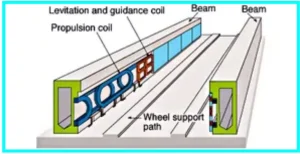
- Maglev (Magnetic Levitation) is a transport technology in which trains float above the guideway and are propelled using electromagnetic forces instead of wheels.
- Working Principle: The technology utilises the electromagnetic force, which is significantly stronger than gravity, to lift, propel, and stabilise the train.
- Advantages: As there is no rolling friction, Maglev trains can achieve very high speeds, provide a smoother ride, and are less affected by rain or snow.
How are Maglev Trains Lifted?
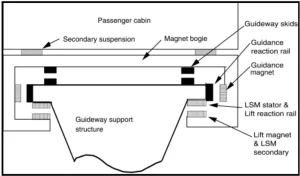
- Electromagnetic Suspension (EMS): Electromagnets mounted beneath the train attract the ferromagnetic guideway, lifting the train approximately 10 mm above the track.
- Control System: Sensors continuously adjust the magnetic force to maintain a constant levitation gap.
- Advantage: The train can levitate even while stationary.
- Electrodynamic Suspension (EDS): Superconducting magnets on the train induce electric currents in coils embedded in the guideway, generating a repulsive magnetic force that lifts the train.
- Operating Requirement: Levitation begins only after the train reaches about 100 km/h, requiring auxiliary wheels during low-speed movement.
- Performance: The train typically levitates around 100 mm above the guideway and can attain higher operating speeds than EMS systems.
How are Maglev Trains Propelled?
- Linear Motor Technology: Alternating Current (AC) flowing through coils along the guideway creates a moving magnetic field.
- Forward Motion: The train’s magnets are attracted towards the magnetic poles ahead and repelled by those behind, producing continuous forward movement.
- Speed Control: Increasing the frequency of AC increases the train’s speed, while reversing the magnetic field slows or stops the train.
- Regenerative Braking: During braking, part of the train’s kinetic energy can be converted into electrical energy and returned to the grid.
Types of Braking and Safety Systems
- Magnetic Guidance: Side-mounted magnets automatically keep the train centred on the guideway.
- Emergency Braking: The system uses auxiliary wheel brakes and friction braking pads when magnetic braking is insufficient.
Comparison between Maglev Train and Bullet Train
| Parameter |
Maglev Train |
Bullet Train (High-Speed Rail) |
| Technology |
- Uses magnetic levitation to float above the track, eliminating wheel-rail contact.
|
- Uses conventional steel wheels on steel rails.
|
| Speed |
- Can attain speeds of 500–600 km/h or higher.
|
- Generally operates at speeds of 250–350 km/h.
|
| Infrastructure |
- Requires dedicated maglev guideways and specialised infrastructure.
|
- Uses dedicated high-speed rail tracks, with relatively conventional rail technology.
|
| Operating Cost & Maintenance |
- Involves higher capital costs but lower mechanical wear due to the absence of physical contact.
|
- Requires lower initial investment but higher maintenance because of wheel-rail friction.
|
| Global Adoption |
- It has limited commercial deployment (e.g., China, Japan under development).
|
- It is widely adopted across countries such as Japan, China, France, Spain, and Italy.
|
Advantages of Maglev Technology
- Very High Speed: Maglev trains can operate at speeds exceeding 400 km/h, while some systems such as Japan’s SCMAGLEV achieved 603 km/h.
- Low Friction: The absence of wheel-track contact significantly reduces mechanical wear and maintenance.
- Energy Efficiency: Reduced friction improves energy efficiency, particularly at moderate operating speeds.
- Passenger Comfort: Eliminates vibrations associated with conventional rail systems, ensuring a smooth and quiet ride.
- Weather Resilience: Performance is less affected by rain, snow, or track wear.
Limitations
- High Capital Cost: Construction of dedicated guideways, magnets, and control systems requires substantial investment.
- Dedicated Infrastructure: Maglev trains cannot operate on existing railway tracks and require exclusive infrastructure.
- Aerodynamic Drag: At speeds above 300 km/h, air resistance becomes the dominant source of energy loss.
- Limited Commercial Viability: High passenger demand is essential to recover the large infrastructure costs.
UPSC Online Coaching
Applications Beyond Railways
- Industrial Machinery: Used in high-speed turbines, compressors, and magnetic bearings to reduce mechanical wear.
- Aircraft Carriers: Linear motor technology is used to launch aircraft from naval carriers.
- Manufacturing: Enables high-precision movement in semiconductor fabrication, CNC machining, food and pharmaceutical packaging, and DNA sequencing.
- Scientific Research: Magnetic levitation is used to suspend biological samples, liquids, molten metals, and other materials for experiments.
Global Status
- China: Operates the Shanghai Maglev, one of the world’s fastest commercial high-speed rail systems.
- Japan: The SCMAGLEV system achieved a world record speed of 603 km/h during testing in 2015 using Electrodynamic Suspension (EDS) technology.
Challenges for India
- High Infrastructure Costs: Large capital investment is required for dedicated guideways and electromagnetic systems.
- Technology Dependence: India has limited indigenous expertise in Maglev technologies.
- Economic Feasibility: High passenger density is necessary to justify the investment.
- Land Acquisition: Developing new corridors requires substantial land and environmental clearances.
Way Forward
- Promote Indigenous Research: Strengthen R&D in magnetic propulsion, superconducting materials, and linear motor technologies.
- Develop Pilot Projects: Implement demonstration corridors to evaluate technical and economic feasibility.
- Encourage Public-Private Partnerships (PPP): Mobilise private investment for technology development and infrastructure.
- Integrate with National Transport Planning: Deploy Maglev on high-demand intercity corridors where conventional high-speed rail may face capacity constraints.
Click to Know UPSC Coaching Centres in India
Conclusion
Maglev technology represents the next generation of high-speed rail transport, offering faster, cleaner, and more efficient mobility. Although its widespread adoption is constrained by high infrastructure costs, continued technological innovation, policy support, and strategic investments can make Maglev an important component of future sustainable transportation systems.
 22 Jul 2026