Subject: GS 1: Modern History
Context: On the anniversaries of the Quit India Movement and Kakori Train Action, national leaders paid tribute to the freedom fighters and recalled their courage, sacrifice and contribution to India’s independence struggle.
UPSC Online Coaching
About Quit India Movement
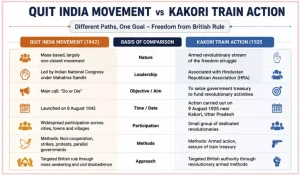
- Background: The Quit India Movement was launched under Mahatma Gandhi’s leadership on 8 August 1942 at the Bombay session of the All India Congress Committee, demanding an immediate end to British rule.
- Central Slogan: Gandhi gave the historic call of “Do or Die”, urging Indians to make a decisive effort for independence.
- August Revolution: The movement is also known as the August Revolution because of its launch in August 1942 and its widespread impact.
- Immediate Trigger: The failure of the Cripps Mission to offer a satisfactory constitutional arrangement during the Second World War intensified Indian dissatisfaction.
- Nature: The movement witnessed mass participation, strikes, protests, underground activities and parallel governments, making it a major mass movement of the freedom struggle.
- British Response: The British responded with mass arrests, censorship and repression. Major Congress leaders, including Mahatma Gandhi, Jawaharlal Nehru, Sardar Vallabhbhai Patel and Maulana Abul Kalam Azad, were arrested.
- Significance: Despite repression, the movement demonstrated the massive popular demand for independence and showed that British rule could no longer continue without widespread resistance.
About Kakori Train Action
- Background: The Kakori Train Action took place on 9 August 1925 near Kakori, Uttar Pradesh, and was carried out by revolutionaries associated with the Hindustan Republican Association.
- Objective: The revolutionaries targeted government funds being transported by train to finance the revolutionary movement.
- Major Revolutionaries: The action was associated with Ram Prasad Bismil, Ashfaqulla Khan, Chandrashekhar Azad, Rajendra Lahiri and their comrades.
- Martyrdom: Ram Prasad Bismil, Ashfaqulla Khan, Rajendra Lahiri and Roshan Singh were executed, becoming enduring symbols of revolutionary nationalism and sacrifice.

Contemporary Relevance
- National Interest: Their legacy reinforces national unity and integrity, reflected in Article 51A(c), which calls upon citizens to uphold the sovereignty, unity and integrity of India.
- Self-Reliance: The freedom struggle’s emphasis on Swadeshi and self-reliance resonates with Atmanirbhar Bharat and the Directive Principles under Article 39(b), which promote the distribution of material resources for the common good.
- Nation-Building: The sacrifices of freedom fighters inspire patriotism, public service and responsible citizenship, reflected in Article 51A through duties relating to national unity, harmony and excellence.
- National Heritage: Remembering the freedom struggle promotes respect for India’s composite cultural heritage, as reflected in Article 51A(f).
- Scientific and Modern India: The transition from the freedom struggle to nation-building also aligns with Article 51A(h), which encourages the scientific temper, humanism and spirit of inquiry and reform.
Click to Know UPSC Offline Courses
Conclusion
The Quit India Movement and Kakori Train Action represented distinct yet complementary strands of India’s freedom struggle. Their enduring legacy lies in courage, sacrifice, nationalism, self-reliance and commitment to nation-building.