Discontinuing ‘100% Pure’ Foods
Context: FSSAI has directed food businesses to discontinue absolute claims such as “100% Pure” and “100% Natural” on packaged food labels to prevent misleading consumers.
UPSC Online Courses
Why ‘100% Pure’ Foods Came Under Scrutiny?
- The Food Safety and Standards Authority of India (FSSAI) has clarified that terms such as “100% Pure”, “100% Natural”, “100% Organic” and “100% Purity Guaranteed” are not defined under Indian food regulations and may mislead consumers.
- Reasons for FSSAI’s Action
-
- Misleading Marketing Claims: Absolute claims create an impression of complete purity or superior nutritional quality, which cannot be scientifically or legally verified for most packaged foods.
- Food Processing Reality: Most packaged foods undergo processing such as washing, pasteurisation, filtration, homogenisation or packaging, making claims of being “100% natural” scientifically difficult to justify.
- Consumer Protection: The move aims to prevent healthwashing, where marketing terms influence purchasing decisions despite not reflecting the actual nutritional value of the product.
Regulatory Framework
- Food Safety and Standards Act, 2006: Empowers FSSAI to regulate food safety, labelling, advertising and consumer protection.
- FSS (Advertising and Claims) Regulations, 2018: Mandate that all food claims must be truthful, unambiguous, scientifically substantiated and not misleading.
- FSSAI stated that the “ 100 % Claim” term is undefined, ambiguous, and creates false impressions of absolute purity or superiority
- Consumer Protection Act, 2019: Prohibits misleading advertisements and unfair trade practices, safeguarding consumers against deceptive marketing.
Impact of Discontinuing 100% Claims
- Improved Transparency: Encourages consumers to rely on ingredient lists and nutrition facts instead of promotional claims.
- Public Health: Supports informed dietary choices and discourages misleading health claims that may contribute to unhealthy consumption patterns.
Indian Peacock at UNOG
Context: India recently donated five young Indian peacocks, including a rare white-feathered male, to the United Nations Office at Geneva (UNOG).
About the Peacock Donation
- Symbolic Donation: The five birds comprise four blue peafowl and one white-feathered male, reflecting the blue-and-white colours associated with the United Nations.
- This was the second such donation by India, following a breeding pair sent to UNOG in 1981.
About Indian Peacock
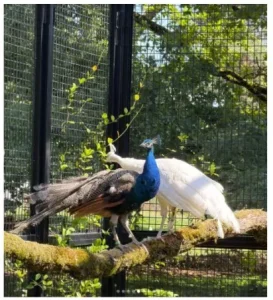
- The Indian Peacock (Pavo cristatus), also called the Common Peafowl, is India’s national bird, known for its striking plumage and deep cultural significance.
- Key Features
- Habitat: It inhabits dry deciduous forests, grasslands, orchards and cultivated areas, including landscapes near human settlements.
- Diet: It is omnivorous, feeding on seeds, fruits, insects, small reptiles and amphibians.
- Distribution: It is native to the Indian subcontinent and is widely distributed across India and neighbouring parts of South Asia.
- Physical Features: Males possess an elaborate train of elongated upper tail-coverts with distinctive eyespots, while females are comparatively duller and lack the long train.
- Protection Status:
- IUCN Status: Least Concern (LC)
- Wildlife Protection Act, 1972: Schedule I
- Cultural Significance
- National Bird: The Indian Peacock was declared India’s National Bird in 1963.
- Religious and Cultural Traditions: The peacock is associated with Lord Kartikeya as his vahana and with Lord Krishna, who is traditionally depicted wearing a peacock feather.
- Art and Architecture: Peacock motifs feature prominently in Indian textiles, paintings, decorative arts and architecture, reflecting their enduring cultural presence.
Sharks to Improve Hurricane Predictions
Context: Researchers are using sharks fitted with sensors to collect ocean data that could improve hurricane intensity predictions.
Researchers are testing sharks as mobile ocean-data observers to improve forecasts of hurricane intensity before landfall.
About CTD Tags
- A CTD Tag (often called a CTD Satellite Relay Data Logger or CTD-SRDL) is a miniaturized, non-invasive electronic tracking device attached to marine animals like seals, sea lions, and whales.
- These tags measure:
- Conductivity (linked to salinity)
- Temperature
- Depth
- As sharks swim and dive, the tags collect real-time ocean data.
- Working Mechanism
- Ocean Data Collection: The tags measure electrical conductivity, which is closely related to salinity, along with temperature and depth.
- Sharks naturally move through different parts of the ocean, allowing sensors to collect observations across the water column.
- Satellite Transmission: When tagged sharks reach the surface, the sensors communicate with orbiting satellite receivers.
- The collected observations can therefore be transmitted for use in oceanographic, atmospheric and climate models.
- Hurricane-Relevant Data: Researchers are particularly interested in the heat content of the ocean’s upper mixed layer.
- A warmer mixed layer provides more heat energy to hurricanes and can contribute to greater storm intensity.
Shark -borne sensors provide near-real-time ocean observations from data-scarce areas, complementing conventional measurements and improving understanding of ocean–atmosphere interactions.
UPSC Online Classes
Recycling Waste Milk Packets
Context: Researchers at the Indian Institute of Science (IISc) in Bengaluru have developed a method to recycle discarded milk packets into durable, outdoor-use materials.
The Scale of the Problem
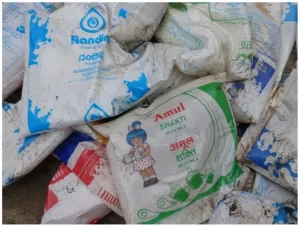
- India uses an estimated 100–120 million single-use milk packets daily, accounting for nearly half of all milk packaging material in the country.
- Milk packets pose a unique waste challenge:
-
- They are often left in bins or on roadsides for extended periods rather than being picked up quickly (unlike plastic bottles, which are more valuable to ragpickers).
- The dark inner layer used to block UV/visible light (to extend shelf life) makes them unattractive to recycling companies.
How Does The Technology Work?
- Polyethylene from milk packets is combined with recycled polypropylene (used in oil/shampoo containers).
- Since the two plastics differ at the molecular level, special molecules called “vitrimers” are used to bind them into a new, structurally strong composite material.
Applications
- The resulting material is strong enough for outdoor use.
- Researchers have successfully 3D-printed podiums — one has been supplied to IISc for testing.
- Other potential products include outdoor furniture like benches.
Click to Know UPSC Coaching Centres in India
Benefits of Recycled Multi-Layer Plastics
- Durability: The recycled material can be used to create durable building materials.
- Faster Construction: It can enable faster construction compared with conventional methods.
- Lower Water Use: It can reduce the water used in construction compared with conventional brick-and-mortar construction.
- Waste Utilisation: It provides an application for multi-layer plastics that are otherwise difficult to recycle.
 11 Aug 2026