On Birsa Munda’s 126th death anniversary (9th June), tribal groups in Jharkhand pledged to protect his legacy.
- This happens amid rising debates over “delisting”—a demand to remove tribal converts to Christianity or Islam from the Scheduled Tribes list.
UPSC Online Coaching
About Birsa Munda
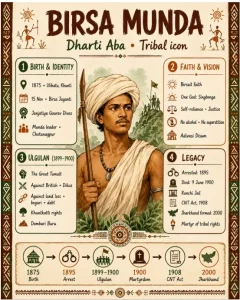
- Birth: He was born in 1875 in the village of Ulihatu, in the Mundari princely state of Khunti, and grew up in a time when the Munda people were facing increasing exploitation and displacement by British colonial rule and Hindu landlords.
- Today, Khunti is an administrative district in Jharkhand, known for preserving its unique tribal governance and customary land rights.
- His birth anniversary falls on 15th November, which is celebrated as ‘Birsa Munda Jayanti’.
- A Munda Leader: Birsa Munda was a tribal leader and religious reformer who belonged to the Munda tribe of Chotanagpur, a region in present-day Jharkhand and Odisha.
- Founded the faith of Birsait: Blend of animism and indigenous beliefs which emphasised the worship of a single god.
- Legacy:
- State of Jharkhand was created on his birth anniversary in 2000
- Honorific Titles: His followers call him “Dharti Aba” (Father of the Earth) and “Bhagwan” (God) because they saw him as a savior.
- The Vision: He fought for tribal dignity, freedom, and indigenous self-rule, which he called “Adivasi disum”.
- National Day: His birthday is celebrated nationally as Janjatiya Gaurav Divas (Tribal Pride Day).
- Significant Movements:
- Mundaism: In the late 19th century, Birsa Munda founded a new religious movement known as “Mundaism” or “Kisangism” or “Birsait faith”.
- Aim: To revive traditional Munda customs and beliefs and unite the Munda people against their oppressors.
- Emphasis On: Birsa’s teachings emphasized the importance of self-reliance, social justice, and resistance against oppression.
- Preachings: He preached that the Munda people should return to their traditional values and reject the influence of both British colonialism, missionaries.
- The Ulgulan Movement (The Great Tumult) – Birsa Munda: (UPSC CSE Prelims- 2020 & 1997)
- The Ulgulan Movement (1899–1900), meaning “The Great Tumult”, was led by Birsa Munda in the Chotanagpur region against colonial exploitation and the erosion of tribal rights.
- The movement opposed the British, who introduced land laws that weakened tribal control; the Dikus (outsiders), including landlords and moneylenders who exploited tribals through debt and forced labour (begari); and missionaries, who were perceived as interfering with traditional tribal customs.
- Causes of the Movement: The major cause was the disruption of the Khuntkatti system of the Munda tribe, a traditional system of joint village land ownership by original settlers.
- British land policies converted tribal lands into private property, enabling outsiders to acquire them. This resulted in land alienation, economic exploitation, and loss of traditional authority.
- Tribals faced further hardship due to high-interest debts, revenue demands, and forced labour, creating widespread resentment.
- Major Events: The movement reached its peak at Dombari Buru Hill in 1899–1900, where British forces fired upon a gathering of Birsa’s followers.
- The incident became a significant example of colonial suppression of tribal resistance.
- Birsa Munda was later arrested and died in Ranchi Jail on 9 June 1900.
- Legal Legacy- Chotanagpur Tenancy Act, 1908: The revolt contributed to the enactment of the Chotanagpur Tenancy (CNT) Act, 1908.
- The Act restricted the transfer of tribal land to non-tribals and protected customary tribal rights over land, water, and forests.
- It also recognised the Khuntkatti system and introduced the Mundari Khuntkattidar category for original Munda landholders.
- Significance: The Ulgulan Movement became a landmark in the history of tribal resistance against colonial rule.
- It strengthened the demand for tribal identity, autonomy, and protection of customary rights.
- Birsa Munda’s legacy also influenced the later Jharkhand movement for a separate tribal-majority state.
- Spiritual Reform- The Birsait Faith: Birsa left missionary schools after disagreements over their views on tribal culture. He then started preaching his own spiritual path, called the Birsait faith.
- Core Principles: It urged tribal members to leave behind superstitions, stop animal sacrifices, give up alcohol, and worship a single supreme creator named Singbonga.
- Social Clean-up: He taught that Adivasi identity comes from ancestry and community, not any outside religion.
- Famous Slogan: “Abua Raj Ete Jana, Maharani Raj Tundu Jana”, meaning “Let our rule be established and the Queen’s rule end.”
- Death: The British arrested Birsa in 1895 and he died in prison in 1900.
- His death sparked violent protests and he became a martyr for tribal activism against the British.
Click to Know UPSC Offline Courses
Government Initiatives Promoting Tribal Histories and Cultures
| Initiative |
Objective |
Key Features |
| Adi Sanskriti Project |
Digital learning of tribal artforms |
- Offers around 100 immersive courses on diverse tribal artforms
- It Includes nearly 5,000 curated documents on India’s socio-cultural tribal heritage.
|
| Adi Vaani (AI Translation) |
An AI-powered translation tool to preserve and promote tribal languages. |
- Provides real-time text and speech translation between Hindi, English, and tribal languages — Mundari, Bhili, Gondi, Santhali, Garo, and Kui
- Helps digitise and preserve folklore, oral traditions, and cultural knowledge.
|
| Tribal Digital Document Repository |
A digital archive of tribal-related research and resources. |
- Serves as a searchable repository of documents related to India’s tribal communities.
|
| Varnamala & Oral Literature |
Preservation of tribal linguistic and oral heritage. |
- Publication of local rhymes and stories in tribal languages
- Collection and documentation of oral tribal literature, folklore, and folktales for preservation.
|
| Aadi Mahotsav |
A national festival of tribal culture organised by the Government of India. |
- Celebrates tribal crafts, cuisine, commerce, culture, and art
- It provides a national platform to showcase tribal talent and entrepreneurship.
|
 11 Jun 2026