Supreme Court’s New Handbook on Gender Sensitivity
Context: The Supreme Court’s 2026 report on gender sensitivity seeks to make judicial language and courtroom practices more survivor-centric, compassionate and trauma-informed.
About the Report
- Title & Preparation: “Judgments and Gender: Sensitivity and Compassion in Writing Judgments”, the report was prepared by an expert committee headed by Justice Aniruddha Bose, former Supreme Court judge and Director of the National Judicial Academy.
UPSC Online Courses
Key Highlights of the Report
- Survivor-Centric Language: It recommends replacing terms such as “prosecutrix” with “victim”, “survivor” or “complainant” and avoiding language based on morality, chastity or honour.
- Trauma-Informed Adjudication: Judges are advised not to draw adverse conclusions merely from delayed reporting, absence of physical injuries, inconsistencies in testimony or a survivor’s demeanour.
- Compassionate Court Practices: It recommends in-camera trials, protection of survivors’ identities, fewer unnecessary adjournments and respectful treatment of witnesses.
- Inclusive Judicial Approach: The report encourages respectful terminology for diverse sexual orientations and gender identities and recognises the SOGIESC (Sexual Orientation, Gender Identity, Expression and Sex Characteristics) framework.
Landmark Supreme Court Judgments on Gender Sensitivity
- Aparna Bhat v. State of Madhya Pradesh (2021): The Court directed judges to avoid gender stereotypes and insensitive practices concerning survivors of sexual offences.
- State of Jharkhand v. Shailendra Kumar Rai (2022): The Court prohibited the two-finger test in rape examinations, holding it violative of survivors’ dignity, privacy and bodily integrity.
Moon Base Programme
Context: Recently, NASA invited ISRO to join its Moon Base programme during the ninth meeting of the India-U.S. Civil Space Joint Working Group held in Bengaluru, building on cooperation under the Artemis Accords.
About the Moon Base Programme
- Introduction: The programme envisages establishing humanity’s first outpost on another celestial body, creating infrastructure for sustained lunar exploration.
- Led by: The programme is spearheaded by NASA as part of its broader effort to advance U.S. leadership in lunar exploration and human spaceflight.
- Target: The programme targets the lunar South Pole, where a sustained human presence and supporting infrastructure are envisaged.
- Key Objectives
-
- Sustained Human Presence: The programme seeks to develop infrastructure that can support long-duration human operations on the Moon.
- Scientific Exploration: The lunar outpost is intended to enable continued scientific research and exploration of the lunar environment.
- Deep-Space Technology: The programme will help develop and demonstrate technologies required for future human spaceflight and deeper-space exploration.
NASA–ISRO Collaboration
- Lunar Exploration: NASA’s invitation to ISRO creates an opportunity for India to contribute to the future lunar exploration architecture, building on India-U.S. cooperation under the Artemis Accords.
- Earth Observation: The successful NISAR (NASA-ISRO Synthetic Aperture Radar) mission provides an important foundation for expanding bilateral cooperation in space science and Earth observation.
- Human Spaceflight: Both countries have discussed pursuing further cooperation in human spaceflight technologies, complementing their respective human-spaceflight programmes.
- Scientific Data & Space Governance: India and the U.S. have agreed to advance discussions on open scientific data sharing under the Artemis Accords and reaffirmed cooperation on the long-term sustainability of outer-space activities through the UN COPUOS framework.
UN Committee on the Peaceful Uses of Outer Space (COPUOS)
- UN COPUOS was established in 1959, it promotes the peaceful, safe and sustainable use of outer space.
- Its framework includes five key treaties:
-
- Outer Space Treaty (1967), Rescue Agreement (1968), Liability Convention (1972), Registration Convention (1975), and Moon Agreement (1979).
- The framework is supported by the UN Office for Outer Space Affairs (UNOOSA).
Dirac Medal
Context: The 2026 Dirac Medal has been awarded to Deepak Dhar, Bernard Derrida, Marc Mézard and Haim Sompolinsky for pioneering work that expanded statistical mechanics into fields including optimization, neuroscience and artificial intelligence.
About the Dirac Medal

- The Dirac Medal is an annual award recognizing outstanding contributions to theoretical physics.
- Origin: Established in 1985 by the International Centre for Theoretical Physics (ICTP) in Trieste, Italy.
- It is named after Paul Dirac, a pioneer of quantum mechanics.
- Eligibility and Prize: The medal recognizes major achievements in theoretical physics.
- The award includes a commemorative medal and US$5,000.
- It is not awarded to scientists who have already received the Nobel Prize, Fields Medal or Wolf Prize.
UPSC Online Classes
2026 Dirac Medal Awardees
- Prof. Dhar is an Indian National Science Academy (INSA) distinguished professor at ICTS, shares the honour with three other — Bernard Derrida, Marc Mezard and Haim Sompolinsky.
- He Made foundational contributions to statistical mechanics and complex systems, including the Abelian sandpile model.
- His work established key foundations of self-organized criticality.
Dhar’s Abelian sandpile model
The Abelian sandpile model became particularly important for understanding self-organized criticality , the phenomenon in which simple interactions among many components can spontaneously generate complex and seemingly unpredictable patterns.
Ozone Redistribution over North Bay of Bengal
Context: Scientists have detected an unusually high concentration of stratospheric ozone over the North Bay of Bengal, providing evidence of ozone redistribution over the Indian subtropical region during winter.
Key Findings
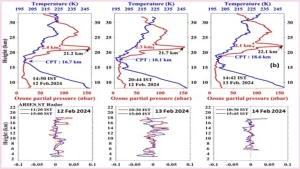
- Ozone enhancement: Ozone concentration at 21–23 km was significantly higher than normally observed over eastern India.
- Unusual altitude: The normal ozone maximum occurs around 25–30 km.
- Cause: Primarily due to the transport of ozone-rich air, followed by downward movement and compression of the air mass.
- Not photochemical: Detection during both day and night indicated that sunlight-driven photochemical processes were unlikely to be the main cause.
- Atmospheric dynamics: Persistent downward air motion in the lower stratosphere played a key role.
- NetRAD-ASMA Campaign: The study was conducted as part of Phase I of NetRAD-ASMA, a nationwide program to improve understanding of atmospheric processes through coordinated observations.
About Stratospheric Ozone
- Location: Stratospheric ozone is concentrated mainly in the lower and middle stratosphere, roughly 15–35 km above Earth’s surface.
- Formation: Ozone (O₃) is formed when UV radiation splits oxygen molecules (O₂) into oxygen atoms, which then combine with O₂ to form O₃.
- Major role: It absorbs most of the Sun’s harmful ultraviolet (UV-B and UV-C) radiation, protecting living organisms.
- Dynamic nature: Ozone is continuously formed, transported and destroyed; therefore, its distribution is influenced by atmospheric circulation.
- Temperature: The stratosphere generally warms with increasing altitude because ozone absorbs UV radiation.
- Contrast with tropospheric ozone:
- Stratospheric ozone: beneficial, protects against UV radiation.
- Tropospheric ozone: pollutant, harmful to human health and vegetation.
- Montreal Protocol: The 1987 Montreal Protocol regulates ozone-depleting substances and is a key international agreement for protecting the ozone layer.
UPSC Online Coaching
Lake Mead
Context: Lake Mead, the largest reservoir in the US, has reached its lowest water level since its filling nearly 90 years ago.
About Lake Mead
- Lake Mead is a reservoir formed by the Hoover Dam on the Colorado River in the Southwestern United States.
- It is the largest reservoir in the US in terms of water capacity.
- Location: It is located in the states of Nevada and Arizona.
- Major Beneficiaries: Communities in Arizona, Nevada, and California depend heavily on its water.
Causes of Decline of Water Levels in Lake Mead
- Prolonged Drought: Persistent dry conditions across the Colorado River Basin.
- Low Snowpack: Poor snow accumulation in the Rocky Mountains reduces snowmelt and river inflow.
- Rising Temperatures: Increase evaporation and water demand.
- Overuse: Long-term intensive water use has reduced stored water.
Shruti NGOPV
Context: The Indian Navy’s Next-Generation Offshore Patrol Vessel (NGOPV) ‘Shruti’ was launched at GRSE, Kolkata, on August 11, 2026, strengthening indigenous maritime capabilities.
About ‘Shruti’
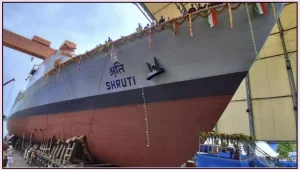
- ‘Shruti’ (Yard 3037) is a Next-Generation Offshore Patrol Vessel (NGOPV) designed for diverse maritime security and surveillance missions.
- Its name draws from India’s ancient heritage and refers to the four Vedas.
- Developed By: The vessel has been indigenously designed and built by Garden Reach Shipbuilders & Engineers (GRSE) in Kolkata.
- It incorporates approximately 85% indigenous content, supporting Aatmanirbhar Bharat and domestic defence manufacturing.
Key Features
- Dimensions & Speed: The vessel measures approximately 113 metres in length, has a displacement of about 3,000 tonnes, and can attain speeds of up to 23 knots.
- Range & Endurance: It has a range of around 8,500 nautical miles at 14 knots, enabling sustained long-duration maritime operations.
- Multi-Mission Capability: It is equipped for maritime surveillance, search and rescue, anti-piracy operations, offshore-asset protection and Humanitarian Assistance and Disaster Relief (HADR) missions.
Click to Know UPSC Coaching Centres in India
Next-Generation Offshore Patrol Vessel (NGOPV) Programme
- The NGOPV Programme aims to strengthen the Indian Navy’s offshore patrol capabilities through 11 indigenously designed and built vessels.
- Nodal Bodies: The programme is being implemented by the Ministry of Defence (MoD) and Indian Navy, with construction shared between GRSE and Goa Shipyard Limited (GSL).
- GSL is constructing seven vessels, while GRSE is building four.
 12 Aug 2026