Subject: GS 3: Science & Technology
Context: The growing global adoption of Non-Animal Testing Models (NAMs) presents India with an opportunity to strengthen its drug discovery and development ecosystem.
IAS coaching
About Non-Animal Testing Models (NAMs)

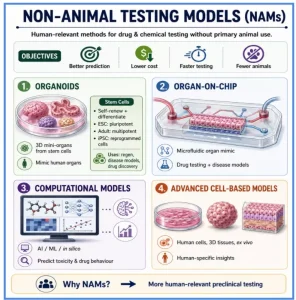
- NAMs are human-relevant scientific methods that evaluate the safety, efficacy, and toxicity of drugs and chemicals without relying primarily on animal testing.
- Objective: To improve the predictive accuracy of preclinical testing, reduce drug development costs and timelines, and minimise the use of laboratory animals.
Types of NAMs
- Organoids: These are three-dimensional miniature organs grown from stem cells that closely mimic the structure and function of human organs.
- Stem Cells are undifferentiated cells with the unique ability to self-renew and differentiate into specialised cell types, making them the body’s natural repair and regeneration system.
- They include embryonic stem cells (pluripotent), adult stem cells (multipotent), and induced pluripotent stem cells (iPSCs), and have wide applications in regenerative medicine, tissue engineering, disease modelling, drug discovery, and personalised medicine.
- Organ-on-Chip: These are microfluidic devices that replicate the physiological functions of human organs for disease modelling and drug testing.
- Computational Models: Artificial Intelligence (AI), Machine Learning (ML), and in silico models are used to predict drug behaviour and toxicity.
- Advanced Cell-based Models: These include human cell cultures, three-dimensional tissue models, and ex vivo tissue studies that provide human-specific biological insights.
Need for NAMs
- Low Success Rate of Drug Development: Only about 10–14% of drug candidates entering Phase I clinical trials ultimately receive regulatory approval.
- Limitations of Animal Models: Animal testing often fails to accurately predict human biological responses, leading to failures in later stages of clinical trials.
- High Development Costs: Ineffective preclinical prediction contributes to high research costs, drug attrition, and delays in bringing new medicines to patients.
India’s Current Scenario
- India has gradually adopted alternative research platforms: C. elegans, Drosophila, zebrafish systems, yeast-based models, and ex vivo tissue studies.
- More recently, 3D organoids and human-relevant cellular models have expanded India’s research toolkit.
- India’s regulatory system already permits NAMs use in proof-of-concept studies, target identification, drug screening, and parts of toxicology.
- However, adoption remains constrained by:
- Limited regulatory clarity
- Absence of a unified national strategy
- Underutilised scientific capacity not yet formally integrated into regulatory pathways
Global Developments
- The US, EU, UK, and Japan have moved beyond experimentation — establishing national centres, dedicated funding streams, and validation programmes for NAMs, with regulatory pathways being adapted accordingly.
UPSC Course Fees Online
Significance for India
- Promotes Drug Innovation: Wider adoption of NAMs can accelerate original drug discovery, complex biologics, and high-value pharmaceutical research.
- Improves Drug Development Efficiency: Human-relevant testing models can reduce drug failure rates, shorten development timelines, and lower research costs.
- Strengthens Intellectual Property Creation: Greater emphasis on innovation can enhance patent generation and technology development.
- Supports the Bioeconomy: NAMs complement the objectives of the BioE3 Policy, Atmanirbhar Bharat, and India’s ambition to become a global life sciences innovation hub.
Applications of NAMs
- Drug Discovery: NAMs improve drug screening, target identification, and preclinical evaluation.
- Biosimilars and Generics: They can enhance quality testing and comparative safety assessment.
- Cosmetics and Personal Care: Virtual skin models and computational platforms can replace animal testing for product safety evaluation.
- Precision Medicine: Human-specific models support the development of personalised therapies and disease-specific treatments.
- Chemical Safety Assessment: NAMs improve the evaluation of industrial chemicals, food additives, and environmental toxins.
Click to Know UPSC Offline Courses
Ethical Issues in Animal Testing
- Animal Welfare: Animal testing subjects animals to pain, distress, injury, and sometimes death, raising concerns about their well-being.
- Violation of Animal Rights: It raises questions about the moral legitimacy of using animals as means for scientific and commercial purposes.
- Lack of Informed Consent: Unlike humans, animals cannot provide consent, making their use ethically contentious.
- Questionable Scientific Validity: Physiological and genetic differences between animals and humans may lead to unreliable or non-transferable results.
- Availability of Alternatives: The emergence of Non-Animal Testing Models (NAMs), such as organoids, organ-on-chip, and AI-based models, reduces the ethical justification for animal experimentation.
- 3Rs Principle: Ethical research requires adherence to the 3Rs—Replacement (use alternatives wherever possible), Reduction (minimise the number of animals used), and Refinement (reduce pain and suffering).
- Public Accountability: Society increasingly expects ethical, humane, and transparent research practices that balance scientific progress with animal welfare.