Subject: GS 2: Polity & Governance
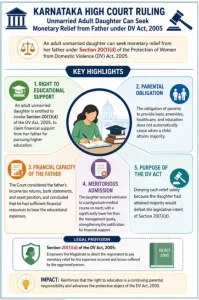
Context: Recently, the Karnataka High Court held that an adult unmarried daughter can seek monetary relief from her father under Section 20(1)(d) of the Protection of Women from Domestic Violence (DV) Act, 2005.
Best Online Coaching for UPSC
Key Highlights

- Right to Educational Support: The Court held that an adult unmarried daughter is entitled to invoke Section 20(1)(d) of the DV Act, 2005, to claim financial support from her father for pursuing higher education.
- Parental Obligation: The Court observed that the obligation of parents to provide basic amenities, healthcare, and education does not automatically cease when a child attains majority.
- Purpose of the DV Act: The Court held that denying such relief solely because the daughter had attained majority would defeat the legislative intent of Section 20(1)(d).
About the Protection of Women from Domestic Violence (DV) Act, 2005
- A civil law enacted to provide effective protection to women facing violence within the family/domestic relationships.
- Enactment: Enacted in 2005 and came into force on 26 October 2006.
- Coverage: Protects any aggrieved woman in a domestic relationship, including those in a relationship in the nature of marriage (live-in relationship).
- Definition of Domestic Violence: Covers physical, sexual, verbal, emotional, and economic abuse, including dowry-related harassment.
- Key Sections:
- Section 18: Provides for Protection Orders,
- Section 19: Residence Orders,
- Section 20: Monetary Relief, including:
- Loss of earnings
- Medical expenses
- Loss/damage to property
- Maintenance for the aggrieved person and her children — Section 20(1)(d) covers this, and the phrase “in addition to” was the interpretive crux in this case and can include educational expenses, where justified.
- Section 21: Custody Orders
- Section 22: Compensation Orders and
- Section 23: Interim/Ex parte Orders.
- Broad Coverage: Protects any aggrieved woman in a domestic relationship from physical, sexual, verbal, emotional, and economic abuse.
- Right to Residence: Guarantees every aggrieved woman the right to reside in the shared household, irrespective of ownership or title.
- Institutional Support & Enforcement: Provides for Protection Officers, Service Providers, Shelter Homes, and Medical Facilities, and makes the breach of Protection Orders a cognizable and non-bailable offence.
- Implementation Mechanism: Provides for the appointment of Protection Officers, registration of Service Providers, and access to Shelter Homes and Medical Facilities for victims.
Associated Judicial Precedents
- Abhilasha v. Prakash (2020): The Supreme Court held that an unmarried major daughter cannot claim maintenance under Section 125 of the CrPC (now Section 144 of the Bharatiya Nagarik Suraksha Sanhita, 2023) merely because she has attained majority, unless she suffers from a physical or mental disability.
- However, she may seek relief under personal laws, if applicable.
- Rajnesh v. Neha (2020): The Supreme Court laid down comprehensive guidelines for determining maintenance, emphasising that it should ensure a dignified standard of living and be decided based on the financial capacity of the parties.
- XYZ v. State of Gujarat & Others (2024): The Supreme Court held that an unmarried daughter has an indefeasible, legally enforceable right to seek educational expenses from her parents, and courts may direct parents to bear the cost of higher education, subject to their financial capacity.
- (This is the judgment relied upon by the Karnataka High Court in the present case.)
|
Click to Know UPSC Coaching Centres in India