Subject: GS 2: Polity & Governance
Context: More than two and a half years after the Supreme Court recorded the Union Government’s assurance to restore Statehood to Jammu & Kashmir (J&K), no concrete steps have been taken.
The issue has resurfaced following Chief Minister Omar Abdullah’s protests demanding early restoration of Statehood.
- The delay has revived debates on federalism, democratic representation, constitutional governance, and national security.
IAS coaching
Background
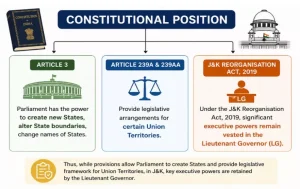
- 5 August 2019: Article 370 and Article 35A were effectively abrogated.
- The Jammu and Kashmir Reorganisation Act, 2019 bifurcated the State into:
- Union Territory of Jammu & Kashmir (with legislature)
- Union Territory of Ladakh (without legislature)
- Assembly elections were held in 2024, leading to the formation of an elected government.
- However, J&K continues to remain a Union Territory.
Supreme Court Judgment (2023)
In Re: Article 370 (2023), the Supreme Court:
- Upheld the constitutional validity of the abrogation of Article 370.
- Accepted the Union Government’s assurance that Statehood would be restored at the earliest.
- Directed the Election Commission to conduct Assembly elections by September 2024 (completed).
- Present Status: J&K remains a Union Territory with a legislature, not a full state.
Concerns with Continued Union Territory Status
- Reduced Executive Authority: Under the Jammu & Kashmir Reorganisation Act, 2019, key executive powers continue to vest in the Lieutenant Governor (LG), particularly over police, public order and All India Services, limiting the effective functioning of the elected government.
- Limited Control over Bureaucracy: The LG’s control over transfers, postings and senior administrative decisions reduces the accountability of the bureaucracy to elected representatives, affecting policy implementation and legislative oversight.
- The Second Administrative Reforms Commission (ARC) emphasised that bureaucratic accountability should primarily flow through elected governments to ensure good governance.
- Control over Police and Public Order: Unlike other States, the elected government has no authority over police and public order, restricting its ability to respond to local law-and-order issues and security concerns.
- Democratic Deficit: Despite the successful conduct of Legislative Assembly elections in 2024, the elected government continues to function with restricted executive powers, creating a gap between the popular mandate and actual governance authority.
- Weakening Federal Principles: The prolonged continuation of Union Territory status raises concerns regarding Cooperative Federalism and asymmetrical federalism, as Jammu & Kashmir remains the only former State yet to regain statehood after elections.
- The Punchhi Commission on Centre–State Relations recommended that excessive centralisation should remain an exception rather than the norm in India’s federal structure.
- Constitutional Morality: In December 2023, while upholding the J&K Reorganisation Act, 2019, the Supreme Court recorded the Union Government’s assurance that Statehood would be restored “at the earliest” after the electoral process.
- Continued delay, despite this assurance, raises concerns regarding constitutional morality, institutional accountability and public confidence in constitutional commitments.
- Political Uncertainty: The absence of a definite timeline for restoring Statehood creates prolonged constitutional and political uncertainty, affecting governance, investment, long-term planning and policy continuity.
- Erosion of Public Trust: Continued restrictions on the powers of elected institutions may weaken public confidence in democratic governance and discourage political participation, particularly among younger voters.
Counter-Arguments
- Security and Democracy are complementary: Internal security and democratic governance are not mutually exclusive; rather, accountable political institutions often strengthen long-term stability by addressing local grievances through constitutional means.
- Better Local Administration: A fully empowered elected government can respond more effectively to local issues, improve public service delivery, and ensure that development policies reflect regional priorities.
Government’s Position
- Security Concerns: The Centre says J&K’s strategic importance and security situation require a calibrated approach before restoring Statehood.
- Cross-border Terrorism: Continued terrorism, infiltration and terror financing from across the border necessitate stronger central oversight, according to the MHA.
- Restoration after Normalcy: The Union Government has assured the Supreme Court that Statehood will be restored after normalcy and completion of the electoral process, but no timeline has been announced.
|
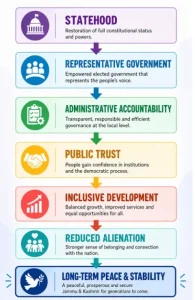
- Enhanced Public Confidence: Restoration of Statehood would strengthen citizens’ faith in constitutional institutions, encourage greater political participation, and reduce perceptions of political alienation.
- Improved Intelligence and Public Cooperation: Greater public trust in elected institutions can enhance community policing, intelligence gathering, and cooperation between citizens and security agencies, making counter-terrorism efforts more effective.
- Democratic Legitimacy Promotes Peace: Experiences from other conflict-affected regions suggest that inclusive political participation, alongside robust security measures, contributes to long-term peace, social reconciliation, and institutional stability, a principle also emphasised by the Second Administrative Reforms Commission (ARC).
UPSC Course Fees Online
Way Forward
- Restore Statehood at the Earliest: The Union Government should restore full statehood to Jammu & Kashmir at the earliest, honouring the assurance given before the Supreme Court in the In Re: Article 370 case (2023) and repeated in Parliament.
- Timely restoration would strengthen federalism, democratic accountability and public trust, especially after the successful conduct of the 2024 Assembly elections, which recorded an overall voter turnout of 63.88%, reflecting citizens’ faith in democratic processes.
- Strengthen Democratic Institutions: The elected government should be vested with full executive and administrative powers, while local self-government institutions such as Panchayati Raj Institutions (PRIs) and Urban Local Bodies should be further empowered in line with the 73rd and 74th Constitutional Amendments.
- According to the Ministry of Panchayati Raj, over 33,000 Panchayat representatives are functioning in Jammu & Kashmir, providing a strong foundation for participatory governance.
- Balance Security and Democracy: Counter-terrorism measures must continue to address cross-border infiltration and militancy, while simultaneously expanding democratic participation, civil liberties and accountable governance.
- The Ministry of Home Affairs Annual Report 2024–25 notes a sustained decline in terrorist incidents and improved security indicators, creating favourable conditions for restoring full democratic governance without compromising national security.
- Institutional Dialogue: A structured mechanism for regular consultations between the Union Government and the elected Government of Jammu & Kashmir should be institutionalised to coordinate policies on governance, security, economic development and constitutional issues.
- Such cooperative federalism would improve policy implementation, reduce administrative friction and ensure that regional aspirations are effectively incorporated into national decision-making.
- Promote Inclusive Development: Political normalcy should be complemented by sustained investments in employment generation, tourism, infrastructure, education and entrepreneurship, particularly for the youth.
- According to the Economic Survey of Jammu & Kashmir 2024–25, the UT recorded a record 2.35 crore tourist arrivals in 2024, while schemes such as PMDP, PMGSY, Jal Jeevan Mission and PMEGP are strengthening infrastructure, connectivity and livelihoods, reinforcing inclusive development as the foundation for lasting peace and stability.
Union Territory vs State: Constitutional Difference
| Aspect |
State |
Union Territory (UT) |
| Constitutional Basis |
Governed under Articles 152–237. |
Governed under Articles 239–241. |
| Executive Head |
Governor is the constitutional head; real executive is the Chief Minister and Council of Ministers. |
Administrator/Lieutenant Governor (LG) appointed by the President; some UTs have a Chief Minister and Council of Ministers. |
| Legislative Powers |
Can legislate on the State List and Concurrent List. |
Parliament has overriding legislative power; only some UTs have limited legislative powers. |
| Administrative Control |
Enjoy greater constitutional autonomy under the federal system. |
Administered directly by the Union Government through the President. |
| Financial & Political Autonomy |
Greater fiscal and administrative autonomy; all States have representation in Rajya Sabha. |
More dependent on Union grants; only some UTs have representation in Rajya Sabha. |
Click to Know UPSC Offline Courses
Conclusion
The restoration of Statehood to Jammu & Kashmir is not merely an administrative decision but a test of India’s commitment to constitutionalism, democratic accountability, and cooperative federalism. While national security remains paramount, durable peace in border regions is best secured through inclusive political participation, empowered local governance, and timely fulfilment of constitutional commitments.
 17 Jul 2026