Subject: GS 3: Science & Technology
Context: On the 98th Foundation Day of ICAR, the Union Agriculture Minister unveiled the ‘Viksit Krishi, Samruddh Kisan’ roadmap.
IAS coaching
Key Features of the Roadmap

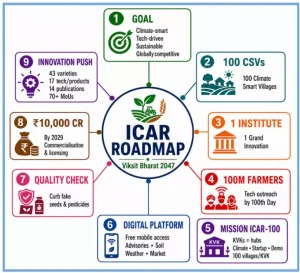
- The roadmap seeks to transform Indian agriculture into a climate-resilient, technology-driven, sustainable and globally competitive sector, contributing to the vision of Viksit Bharat 2047.
- Climate Smart Villages: ICAR will develop 100 Climate Smart Villages before its centenary to demonstrate climate-resilient agriculture, integrated farming systems, water conservation and climate risk management.
- One Institute–One Grand Innovation: Every ICAR institute will develop at least one transformational innovation—such as a crop variety, vaccine, digital technology or climate-smart solution—within the next two years.
About the Indian Council of Agricultural Research (ICAR)
- About: Apex autonomous body for agricultural education, research and extension in India.
- Established: 16 July 1929 as the Imperial Council of Agricultural Research; renamed ICAR after Independence.
- Administrative Ministry: ICAR functions under the Department of Agricultural Research and Education (DARE), Ministry of Agriculture and Farmers’ Welfare.
- Headquarters: New Delhi.
- Functions: ICAR conducts and coordinates research in agriculture, horticulture, animal sciences, fisheries, natural resource management and agricultural engineering, develops improved crop varieties and technologies, and strengthens agricultural extension through Krishi Vigyan Kendras (KVKs).
|
- Technology Outreach: ICAR aims to extend its scientific innovations and agricultural technologies to 100 million farmers by its 100th Foundation Day.
- Mission ICAR-100: The initiative will transform Krishi Vigyan Kendras (KVKs) into innovation hubs, climate advisory centres, startup incubation centres and farmer technology demonstration centres, while ensuring outreach to at least 100 villages per Krishi Vigyan Kendras (KVKs).
- ICAR Open Digital Knowledge Platform: A digital platform will provide farmers free access to scientific advisories, crop management practices, soil testing information, weather forecasts and market intelligence through mobile phones.
- Quality Regulation: The Government will strengthen legal provisions against counterfeit seeds and pesticides and promote simple technologies to help farmers verify the quality of agricultural inputs.
- Technology Commercialisation: ICAR aims to generate ₹10,000 crore in internal resources by 2029 through the commercialisation and licensing of crop varieties, vaccines and other agricultural technologies.
- Research and Innovation: During the event, ICAR released 43 new crop varieties, 17 technologies and products, and 14 publications, covering disease-resistant and nutrient-rich crops, livestock and fisheries vaccines, and digital agriculture.
Click to Know UPSC Offline Courses