The Reserve Bank of India (RBI) has introduced a temporary US Dollar-Rupee Forex Swap Facility to encourage banks to mobilize Foreign Currency Non-Resident (Bank) [FCNR(B)] deposits from Non-Resident Indians (NRIs).
- The move aims to strengthen foreign exchange reserves, support the Balance of Payments (BoP) position, and enhance stability in India’s external sector.
UPSC Online Preparation
About FCNR(B) Deposits
- FCNR(B) stands for Foreign Currency Non-Resident (Bank) deposits. These are fixed-term foreign currency deposits maintained with Indian banks by eligible non-residents, including NRIs, Overseas Citizens of India (OCIs), and Persons of Indian Origin (PIOs).
- FCNR(B) deposits are one of the few deposit instruments in India where both the deposit and interest are maintained in foreign currency, and the interest income is exempt from Indian income tax for eligible NRIs.
- The exemption is available under Section 10(15)(iv)(fa) of the Income-tax Act, 1961.
- Currency Maintenance: Unlike rupee-denominated deposits, FCNR(B) accounts are completely maintained in permitted foreign currencies such as the US Dollar ($), Euro (€), Pound Sterling (£), and Japanese Yen (¥).
 Exchange Rate Protection: Since these deposits are held entirely in foreign currency, depositors are protected from losses arising due to rupee depreciation against international currencies.
- Repayment Mode: The principal amount and the interest on FCNR(B) deposits are paid back in the same foreign currency in which the deposit was originally made.
Need for the RBI Swap Facility
- Declining Inflows: The facility was introduced after a sharp decline in FCNR(B) inflows. Higher interest rates offered by advanced economies, particularly the United States, reduced the attractiveness of Indian foreign currency deposits.
- Core Objectives: The RBI’s intervention seeks to:
- Increase foreign currency inflows into India.
- Strengthen the country’s forex reserves.
- Improve the ability of the central bank to manage exchange rate volatility.
- Support India’s Balance of Payments (BoP) position.
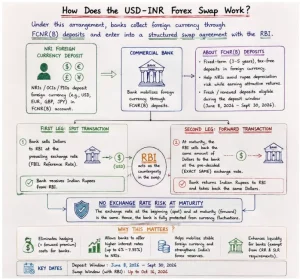
How Does the USD-INR Forex Swap Work?
Under this arrangement, banks collect foreign currency through FCNR(B) deposits and enter into a structured swap agreement with the RBI.
- First Leg: Spot Transaction: The bank sells the foreign currency collected through FCNR(B) deposits to the RBI at the prevailing market exchange rate.
- Second Leg: Forward Transaction: At the end of the swap period, the RBI sells back the exact same amount of foreign currency to the bank at a pre-decided exchange rate.
- Eliminating Risk: Because both transactions are carried out at the same exchange rate, banks face no exchange rate risk.
- Lowering Cost: The arrangement removes the hedging burden from banks. Since banks do not have to buy expensive market contracts to protect themselves from currency fluctuations, they can offer more attractive interest rates to attract depositors.
Significance of the Facility
- Strengthening Forex Reserves: The RBI receives hard foreign currency assets through the swap mechanism, directly increasing its foreign exchange reserves.
- This enhances the RBI’s capacity to intervene in the currency market during periods of sharp rupee volatility.
- Supporting Balance of Payments: FCNR(B) deposits bring capital into the Indian banking system and positively contribute to the capital account of the Balance of Payments.
- These higher inflows stabilize India’s external sector ledger.
- Reducing Cost for Banks: Normally, banks need to purchase currency hedging contracts to protect their books from exchange rate shifts.
- Under this facility, the RBI absorbs the hedging cost/risk through a par swap, lowering the cost of mobilizing funds.
- Improving Banking Sector Liquidity: Fresh FCNR(B) deposits mobilized under the scheme receive exemptions from strict regulatory requirements such as the Cash Reserve Ratio (CRR) and the Statutory Liquidity Ratio (SLR).
- This releases a greater portion of deployable funds for credit expansion.
Concerns Associated with the Facility
- Temporary Nature of Inflows: FCNR(B) deposits are a form of short-to-medium-term foreign currency liability for Indian banks.
- Because this money must be repaid at maturity, it acts as a short-term cushion rather than a permanent source of foreign capital.
- Maturity Concentration Risk: Since these deposits are mobilized during a limited, highly compressed window, a large volume of capital may mature together after a few years.
- This can create sudden, heavy pressure on India’s foreign currency outflows in the future.
- Liquidity Management Challenge: Large-scale forex swap operations increase rupee liquidity in the domestic financial system as the RBI releases rupees in the first leg.
- The RBI may need to undertake extensive sterilization measures (like open market operations) to prevent this extra money from causing domestic inflation.
Way Forward
- Calibrated Sterilization: The RBI must remain vigilant and use open market operations or the Market Stabilization Scheme (MSS) to mop up any excess rupee liquidity created by the dollar swaps, ensuring domestic price stability is maintained.
- Monitoring Leverage and Risk: Regulators should closely track banking guarantees and set macroprudential limits on credit-linked leverage to insulate domestic bank balance sheets from global counterparty shocks.
- Focus on Stable Capital Inflows: While swap tools are excellent short-term shock absorbers during global market volatility, long-term policy must focus on expanding Foreign Direct Investment (FDI) and structural trade reforms to sustain external sector strength naturally.
Click to Explore UPSC Offline Coaching
| Difference Between FCNR(B) and NRE Deposits |
| Feature |
FCNR(B) Deposits |
NRE (Non-Resident External) Deposits |
| Currency of Account |
- Maintained fully in foreign currency.
|
- Maintained and held in Indian Rupees.
|
| Exchange Rate Risk |
- The depositor is completely protected from exchange rate risk.
|
- The depositor bears the risk; value changes with fluctuations in the rupee.
|
| Repayment Currency |
- Interest and principal are repaid in foreign currency.
|
- Interest and principal are paid out in Indian Rupees.
|
Key Terms
- Balance of Payments (BoP): A systematic record of all economic transactions between a country and the rest of the world during a given period, including trade, investments, and capital flows.
- Capital Account: A component of the Balance of Payments that records transactions related to foreign investments, borrowings, and capital transfers between a country and the rest of the world.
- External Sector: The part of an economy that deals with its economic relations with other countries, including trade, foreign investment, exchange rates, and forex reserves.
- Foreign Exchange Reserves (Forex Reserves): Foreign currency assets maintained by the central bank to meet international payment obligations and manage exchange rate fluctuations.
- Exchange Rate Volatility: Frequent fluctuations in the value of one currency relative to another currency due to changes in economic or financial conditions.
- Currency Hedging: A risk management method used to protect against potential losses arising from changes in exchange rates.
- Hedging Cost: The cost incurred by banks or businesses to protect themselves from currency fluctuations through financial instruments.
- Par Swap: A swap arrangement where the exchange rate for both the initial and final currency exchanges is kept the same, reducing the cost of managing exchange rate risk.
- Cash Reserve Ratio (CRR): The percentage of a bank’s total deposits that it must maintain as cash reserves with the RBI.
- Statutory Liquidity Ratio (SLR): The percentage of deposits that banks are required to maintain in the form of liquid assets such as government securities.
- Deployable Funds: The portion of funds available with banks for lending and investment after fulfilling regulatory requirements.
- Liquidity: The availability of funds in the financial system or banking sector for carrying out transactions and lending activities.
- Sterilisation: Measures undertaken by a central bank to absorb excess liquidity from the financial system to control inflationary pressures.
- Open Market Operations (OMO): RBI’s purchase or sale of government securities to regulate liquidity in the banking system.
- Market Stabilization Scheme (MSS): A mechanism through which the RBI absorbs excess liquidity by issuing government securities.
- Foreign Direct Investment (FDI): Long-term investment by a foreign entity in domestic businesses with the objective of establishing a lasting interest.
- Macroprudential Measures: Regulatory steps taken to reduce risks and maintain stability of the overall financial system.
|
 12 Jun 2026