Recently, an independent team of climate scientists published the latest annual study called the Indicators of Global Climate Change (IGCC).
- The report contains a clear warning- the heat added to our atmosphere by human activities reached its highest level ever in the year 2025.
UPSC Online Coaching
Key Findings of the Study
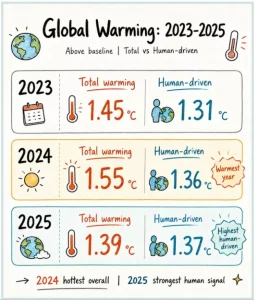
The report breaks down the exact temperatures and pollution levels recorded in 2025:
- The Temperature Spike: In 2025, the Earth’s average temperature was 1.39°C hotter than the pre-industrial baseline (the average temperature from 1850 to 1900).
- The Human Footprint: Out of that total increase, a massive 1.37°C was caused directly by human activities—primarily the burning of fossil fuels (coal, oil, and gas). Only a tiny 0.02°C was caused by natural climate variations.
- Historical Comparisons: For comparison, look at how the human share of warming has steadily grown over the past three years (in figure).
About the IGCC Study
- What it is: The Indicators of Global Climate Change (IGCC) is an independent scientific project started in 2023. It is published in the scientific journal Earth System Science Data.
- Who runs it? It is managed by a global team of climate scientists. Many of these experts are the main authors behind the UN’s Intergovernmental Panel on Climate Change (IPCC).
- Why it is unique: The official, authoritative UN IPCC reports are only published once every few years. Because our climate is shifting rapidly, leaders need fresh data every year.
- The IGCC fills this knowledge gap by providing a strict annual check-up on global warming using the exact same official guidelines as the UN.
|
Why 2025 Wasn’t the Hottest Year
If human heat contribution was at an all-time high, it seems strange that 2025 was only the third warmest year on record, ranking behind 2024 and 2023.
- The study explains that this happened because of a natural ocean cycle called La Niña:
- During a La Niña year, the waters in the equatorial Pacific Ocean become much colder than usual.
- This cold water acts like a massive natural air conditioner for the planet, temporarily lowering total air temperatures.
- Essentially, La Niña masked the true strength of human-caused warming in 2025. Without this natural cooling cycle, 2025 would have easily broken all previous heat records.
Concerns Raised by Scientists
The report highlights three major warning signs that require urgent attention from policymakers:
- Record Pollution Levels: Global greenhouse gas emissions reached an all-time high of 56.8 billion tonnes of carbon dioxide equivalent in 2025.
- An Exhausted Carbon Budget: To keep global warming under the semi-safe limit of 1.5°C, the world can only emit a total of 130 billion tonnes of additional carbon dioxide starting from 2026.
- At our current record-breaking pace, this remaining carbon budget will be completely used up in less than three years.
- Rapid Speed of Warming: The Earth is currently heating up at a steady rate of 0.27°C per decade.
- The Threat of El Niño: Scientists warn that a powerful El Niño cycle—which does the opposite of La Niña by dumping massive amounts of heat from the ocean into the air—is building up.
- There is a 91% chance that at least one year before 2030 will shatter the 1.5°C threshold due to this combination of human emissions and El Niño heat.
About La Niña: (UPSC CSE Prelims- 2011)
- La Niña is a natural climate phenomenon that occurs when the surface waters of the central and eastern equatorial Pacific Ocean become unusually cooler than normal.
- Part of ENSO Cycle: It is the cool phase of the El Niño–Southern Oscillation (ENSO) cycle, with El Niño being the opposite warm phase.
- Cause: La Niña develops due to stronger-than-normal trade winds that push warm surface waters towards the western Pacific, allowing cold deep ocean water to rise (upwelling) in the eastern Pacific.
- Global Impact: The cooling of the Pacific Ocean influences global atmospheric circulation, affecting rainfall patterns, temperatures, and extreme weather events worldwide.
- Temperature Effect: La Niña generally has a temporary cooling influence on global average temperatures by absorbing more heat into the oceans, though it does not stop the long-term trend of human-induced global warming.
- Impact on India: La Niña is often associated with:
- Stronger Indian monsoon conditions
- Increased possibility of above-normal rainfall
- Higher risk of floods in some regions
- Contrast with El Niño:
- La Niña: Cooler Pacific waters → generally cooler global conditions → often stronger monsoon in India.
- El Niño: Warmer Pacific waters → global warming effect intensifies → often linked with weaker Indian monsoon.
|
Click to Know UPSC Coaching Centres in India
Way Forward
To handle this emergency, climate diplomats at the mid-year talks in Bonn, Germany, have proposed a major structural change to the global energy system:
- The ‘35% by 2035’ Target: Countries are pushing for a global pledge to ensure that electricity accounts for at least 35% of all energy consumed by humanity by 2035.
- Right now, electricity only makes up 20% of global energy use (the rest is dominated by burning oil in vehicles and coal/gas in factories).
- The Clean Energy Shift: Moving the world toward electricity is the most practical way to eliminate fossil fuels.
- However, this step only works if nations rapidly build up green energy sources, like solar, wind, and green hydrogen, to generate that electricity.
- Focus on Adaptation for India: For a developing nation like India—which has a high number of cities highly vulnerable to extreme heat waves—the shrinking carbon budget means time has run out.
- India must aggressively scale up:
- Local climate defenses (adaptation)
- Urban infrastructure to handle extreme heat
- Pressure on wealthier nations to deliver the climate funding they promised.
 12 Jun 2026