India is debating a policy push for a mandatory transition to Electric Vehicles (EVs) by 2028 for two- and four-wheelers, rooted in pollution control, energy security, and long-term restructuring of the automobile sector.
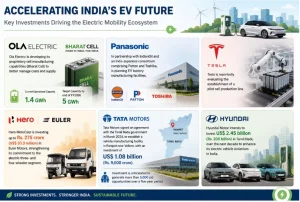
- India has set an ambitious target to elevate EV sales to 30% of private cars, 70% of commercial vehicles, 40% of buses, and 80% of two- and three-wheelers by 2030.
- Globally, the electric vehicle market was valued at US$ 917.30 billion in 2025 and is forecasted to reach US$ 4,886.20 billion by 2034, growing at a CAGR of 20.43% from 2026-34.
Best Online Coaching for UPSC
About Electric Vehicle (EV) Transition
- EV transition refers to the gradual shift from Internal Combustion Engine (ICE) vehicles that run on petrol and diesel to electric mobility powered by electricity stored in batteries.
- It involves replacing conventional vehicles with electric cars, buses, two-wheelers, and commercial vehicles while developing supporting infrastructure such as charging stations, battery manufacturing, and recycling systems.
- The transition aims to achieve cleaner transportation, lower emissions, reduced fossil fuel dependence, and sustainable mobility.
Why is the EV Shift Being Advocated?
- Environmental and Public Health Imperative:
- The transport sector contributes significantly to urban air pollution, especially in cities like Delhi-NCR, where vehicular emissions are a key source of PM2.5.
- WHO estimates air pollution causes millions of premature deaths globally each year, with India among the worst affected countries.
- EV adoption reduces tailpipe emissions (NOx, CO, particulate matter), improving urban air quality and public health outcomes.
- Hence, EV adoption is seen as a public health intervention, not merely an energy transition.
- Energy Security and Strategic Independence:
- Fossil fuel imports increase India’s external vulnerability, especially crude oil dependence.
- EVs enhance energy security as electricity can be generated domestically, including through renewables.
- Batteries and magnets are durable assets; unlike fuel, EVs do not require continuous imports for operation.
- Climate Commitments and Net Zero Targets
- India has committed to Net Zero emissions by 2070 (COP26 pledge).
- The transport sector is a major contributor to greenhouse gas emissions, making electrification essential.
- EVs are aligned with the National Electric Mobility Mission Plan (NEMMP) and schemes like FAME India.
- Economic Efficiency and Lower Operating Costs: EVs have lower running costs per km compared to internal combustion engine (ICE) vehicles due to:
- Lower electricity cost vs petrol/diesel
- Fewer moving parts → reduced maintenance
- Industrial Transformation and Manufacturing Growth: EV transition supports development of a new green industrial ecosystem:
- Batteries and energy storage
- Power electronics and semiconductors
- Charging infrastructure
- Urban Planning and Reduced Oil Intensity of Cities: EV adoption reduces urban dependence on fossil fuel distribution networks (fuel stations, logistics chains).
- Foreign Exchange Savings and Macro Stability: Reduced oil imports lead to lower current account pressure and improved foreign exchange stability.
- India spends a significant share of its import bill on crude oil; EV transition can reduce this structural trade deficit component.
- Technological Leapfrogging Opportunity: EVs allow India to skip incremental ICE evolution and directly adopt advanced mobility technologies. It gives an opportunity to integrate AI-based fleet management, Smart grids and vehicle-to-grid (V2G) systems
- Rural and Urban Mobility Transformation: EVs, especially two- and three-wheelers, are highly suitable for India’s short-distance travel patterns.
- Lower running costs improve mobility affordability in rural and semi-urban areas.
- Battery Reuse and Circular Economy Potential: EV batteries can be repurposed for energy storage systems after automotive life. It supports a circular economy model through recycling of lithium, cobalt, nickel.
Structural Requirements for EV Transition
- Charging Infrastructure Expansion: Charging network expansion is essential through petrol pumps, parking lots, residential areas, and public spaces for widespread EV adoption.
- Utility companies must be integrated as key stakeholders to ensure reliable electricity supply and smart charging systems.
- Interim Strategic Measures: Strategic stockpiling of critical minerals and rare earth elements is required to reduce supply chain vulnerabilities.
- Accelerated depreciation support can help automobile companies manage transition losses from shifting away from ICE vehicles.
- Investment in R&D is needed to build a domestic battery and EV component ecosystem.
- Industry–Government Collaboration: Automakers should invest in EV research, charging networks, and battery recycling infrastructure to strengthen the EV ecosystem.
- Government support should focus on policy certainty, long-term EV roadmap, and transition financing mechanisms for a smooth industry shift.
- Domestic Battery Manufacturing: India needs to develop a strong battery manufacturing ecosystem to reduce dependence on imported battery cells and components.
- Critical Mineral Security: Ensuring access to lithium, cobalt, nickel, and rare earth elements is essential for long-term EV growth.
- Grid Modernisation and Renewable Integration: EV transition requires power grid strengthening and integration of renewable energy for sustainable charging.
- Solar-powered charging stations can reduce pressure on conventional electricity sources.
- Skill Development and Workforce Transition: Workers in the traditional automobile sector need reskilling and upskilling for EV-related technologies.
- Mechanics can be trained in battery management systems and electric powertrains.
- Battery Recycling and Circular Economy: Developing a battery recycling ecosystem is necessary to recover valuable materials and manage waste sustainably.
- Recycling lithium-ion batteries can reduce dependence on imported minerals.
- Consumer Incentives and Awareness: Policy support through affordable financing, incentives, and awareness campaigns can encourage EV adoption.
- Credit schemes can help delivery workers and small businesses shift to electric vehicles.
Steps Taken to Promote EV Adoption in India
| Initiative / Policy |
Key Features and Objectives |
| PM E-DRIVE Scheme (2024–2026) |
The PM Electric Drive Revolution in Innovative Vehicle Enhancement (PM E-DRIVE) Scheme promotes green mobility and EV ecosystem development with an outlay of ₹10,900 crore over two years. |
| Investment in Charging Infrastructure |
Under PM E-DRIVE, ₹2,000 crore has been allocated to establish around 72,000 EV charging stations across cities, highways, airports, and industrial corridors. |
| FAME II Scheme |
The government supported EV adoption through FAME II with a budget of around ₹10,000 crore, promoting electric two-wheelers, three-wheelers, and buses. |
| Electric Vehicle Manufacturing Policy (2024) |
The policy aims to make India an EV manufacturing hub by requiring a minimum investment of ₹4,150 crore, setting up production facilities within 3 years, and achieving 50% domestic value addition within 5 years. |
| State-Level EV Initiatives |
States like Delhi, Karnataka, and Telangana are expanding electric bus fleets and implementing EV policies to promote sustainable public transport. |
| Production Linked Incentive (PLI) for ACC Batteries |
The government allocated ₹18,100 crore under the PLI scheme to promote domestic Advanced Chemistry Cell (ACC) battery manufacturing and reduce import dependence. |
| SPMEPCI Scheme (Electric Passenger Cars) |
The Scheme to Promote Manufacturing of Electric Passenger Cars in India encourages global EV manufacturers to invest in India through reduced import duties and domestic production incentives. |
| GST Reduction on EVs and Charging Equipment |
GST on EVs and charging equipment has been reduced to 5% to lower vehicle costs and encourage consumer adoption. |
| PM e-Bus Sewa Scheme |
Aims to deploy 10,000 electric buses through a PPP model with central support for EV-based public transport infrastructure. |
| EV Mitra Scheme |
Simplifies access to EV subsidies and promotes awareness by creating a transparent platform for consumers to avail incentives. |
Challenges in EV Transition from Conventional Vehicles
- High Initial Cost: EVs involve higher upfront costs due to expensive battery technology, making affordability a challenge for many consumers.
- For Example: As of early 2026 in India, a typical high-speed electric scooter ranges from ₹1.20 lakh to ₹1.50 lakh (on-road), compared to ₹95,000 to ₹1.10 lakh for a comparable petrol scooter
- Slow Adoption: As Per Niti Aayog Report, India has progressed to only about 7.6 % of the sales in 2024 being electric, which is far behind its target of 30% by 2030.
- Thus, it has taken nearly 10 years to reach a penetration level of 7.6% and now needs to increase this share by over 22% in the next 5 years alone.
- Charging Infrastructure Gap: Limited availability of charging stations creates range anxiety and affects widespread EV adoption.
Example: Rural areas and highways have fewer charging facilities compared to petrol pumps.
- Critical Mineral Dependence: India remains dependent on imports of lithium, cobalt, and rare earth materials required for battery manufacturing.
Example: Global supply disruptions can increase battery prices and affect EV production.
- Power Grid Readiness: Large-scale EV adoption requires upgradation of electricity grids and smart charging systems to handle rising demand.
Example: Urban electricity networks may face pressure due to increased EV charging loads.
- Battery Recycling Challenge: Lack of efficient battery recycling and disposal systems can create environmental and safety concerns.
Example: Improper disposal of lithium-ion batteries may lead to toxic waste and fire risks.
- Employment Disruption: The EV transition may impact jobs related to traditional vehicle manufacturing, repair, and maintenance sectors.
Example: Mechanics specialising in internal combustion engines may require new EV-related skills.
- Consumer Adoption Barriers: Concerns regarding battery life, charging time, resale value, and vehicle reliability slow consumer acceptance.
Example: Many buyers hesitate to shift from petrol vehicles due to uncertainty about EV performance.
- Automobile Industry Restructuring: Automobile companies require significant investments to shift from internal combustion engine (ICE) production to EV manufacturing.
Example: Companies need to redesign factories and invest in battery and software capabilities.
Way Forward
- Moving from incentives to mandates:
- Announce a clear policy, with target timelines, for Zero Emission Vehicle (ZEV) adoption
- Design a progressively more stringent plan for mandating the production and purchase of EVs and disincentivising the continued use/production of ICE vehicles
- Expand Corporate Average Fuel Efficiency (CAFÉ) norms to a wider segment of vehicles
- Scale up research for new battery technologies:
- Set up an academia-industry-government partnership for accelerating research on new battery chemistries
- Enable financing for e-Buses and e-Trucks:
- Create a pooled fund with contributions from the public budget and multilateral development banks for providing lower interest loans for the procurement of e-buses and e-trucks
- Design and launch an appropriate scheme to channel the funds
- Strategic scaling of charging infrastructure:
- Identify 20 high density corridors for e-Bus and e-Truck operations and commission a study to identify strategic locations for charging hubs based on current haltage patterns on these corridors
- Arrange for viability studies and coordinate all the approvals required for private charge point operators to invest in setting up the facilities
- Establish nodal agencies in each state, on the lines of EVs in Singapore, to facilitate and enable more charging stations to be established.
- Shifting capital costs to operating costs:
- Nurture the establishment of a battery leasing industry to reduce capital cost of an EV
- Support the establishment of a battery passport system that contains details to assess the health of a battery
- Enhance awareness and information availability:
- Design and manage the awareness building program
- Assess data and information needs by different stakeholders and nurture the creation of a comprehensive information system
Click to Explore UPSC Offline Coaching
Conclusion
A mandatory EV shift by 2028 is technologically plausible but institutionally demanding. The transition requires not just policy announcement but:
- Infrastructure readiness
- Supply chain resilience
- Industry adaptation
- Consumer affordability mechanisms
India’s success depends on whether EV transition is treated as an industrial transformation strategy rather than a regulatory mandate alone.
 12 Jun 2026