Subject: GS 3: Science & Technology
Context: Recently, the United Nations (UN) has released the Preliminary Report of the Independent International Scientific Panel on Artificial Intelligence (AI)—the first UN-commissioned scientific assessment of AI.
Best Online Coaching for UPSC
About the UN AI Report
- Nature: It is the first independent scientific assessment of AI commissioned by the United Nations, intended to provide evidence-based guidance for global AI governance.
- Objective: To provide independent scientific evidence for policymakers on AI’s opportunities, risks and governance challenges, thereby supporting informed international decision-making.
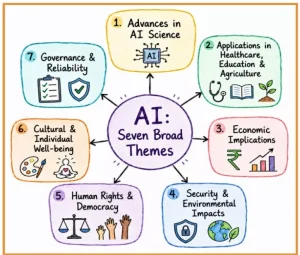
- Coverage: Examines AI across seven broad themes—advances in AI science; applications in healthcare, education and agriculture; economic implications; security and environmental impacts; human rights and democracy; cultural and individual well-being; and governance and reliability.
- Future Roadmap: Serves as the first in a series of periodic global assessments, with a comprehensive report scheduled for release in 2027.
Key Findings of the Report
- Rapid Advancement of AI: AI capabilities are advancing faster than scientific understanding, regulatory frameworks and public oversight, creating significant governance challenges.
- Governance Deficit: Existing AI governance mechanisms remain fragmented, underdeveloped and unevenly implemented, with limited capacity for independent evaluation of AI risks and effectiveness.
- Rise of Frontier AI Systems: Increasingly capable frontier AI models and autonomous AI agents can perform complex tasks with minimal human intervention, offering productivity gains while introducing new safety, security and ethical risks.
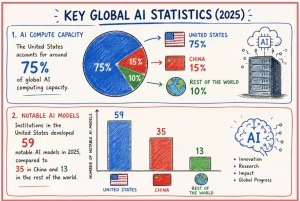
- Growing Compute Divide: AI leadership increasingly depends on access to advanced semiconductors, hyperscale data centres, cloud infrastructure and high-quality datasets, creating a widening global compute divide.
- Concentration of AI Capabilities: AI development is concentrated among a small number of countries and technology companies, raising concerns over market concentration, technological dependence and reduced strategic autonomy.
- Threats to Human Rights and Democracy: Unregulated AI systems can contribute to misinformation, surveillance, algorithmic bias, discrimination and erosion of democratic accountability.
- Limited Cultural and Linguistic Representation: Current AI models primarily reflect a limited range of languages, cultures and social contexts, excluding much of the world’s linguistic and cultural diversity.
- Need for Early Regulatory Action: Governments should adopt a precautionary approach, as waiting for complete scientific certainty could allow irreversible harms to emerge before effective regulation is in place.
Major Concerns Highlighted
- Global Compute Divide: Computing infrastructure has become a strategic geopolitical resource, with countries lacking access to advanced chips, compute capacity and datasets risking long-term technological dependence.
- AI Ecosystem Concentration: High costs of advanced chips, specialised talent, computing infrastructure and data have concentrated AI development among a handful of firms, reducing competition and innovation.
- Technological Dependence: Countries without adequate domestic AI infrastructure may become consumers rather than creators of AI technologies, limiting their ability to shape global AI standards and develop models suited to local needs.
- Risks for the Global South: Developing countries remain more vulnerable to AI misuse, while possessing limited institutional capacity to manage associated risks and ensure inclusive AI development.
Recommendations of the Report
- Strengthen Global AI Governance: Develop coordinated international governance frameworks supported by independent scientific assessments.
- Promote Responsible AI: Embed human rights, ethics, transparency, accountability and safety throughout the AI lifecycle.
- Reduce the Compute Divide: Expand equitable access to computing infrastructure, advanced semiconductors, datasets and scientific resources, particularly for developing countries.
- Support Open and Inclusive AI: Promote open scientific research, public-interest AI and wider global participation to reduce technological concentration.
- Strengthen Independent Oversight: Establish institutions capable of conducting independent capability, safety and risk assessments of advanced AI systems.
Significance for India
- Strengthening AI Sovereignty: Reinforces the need to expand domestic computing infrastructure and reduce dependence on foreign AI ecosystems.
- Supporting the IndiaAI Mission: Aligns with India’s efforts to build indigenous AI compute capacity, datasets, foundation models and innovation ecosystems under the IndiaAI Mission.
- Promoting Inclusive AI: Highlights the importance of developing AI systems that support Indian languages, local datasets and diverse socio-economic contexts.
- Enhancing AI Governance: Underscores the need for a balanced regulatory framework that promotes innovation while safeguarding privacy, security, human rights and public trust.
Click to Know UPSC Coaching Centres in India
About the IndiaAI Mission
- Launch: Approved by the Union Cabinet in 2024.
- Nodal Ministry: Implemented by the Ministry of Electronics and Information Technology (MeitY).
- Objective: To build a safe, trusted, inclusive and globally competitive AI ecosystem through investments in compute infrastructure, indigenous AI models, datasets, skilling, startups and AI applications.
- Key Pillars: Comprises IndiaAI Compute Capacity, IndiaAI Innovation Centre, IndiaAI Datasets Platform, IndiaAI Application Development Initiative, IndiaAI FutureSkills, IndiaAI Startup Financing, and Safe and Trusted AI.
|
 16 Jul 2026