Subject: GS 3: Science & Technology
Context: The United Nations’ Preliminary Report of the Independent International Scientific Panel on Artificial Intelligence (AI) highlights the transformative potential of AI while warning against widening Global North–Global South inequalities and regulatory gaps.
Best Online Coaching for UPSC
Major Concerns Highlighted
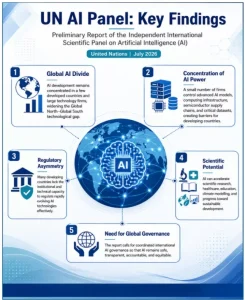
- Digital Inequality: Unequal access to computing power, data, talent and capital may widen global technological and economic disparities.
- Market Concentration: Dominance of a handful of technology companies could limit competition, innovation and equitable access to AI.
- Deepfakes and Misinformation: AI-generated content threatens electoral integrity, public trust and democratic institutions.
- Cybersecurity Risks: Advanced AI can be misused for sophisticated cyberattacks, automated hacking and disruption of critical infrastructure.
- Ethical Challenges: AI systems may perpetuate algorithmic bias, discrimination, privacy violations and lack transparency in automated decision-making.
- Economic Disruptions: Rapid AI adoption could reshape labour markets, increase job displacement and create systemic financial risks.
About the Independent International Scientific Panel on AI
- It was established under the United Nations (UN) following the recommendations of the UN High-Level Advisory Body on Artificial Intelligence to provide independent, science-based assessments on AI.
- Objective: To evaluate the scientific, economic, social, ethical and environmental implications of AI and support evidence-based global AI governance.
- Nature: It is an independent multidisciplinary expert body, bringing together scientists, technologists and policy experts from different regions.
|
Challenges for India
- Limited Compute Infrastructure: India continues to face shortages in high-performance computing (HPC) capacity, advanced GPUs and semiconductor manufacturing, constraining the development of frontier AI models.
- Example: The launch of the IndiaAI Compute Facility reflects the government’s recognition of the country’s compute deficit and the need for affordable GPU access.
- Dependence on Foreign Models: Heavy reliance on global AI companies, foreign foundation models and imported AI chips (such as NVIDIA GPUs) raises concerns over strategic autonomy, technological dependence and data sovereignty.
- Example: Most widely used Generative AI systems in India—including models from OpenAI, Google and Anthropic—are developed abroad.
- Regulatory Preparedness: India’s AI governance framework is still evolving to address issues of accountability, liability, privacy, algorithmic transparency, bias, copyright and AI-generated misinformation.
- Example: The UN’s Preliminary Report of the Independent International Scientific Panel on AI (2026) highlighted the need for stronger governance and greater Global South participation in AI regulation, reinforcing the importance of India’s evolving policy framework.
- Skill Gap: Demand for AI researchers, engineers, data scientists and AI ethics professionals continues to outpace supply, requiring greater investment in AI education, reskilling and advanced research ecosystems.
- Example: The IndiaAI Mission’s FutureSkills pillar has been launched to expand AI education and create a larger pool of skilled AI professionals.
- Data Quality and Language Diversity: AI systems require high-quality, representative and multilingual datasets, but many Indian languages remain underrepresented, affecting model accuracy and inclusiveness.
- Example: The BharatGen Mission seeks to address this gap by developing indigenous multilingual foundation models tailored to Indian languages and contexts.
- High Energy and Environmental Costs: Training and operating large AI models require substantial electricity, cooling infrastructure and water resources, posing sustainability challenges.
- Example: As India expands AI data centres under the IndiaAI Mission, balancing AI growth with renewable energy and resource efficiency has become an emerging policy priority.
India’s AI Initiatives
- IndiaAI Mission: A flagship initiative to build a robust AI ecosystem by supporting computing infrastructure, high-quality datasets, AI start-ups, research, innovation, skilling, and adoption across sectors.
- IndiaAI Compute Facility: Expands access to high-performance GPU computing infrastructure for researchers, start-ups, academia and public institutions, reducing dependence on expensive private computing resources.
- Digital Personal Data Protection Act, 2023: Establishes a rights-based legal framework for protecting personal data, regulating data processing, ensuring user consent and strengthening accountability in the digital ecosystem.
- National Strategy for Artificial Intelligence (#AIforAll): Provides a roadmap for the responsible, inclusive and ethical adoption of AI, with priority focus on healthcare, agriculture, education, smart mobility and governance.
- BharatGen Mission: Promotes the development of indigenous multilingual foundation models and Generative AI, enabling AI solutions tailored to Indian languages, culture and local use cases.
Global AI Governance Initiatives:
- United Nations: Promotes a global, inclusive and human-centric AI governance framework to ensure AI advances sustainable development while addressing risks related to safety, inequality and human rights.
- Global Digital Compact: Encourages international cooperation on digital technologies, AI governance, data governance, digital public infrastructure and bridging the global digital divide.
- UNESCO Recommendation on the Ethics of AI: Provides the first global normative framework for AI, emphasizing transparency, fairness, accountability, privacy, human rights and environmental sustainability.
- Global Partnership on Artificial Intelligence (GPAI): A multistakeholder initiative that fosters international collaboration on responsible AI development, policy research and the practical implementation of trustworthy AI.
|
Way Forward
- Strengthen Indigenous AI Ecosystem: Expand investment in computing infrastructure, foundation models, semiconductor manufacturing and AI research.
- Develop Robust AI Regulation: Establish risk-based regulatory frameworks balancing innovation with safety, accountability and ethical safeguards.
- Promote International Cooperation: Advocate inclusive global AI governance that reflects the interests of developing countries.
- Build Human Capital: Expand AI education, digital skills and interdisciplinary research to meet future workforce requirements.
- Ensure Responsible AI: Adopt principles of fairness, transparency, privacy, accountability and human oversight in AI deployment.
Click to Explore UPSC Offline Coaching
Conclusion
Artificial Intelligence (AI) offers unprecedented opportunities for scientific advancement and economic growth, but its benefits must be shared equitably. Strengthening international cooperation, promoting inclusive AI governance and investing in indigenous capabilities will be essential to ensure that AI serves humanity while minimising technological, economic and ethical risks.
 3 Jul 2026