Subject: GS 3: Science & Technology
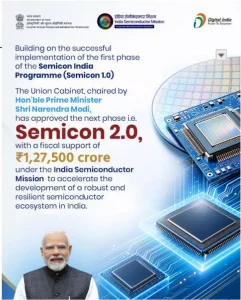
Context: Recently, the Cabinet Committee on Economic Affairs (CCEA) has approved the India Semiconductor Mission (Semicon Mission) 2.0 with an outlay of ₹1.27 lakh crore.
- Other Schemes Approved by the Cabinet:
-
- Mobile Phone Manufacturing Scheme (MPMS): Approved with an outlay of ₹62,500 crore to promote domestic mobile phone manufacturing, Indian brands, design, research & development (R&D), domestic value addition and exports.
- National Investment Policy for Urea (NIPU)-2026: Approved to facilitate the establishment of 8–9 new gas-based urea plants with an additional production capacity of 10 million tonnes, aiming to reduce import dependence and strengthen fertiliser security.
UPSC Online Preparation
Global Semiconductor Market
- Rapid Market Growth: Valued at ~US$792 billion (2025) and projected to approach US$1 trillion by 2026, driven by AI, cloud computing, 5G, EVs and IoT.
- Concentrated Supply Chain: Manufacturing is dominated by Taiwan, South Korea, the US, Japan and China, with a few firms controlling advanced chip production.
- Strategic Importance: Semiconductors have become critical to economic competitiveness, technological leadership and national security.
- Geopolitical Realignment: Countries are investing heavily to diversify supply chains and reduce dependence on a few manufacturing hubs amid geopolitical tensions.
Indian Semiconductor Market
- Fast-Growing Demand: India’s semiconductor market is projected to grow from ~US$54 billion to over US$100 billion by 2030, driven by electronics, automotive, telecom and digitalisation.
- Import Dependence: India currently imports over 90% of its semiconductor requirements, creating strategic vulnerabilities.
- Design Strength: India is a global hub for semiconductor design, with about 20% of the world’s chip design engineers based in the country.
- Manufacturing Push: Through the India Semiconductor Mission (ISM) and Semicon 2.0, India aims to build a complete semiconductor ecosystem spanning design, fabrication, ATMP/OSAT, packaging and R&D.
|
About Semicon Mission 2.0
- Objective: To build a globally competitive, resilient and self-reliant semiconductor ecosystem by promoting indigenous chip design, manufacturing and supply chains.
- Investment Target: Aims to attract around ₹4 lakh crore in investments and facilitate semiconductor production worth ₹2 lakh crore during the scheme period.
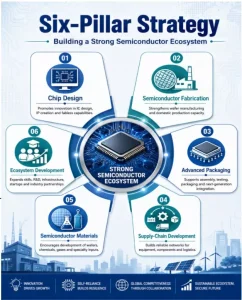 Six-Pillar Strategy: Focuses on chip design, semiconductor fabrication, advanced packaging, supply-chain development, semiconductor materials and ecosystem development.
- Expanded Scope: Extends financial support to raw materials, specialty gases, minerals, chemicals and other critical semiconductor supply-chain components, in addition to chip manufacturing.
- Strategic Focus: Seeks to strengthen domestic capabilities in Artificial Intelligence (AI), memory chips, advanced semiconductor technologies and strategic electronics.
- Building on Earlier Success: Expands the India Semiconductor Mission (2021), under which 12 projects involving investments of around ₹1.64 lakh crore have already been approved.
About Semiconductor
- A semiconductor is a material whose electrical conductivity lies between a conductor and an insulator, allowing controlled flow of electricity.
- Common Materials: The most widely used semiconductor is silicon (Si), while germanium (Ge) and gallium arsenide (GaAs) are used for specialized applications.
- Key Property: Its conductivity can be precisely controlled through doping (adding impurities), making it suitable for electronic switching and signal processing.
- Applications: Semiconductors form the foundation of integrated circuits (ICs), microprocessors, memory chips, sensors, and power electronics used in smartphones, computers, automobiles, telecommunications, defence, AI, and medical devices.
- Strategic Importance: Semiconductors are regarded as the “building blocks of the digital economy”, underpinning emerging technologies such as Artificial Intelligence (AI), 5G, Internet of Things (IoT), electric vehicles (EVs), quantum computing, and advanced manufacturing.
|
Need for Semicon Mission 2.0
- Reducing Import Dependence: India remains heavily dependent on imports for semiconductors, exposing critical sectors to global supply-chain disruptions.
- Addressing Geopolitical Risks: Global semiconductor shortages and geopolitical tensions have highlighted the need for secure and resilient domestic semiconductor manufacturing.
- Meeting Future Demand: Rapid growth in Artificial Intelligence (AI), electric vehicles (EVs), 5G, Internet of Things (IoT), consumer electronics and defence technologies is driving demand for advanced semiconductor chips.
- Strengthening Supply Chains: Domestic manufacturing of chips, raw materials and critical components is essential for creating an integrated semiconductor ecosystem.
- Enhancing Technological Sovereignty: Indigenous semiconductor capabilities are crucial for ensuring strategic autonomy, national security and digital sovereignty.
About Other Initiatives:
- India Semiconductor Mission (ISM) (2021): Approved with an outlay of ₹76,000 crore to establish a comprehensive semiconductor and display manufacturing ecosystem in India.
- Implemented by the India Semiconductor Mission (ISM) under the Ministry of Electronics and Information Technology (MeitY).
- Design Linked Incentive (DLI) Scheme (2021): Supports domestic semiconductor design companies by providing financial incentives for chip design, product development and commercialisation.
- Production Linked Incentive (PLI) Scheme for Large-Scale Electronics Manufacturing (2020): Promotes large-scale manufacturing of mobile phones and specified electronic components to increase exports and domestic value addition.
- Scheme for Promotion of Manufacturing of Electronic Components and Semiconductors (SPECS) (2020): Provides financial incentives for manufacturing electronic components, semiconductor packaging, sub-assemblies and specialised electronics.
|
Click to Explore UPSC Offline Coaching
Conclusion
Semicon Mission 2.0 will strengthen India’s semiconductor ecosystem by promoting indigenous design, manufacturing and innovation, enhancing technological self-reliance, economic resilience and global competitiveness.
 16 Jul 2026