Subject: GS 3: Science & Technology
Context: The United States Food and Drug Administration (US FDA) has approved Vepdegestrant, the world’s first PROTAC (Proteolysis-Targeting Chimera)-based therapy, for ESR1-mutated, Estrogen Receptor (ER)-positive, Human Epidermal Growth Factor Receptor 2 (HER2)-negative advanced breast cancer.
UPSC Coaching Classes
About Vepdegestrant
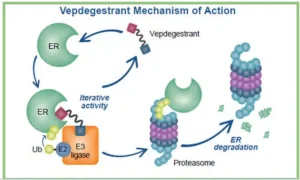
- It is a first-in-class, once-daily oral targeted anti-cancer drug developed using PROTAC technology, which destroys disease-causing proteins rather than merely blocking their activity.
- Developed By: The drug was co-developed by Arvinas, Inc., the pioneer in clinical PROTAC development, and Pfizer, representing a landmark collaboration in precision oncology.
- Approved Indication: It is approved for treating patients with ESR1-mutated, Estrogen Receptor (ER)-positive, Human Epidermal Growth Factor Receptor 2 (HER2)-negative advanced or metastatic breast cancer, particularly after progression on endocrine therapy and CDK4/6 inhibitors.
- Mechanism of Action: Unlike conventional therapies that merely inhibit the estrogen receptor, Vepdegestrant harnesses the cell’s natural protein disposal system to completely degrade the receptor, thereby overcoming hormone therapy resistance.
How Does PROTAC Technology Work?
- A PROTAC (Proteolysis-Targeting Chimera) molecule possesses two functional ends—one binds the target protein, while the other binds an E3 ubiquitin ligase, an enzyme involved in cellular protein degradation.
- Ternary Complex Formation: The PROTAC simultaneously binds the target protein and the E3 ligase, forming a temporary ternary complex that initiates the degradation process.
- Ubiquitination: The E3 ligase attaches multiple ubiquitin molecules to the target protein, permanently marking it for destruction.
- Proteasomal Degradation: The tagged protein is recognised and destroyed by the proteasome, the cell’s protein recycling machinery, while the PROTAC molecule remains intact and can repeatedly degrade additional target proteins.
|
Key Features of Vepdegestrant
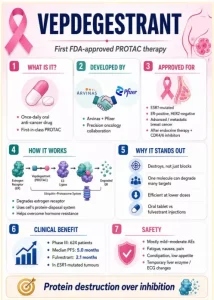
- First Approved PROTAC Therapy: It is the world’s first FDA-approved drug based on targeted protein degradation (PROTAC) technology, validating a therapeutic approach developed over two decades.
- Protein Destruction Over Inhibition: Unlike conventional drugs that only block protein activity, Vepdegestrant completely removes the estrogen receptor, eliminating all its cancer-promoting functions.
- Catalytic Efficiency: A single Vepdegestrant molecule can repeatedly degrade multiple copies of the target protein, enabling effective treatment at comparatively lower doses.
- Convenient Oral Therapy: It is administered as a once-daily oral tablet, replacing the need for monthly intramuscular injections required with therapies such as Fulvestrant.
- Proven Clinical Benefit: In a Phase III clinical trial involving 624 patients, the drug improved median progression-free survival to 5 months, compared with 2.1 months for Fulvestrant among patients with ESR1-mutated tumours.
- Favourable Safety Profile: Most adverse effects were mild to moderate, including fatigue, nausea, musculoskeletal pain, constipation, reduced appetite, and temporary changes in liver enzymes and electrocardiogram (ECG) findings.
Significance
- New Therapeutic Paradigm: The approval establishes targeted protein degradation as a clinically viable therapeutic strategy, complementing conventional protein inhibition approaches.
- Overcoming Drug Resistance: By destroying mutated estrogen receptors, the drug addresses a major mechanism of resistance to hormone therapy in advanced breast cancer.
- Targeting ‘Undruggable’ Proteins: PROTAC technology can target proteins lacking suitable binding sites for conventional drugs, significantly expanding the scope of drug discovery.
- Broad Therapeutic Potential: More than 40 PROTAC candidates targeting over 200 proteins are currently undergoing clinical trials for cancer, neurodegenerative disorders, inflammatory diseases, and muscle disorders.
- Catalysing Future Drug Innovation: The approval is expected to accelerate research into protein degradation-based therapeutics, advancing the field of precision medicine.
Click to Know UPSC OnlyIAS Coaching Centres
Conclusion
The FDA approval of Vepdegestrant marks a watershed moment in precision oncology, validating targeted protein degradation as a transformative therapeutic strategy. By enabling the destruction of previously ‘undruggable’ proteins, PROTAC technology has the potential to redefine the treatment of cancer and numerous other complex diseases.
 11 Jul 2026