Subject: GS 3: Economy
Context: Recently, the Vice President of India launched the national programme for issuance of Letters of Authorisation (LoAs) for Sustainable Harnessing of Fisheries in the High Seas at Bhubaneswar, Odisha.
UPSC Online Coaching
Key Highlights of the Initiative
- National Rollout of Letters of Authorisation (LoAs): The Government launched Letters of Authorisation valid for 3 years for Indian-flagged fishing vessels operating in high seas (distant waters), creating a transparent regulatory framework for lawful, sustainable, and internationally compliant fishing.
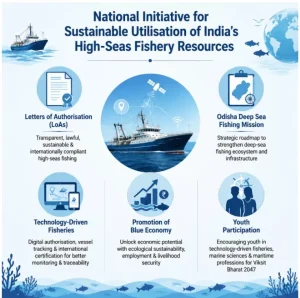 Odisha Deep Sea Fishing Mission: The Odisha Deep Sea Fishing Mission Document was unveiled as a strategic roadmap to strengthen the State’s deep-sea fishing ecosystem, improve infrastructure, and promote sustainable marine resource utilisation.
- Technology-Driven Fisheries: The initiative promotes digital authorisation, vessel tracking systems, and internationally recognised certification standards to improve monitoring, traceability, and sustainable fisheries management.
- Significance:
- Unlock the economic potential of India’s marine resources,
- Ensure ecological sustainability,
- Employment generation, and
- Livelihood security for coastal communities.
About High-Seas Fisheries
- High seas refer to ocean areas lying beyond the Exclusive Economic Zone (EEZ) of any country and are governed under international law rather than the jurisdiction of a single nation.
- Fishing Resources: High-seas fisheries primarily target high-value migratory species such as tuna, billfish, squid, and other pelagic fish.
- Need for Regulation: Fishing in distant waters requires authorisation, monitoring, and compliance with international conservation measures to prevent Illegal, Unreported and Unregulated (IUU) fishing and overexploitation of marine resources.
Significance of the Initiative
- Sustainable Marine Resource Management: Establishes a regulatory framework for the responsible utilisation of marine resources while ensuring long-term ecological sustainability.
- Strengthening the Blue Economy: Expands economic opportunities through deep-sea fisheries, value addition, seafood exports, and employment generation in coastal regions.
- Enhancing Seafood Exports: India’s seafood exports have crossed ₹73,000 crore and reach over 120 countries. Sustainable certification and traceability can further improve global market access.
- Promoting Responsible Fishing: Digital authorisation, vessel monitoring, and certification standards improve transparency, accountability, and compliance with international fisheries regulations.
- Supporting Coastal Livelihoods: Expanding deep-sea fishing reduces pressure on near-shore fish stocks while creating new livelihood opportunities for fishers.
India’s Related Initiatives
- Sagarmala Programme (2015): A flagship port-led development initiative aimed at modernising ports, strengthening coastal infrastructure, improving maritime logistics, and promoting coastal economic development.
- Pradhan Mantri Matsya Sampada Yojana (PMMSY) (2020): Launched with an investment of ₹20,050 crore to promote sustainable fisheries, aquaculture, fisheries infrastructure, value-chain development, and the welfare of fishers.
- Draft Blue Economy Policy (2021): Prepared by the Ministry of Earth Sciences (MoES) to promote the sustainable utilisation of marine resources for economic growth, environmental conservation, livelihood generation, and integrated ocean governance.
- Deep Ocean Mission (2021): Approved with an outlay of ₹4,077 crore to support deep-sea exploration, ocean technologies, marine biodiversity research, and the sustainable utilisation of India’s ocean resources.
- Marine Fisheries (Regulation and Management) Bill, 2024: Seeks to establish a comprehensive legal framework for the sustainable management of fisheries in India’s Exclusive Economic Zone (EEZ) through vessel registration, digital monitoring, vessel tracking systems, and measures to combat Illegal, Unreported and Unregulated (IUU) fishing.
Click to Know UPSC Offline Courses
Conclusion
The initiative marks a significant step towards sustainable deep-sea fisheries and responsible utilisation of India’s marine resources. By combining technology-driven governance, scientific resource management, and Blue Economy principles, it can strengthen coastal livelihoods, boost seafood exports, and contribute to the vision of Viksit Bharat 2047.
 11 Jul 2026