Subject: GS 2: Polity & Governance
Context: The Government of India has announced a full digital rollout of the criminal justice system from July 1, 2027.
- Following the rollout, the procedures related to investigations and trials under the new criminal laws will be recorded digitally through the Interoperable Criminal Justice System.
IAS coaching
What is the Interoperable Criminal Justice System (ICJS)?
- It is a National e-Governance initiative of the Ministry of Home Affairs (MHA) that digitally integrates the five pillars of the criminal justice system to enable seamless, secure, and real-time exchange of information across agencies.
- Five Integrated Pillars
- Police: Crime registration, investigation, and law enforcement through CCTNS.
- Courts: Digital case management and judicial proceedings through the e-Courts Mission Mode Project.
- Prisons: Prison administration and inmate management through e-Prisons.
- Prosecution: Digital scrutiny and management of prosecution through e-Prosecution.
- Forensic Science Laboratories (FSLs): Electronic management and tracking of forensic evidence through e-Forensics.
|
What is the Criminal Justice System (CJS)?
- The Criminal Justice System is the institutional framework responsible for maintaining law and order, investigating crimes, prosecuting offenders, and ensuring justice.
- Procedural Chain of Criminal Justice: Procedural efficiency encompasses the seamless progression of a criminal case—from the registration of the First Information Report (FIR), investigation, and filing of the chargesheet specifying the charges against the accused, to the presentation of evidence and witness testimonies during trial, culminating in the final disposal of the case.
- Objectives:
- Protect Life, Liberty & Property: Safeguards individuals against crime while ensuring constitutional protection of life, personal liberty, and property rights.
- Ensure Speedy & Fair Justice: Promotes timely investigation and trial while upholding due process, fairness, and the principles of natural justice.
- Safeguard Rights of Victims & Accused: Balances victims’ right to justice with the accused’s right to a fair trial and legal safeguards.
- Maintain Rule of Law & Public Confidence: Upholds the supremacy of law, deters crime, and strengthens citizens’ trust in the justice delivery system.
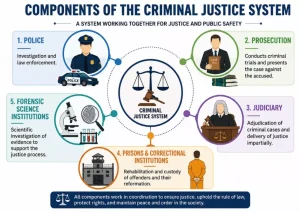
Criminal Justice System
| Adversarial System |
Inquisitorial System |
| Judge acts as a neutral umpire who decides the case based on evidence presented by the parties. |
Judge plays an active investigative role by supervising evidence collection and examining witnesses. |
| Prosecution and defence control the proceedings by presenting evidence and arguments before the court. |
Judge directs the investigation and independently seeks relevant evidence to establish the truth. |
| Focuses on procedural fairness and ensuring a fair contest between opposing parties. |
Focuses on substantive justice by prioritising the discovery of objective truth. |
| Common in Common Law countries such as India, the United Kingdom, and the United States. |
Common in Civil Law countries such as France, Germany, Italy, and Spain. |
| Judicial intervention is limited to maintaining fairness during the trial. |
Judicial intervention is extensive, with the judge playing a central role throughout the proceedings. |
How the Earlier Criminal Justice System Differs from the Present Framework?
| Earlier Framework (IPC & CrPC) |
Present Framework (BNS & BNSS) |
| Punishment-centric approach focused primarily on penalising the offender. |
Justice-centric approach aims at ensuring fair, timely, and victim-oriented justice while maintaining accountability. |
| Reflected a colonial philosophy, where protecting the authority of the State was a primary objective. |
Adopts a citizen-centric and democratic philosophy, placing greater emphasis on individual rights and constitutional values. |
| Criminal trials largely viewed the accused as a ‘criminal’, with limited emphasis on balancing competing rights. |
Treats the accused as a citizen presumed innocent until proven guilty, balancing the rights of the accused with those of victims. |
| Greater emphasis on state prosecution and maintenance of law and order. |
Gives increased importance to victim participation, victim rights, and restorative justice, alongside effective prosecution. |
| Procedures were often lengthy and paper-based, resulting in delays and procedural inefficiencies. |
Promotes time-bound investigations, digital processes, e-FIRs, electronic evidence, and technology-enabled justice delivery. |
| Focused mainly on retributive punishment after the commission of an offence. |
Moves towards retributive justice with greater emphasis on speedy, transparent, and citizen-oriented justice delivery. |
Major Digital Reforms in the Criminal Justice System
- End-to-End Digital Criminal Process: Introduces e-FIRs, digital case diaries, electronic charge sheets, digital summons and warrants, electronic evidence management, online court records, and digital prison management to improve efficiency, transparency, and speed.
- MeghRaj Government Cloud: Stores criminal justice records on the MeghRaj Government Cloud, ensuring secure data storage, authorised access, reduced paperwork, and seamless sharing of information across agencies.
- Scientific Investigation under BNSS: Mandates forensic examination for offences punishable with seven years or more imprisonment, strengthening evidence-based investigations; forensic laboratories have increased from 129 (2023) to 154 (2025) to support this reform.
- e-Sakshya (Digital Evidence Management): Enables digital recording, storage, and transfer of photographs, videos, and forensic evidence, strengthening the chain of custody and improving the reliability of investigations.
- e-Forensics & Mobile Forensic Units: Scientific Crime Scene Investigation: Uses digital forensic tools, mobile forensic vans, and AI-assisted analysis to ensure timely collection, preservation, and examination of evidence at crime scenes.
- e-Courts Integration: Digitised Judicial Processes to facilitate e-filing, virtual hearings, digital case records, and online case tracking, reducing delays and improving accessibility, transparency, and judicial efficiency.
- Crime and Criminal Tracking Network & Systems (CCTNS): It is a Nationwide Police Networking system that digitally connects police stations across India for online FIR registration, criminal record management, investigation support, and real-time sharing of crime.
UPSC Course Fees Online
Need for Digitisation of the Criminal Justice System
- Improves Procedural Efficiency: Digitisation enables e-FIR registration, digital case diaries, electronic charge sheets, and seamless transfer of records, reducing paperwork, duplication and procedural delays.
- Enhances Transparency & Accountability: A secure digital audit trail records every stage of investigation and prosecution, reducing scope for manipulation, loss of records and procedural irregularities.
- Speeds Up Justice Delivery: Electronic transmission of FIRs, charge sheets, summons, warrants and court records accelerates investigation and trial, reducing procedural bottlenecks and case pendency.
- Strengthens Evidence Management: Digitisation ensures secure preservation of digital evidence, electronic chain of custody and authenticated forensic reports, improving evidentiary integrity and admissibility in courts. It also supports AI-enabled investigation and forensic analysis under ICJS Phase-II.
- Promotes Citizen-Centric Governance: Citizens can file complaints online, track FIRs, seek police verification, monitor case status and access justice services digitally, reducing repeated visits to police stations while improving accessibility and victim support.
- Enables Better Coordination: ICJS enables real-time information sharing among Police, Courts, Prisons, Prosecution and Forensic Science Laboratories, eliminating institutional silos and ensuring coordinated investigation, prosecution and adjudication.
Challenges in Digitisation of the Criminal Justice System
- Digital Divide: Wide disparities in digital infrastructure and internet connectivity across States hinder the uniform implementation of technology-enabled criminal justice services.
- For Example: While India’s internet user base has crossed 1.09 billion, rural internet penetration sits at roughly 47 subscriptions per 100 people—half the urban rate.
- Cybersecurity Risks: Criminal records and digital evidence are vulnerable to cyberattacks, data breaches, and unauthorised access, necessitating robust cybersecurity mechanisms.
- Privacy Concerns: Large-scale digital storage and sharing of criminal records require strict compliance with data protection principles and safeguards against misuse
- Capacity Constraints: Effective implementation depends on regular training of police officers, prosecutors, forensic experts, and judicial officers in digital technologies.
Role of Judiciary in Criminal Justice Reform
- Courts fill legislative gaps through rulings, guiding the evolution of the criminal justice system.
- Example cited: Vishaka v. State of Rajasthan (1997) — Supreme Court laid down guidelines against sexual harassment at workplace, holding it violates Articles 14, 15, and 21 of the Constitution (until codified later via the POSH Act, 2013).
|
-
- For Example: The Ministry of Home Affairs has established cyber forensic-cum-training laboratories in 33 States/UTs, providing specialized training on cybercrime investigation and digital forensics to over 24,600 Law Enforcement Agency (LEA) personnel, prosecutors, and judicial officers.
- Infrastructure Deficit: Shortage of forensic laboratories, trained experts, and reliable broadband connectivity, especially in rural areas, affects efficient implementation.
- Interoperability Issues: Different software systems and varying technological standards across States impede seamless information sharing among criminal justice institutions.
- Implementation Gap:Despite ongoing reforms, only 46% of FIRs are digitally transmitted to courts (NCRB), indicating gaps in end-to-end digital integration.
Click to Know UPSC Offline Courses
Way Forward
- Complete ICJS Integration: Fully integrate police, courts, prisons, prosecution, and forensic institutions through the Interoperable Criminal Justice System (ICJS) for real-time information sharing.
- Strengthen Digital Infrastructure: Upgrade police stations, courts, forensic laboratories, and digital communication networks with reliable hardware, software, and high-speed internet.
- Capacity Building: Conduct regular digital literacy and technology training programmes for investigators, prosecutors, judicial officers, and forensic professionals.
- Robust Cybersecurity: Implement end-to-end encryption, multi-factor authentication, periodic security audits, and disaster recovery systems to safeguard criminal justice data.
- Uniform National Standards: Develop common standards for digital evidence, electronic records, interoperability, and data sharing to ensure consistency across States.
- Strengthen Scientific Investigation: Increase forensic laboratories, deploy mobile forensic units, and recruit skilled experts to support evidence-based investigations.
- Citizen-Friendly Digital Services: Promote online FIR tracking, digital summons, virtual hearings, multilingual interfaces, and mobile-based services to improve accessibility, transparency, and public trust.
 16 Jul 2026