Subject: GS 3: Environment
Context: A recent study has warned that the Caspian Sea is shrinking rapidly due to climate change and human interventions, posing serious ecological, hydrological and regional security challenges.
UPSC Online Classes
About the Caspian Sea
- Largest Inland Water Body: The Caspian Sea is the world’s largest enclosed inland water body (often regarded as the world’s largest lake), covering an area of about 371,000 sq. km.
- The water is almost fresh in the northern part and becomes saltier towards the south, important islands.
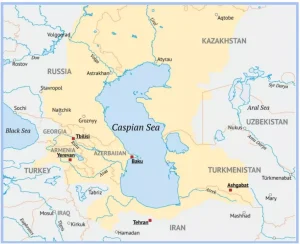 Location: It lies between Europe and Asia and is bordered by Russia, Kazakhstan, Turkmenistan, Iran and Azerbaijan.
- Endorheic Basin: It is an endorheic (closed-basin) water body, receiving water from rivers but having no natural outlet to the oceans, with water loss occurring only through evaporation.
- Major Inflow: It receives water from around 130 rivers, with the Volga River contributing nearly 80% of the total freshwater inflow.
- Biodiversity Hotspot: Around 80% of its aquatic species are endemic, including the Caspian Seal and several sturgeon species, which historically produced nearly 90% of the world’s black caviar.
- Strategic Importance: It contains significant oil and natural gas reserves and serves as a major transport corridor linking Europe, Central Asia and West Asia, including routes connected to the International North-South Transport Corridor (INSTC).
Reasons for the Shrinkage
- Declining River Inflows: Reduced freshwater inflow, particularly from the Volga River, due to dams, reservoirs, river diversions and excessive water withdrawal for irrigation.
- Climate Change: Rising temperatures have significantly increased evaporation rates, exceeding freshwater inflows into the sea.
- Rising Surface Temperature: The average sea surface temperature has increased by about 1°C since the mid-20th century, accelerating water loss.
- Changing Climatic Conditions: Altered wind patterns and prolonged warming have intensified evaporation across the enclosed basin.
Its Major Ecological and Socio-Economic Impacts
- Biodiversity Loss: Shrinking shallow waters threaten breeding habitats of endemic species, including the endangered Caspian Seal and Beluga Sturgeon.
- Declining Fisheries: Falling water levels and habitat degradation are reducing fish populations and affecting the global caviar industry.
- Algal Blooms: Rising chlorophyll-a concentrations indicate increasing harmful algal blooms, resulting in deteriorating water quality.
- Wetland Degradation: Loss of wetlands threatens migratory bird habitats along the Europe–Asia–Africa flyway.
- Dust and Salt Storms: Exposure of the dried seabed could generate toxic dust and salt storms, affecting human health and agriculture.
- Navigation Challenges: Declining water levels reduce navigability, affecting shipping, regional trade and energy transportation.
- Livelihood Impacts: Coastal communities dependent on fisheries, shipping and tourism face increasing socio-economic vulnerability.
Click to Know UPSC Coaching Centres in India
Why is it Significant for India?
- International North-South Transport Corridor (INSTC): Reduced navigability may affect the efficiency of the INSTC, an important trade route connecting India with Central Asia, Russia and Europe.
- Energy Security: The Caspian region’s vast oil and gas reserves are strategically important for India’s long-term energy diversification.
- Regional Connectivity: Environmental degradation could affect India’s growing economic engagement with the Eurasian region.
 16 Jul 2026