Subject: GS 3: Environment
Context: The Union Government will continue pricing E20 (20% ethanol-blended petrol) above pure petrol despite low crude oil prices, reigniting the debate over balancing energy security, farmer welfare, consumer interests and resource sustainability.
UPSC Online Classes
About Ethanol-Blended Fuel (EBF) Programme
- The Ethanol-Blended Petrol (EBP) Programme involves blending ethanol with petrol to reduce dependence on imported crude oil, lower greenhouse gas emissions, and support farmers through additional demand for agricultural produce.
- Launch: The programme was launched in 2003 and has been expanded progressively under the National Policy on Biofuels.
- Current Target: India has achieved the target of 20% ethanol blending (E20) ahead of schedule in selected regions and aims to expand nationwide.
- Major Feedstocks: Ethanol is primarily produced from sugarcane molasses, sugarcane juice, maize, damaged food grains, and increasingly from agricultural residues for Second-Generation (2G) ethanol.
Objectives of the Ethanol-Blending Programme
- Reduce Crude Oil Imports: Lower dependence on imported petroleum products, thereby improving energy security and reducing the import bill.
- Support Farmers’ Income: Create an assured market for agricultural produce and diversify farmers’ income sources.
- Promote Cleaner Fuels: Reduce greenhouse gas emissions, improve air quality, and contribute to India’s climate commitments.
- Strengthen the Bioeconomy: Encourage investment in biofuel industries, rural infrastructure, and value addition in agriculture.
Benefits of Ethanol Blending
- Enhances Energy Security: Ethanol blending reduces India’s dependence on imported crude oil, improving resilience against global energy price volatility.
- Provides Additional Income to Farmers: Diversifies revenue sources by creating demand for sugarcane, maize, and crop residues.
- Reduces Carbon Emissions: Ethanol is a renewable fuel that helps lower vehicular emissions and contributes to Net Zero by 2070.
- Boosts Rural Economy: Expansion of distilleries and biofuel industries generates employment and promotes rural industrialisation.
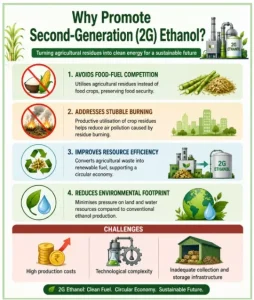
- Supports Circular Economy: Second-Generation (2G) ethanol utilises agricultural residues, converting waste into value-added fuel.
Concerns Associated with the Existing Policy
- Higher Burden on Consumers: Maintaining a higher price for E20 petrol despite lower international crude oil prices increases fuel costs for consumers, including economically weaker sections.
- Favours Water-Intensive Crops: Since most ethanol is currently produced from sugarcane, the policy indirectly incentivises cultivation of one of India’s most water-intensive and fertiliser-intensive crops.
- Example: Major sugarcane-producing States such as Maharashtra and Karnataka are frequently affected by water stress.
- Weak Resource Efficiency: Uniform incentives irrespective of feedstock encourage the use of feedstocks with established processing infrastructure rather than those that are more resource-efficient.
- Food-Fuel Trade-Off: Diversion of food crops such as maize and rice towards ethanol production may affect food availability and price stability during periods of supply constraints.
- Limited Impact on Farmers’ Structural Problems: Higher feedstock prices alone cannot address challenges such as small landholdings, post-harvest losses, poor market access, and low value addition.
- Lower Fuel Efficiency: Since ethanol has lower energy density than petrol, E20 fuel generally delivers lower mileage, increasing the effective fuel cost for consumers.
UPSC Online Coaching
Alternative Feedstocks for Sustainable Ethanol Production
- Maize: Requires less water than sugarcane but still depends on relatively high fertiliser use.
- Millets: More climate-resilient and water-efficient, although lower starch content limits ethanol yield.
- Sweet Sorghum: Requires significantly less water than sugarcane, has a shorter crop cycle, and is suitable for semi-arid regions.
- Agricultural Residues: Rice straw, wheat straw, maize stover, and groundnut shells serve as feedstock for Second-Generation (2G) ethanol, reducing pressure on agricultural land.
Government Initiatives
- Ethanol Blended Petrol (EBP) Programme (2003): Promotes blending of ethanol with petrol through administered procurement prices and coordinated implementation by Oil Marketing Companies (OMCs).
- National Policy on Biofuels (2018; Amended 2022): Advanced the target of 20% ethanol blending from 2030 to 2025–26 and expanded the range of permissible feedstocks.
- Pradhan Mantri JI-VAN Yojana (2019): Supports establishment of Second-Generation (2G) ethanol projects using agricultural residues and other lignocellulosic biomass.
- SATAT Initiative (2018): Promotes production of Compressed Biogas (CBG) from agricultural waste and organic residues, complementing the biofuel ecosystem.
Way Forward
- Promote Feedstock Diversification: Introduce differentiated incentives that favour water-efficient and resource-efficient feedstocks rather than providing uniform support.
- Scale Up 2G Ethanol: Provide viability gap funding, support for residue collection infrastructure, assured offtake arrangements, and incentives for commercial-scale 2G ethanol plants.
- Integrate Biofuel and Agricultural Policies: Align ethanol procurement with objectives relating to water conservation, cropping pattern diversification, food security, and climate resilience.
- Improve Farmer Competitiveness: Invest in irrigation, storage, logistics, processing infrastructure, and market linkages instead of relying primarily on higher administered prices.
- Protect Consumer Interests: Ensure that biofuel pricing remains transparent and balanced so that consumers are not disproportionately burdened while pursuing energy security objectives.
Click to Know UPSC Offline Courses
Conclusion
India’s Ethanol-Blended Fuel (EBF) Programme advances energy security and climate goals, but its long-term success depends on balancing farmer welfare, consumer affordability and resource sustainability through diversified feedstocks, Second-Generation (2G) ethanol and integrated agriculture-energy policies.
 13 Jul 2026