Subject: GS 3: Environment
Context: A CREA report found that 81% of sulphur dioxide (SO₂) emissions from coal plants within 300 km of Delhi-NCR come from plants exempted from mandatory Flue Gas Desulphurisation (FGD) installation under the July 2025 notification.
UPSC Online Coaching
Key Findings of the Centre for Research on Energy and Clean Air (CREA) Report
- Pollution Despite Relaxed Norms: The report highlights that 78% of India’s coal-fired power plants are no longer required to install FGDs following the July 2025 revision of emission norms.
About Centre for Research on Energy and Clean Air (CREA)
- Founded in 2019, it is an independent international research organisation working on air pollution, energy transition and climate policy.
- Objective: Supports governments, researchers and civil society through scientific analysis and evidence-based policy recommendations for improving air quality and accelerating the transition to clean energy.
|
- Health Concerns: Sulphur dioxide (SO₂) is a major precursor of secondary PM2.5, contributing to respiratory diseases, cardiovascular disorders, stroke and premature deaths.
- Regional Pollution: Since SO₂ can travel hundreds of kilometres before converting into PM2.5, emissions from distant thermal power plants can significantly affect air quality in Delhi-NCR.
- Performance of FGD-equipped Plants: Coal plants equipped with FGD systems emitted significantly lower SO₂ compared to similar-capacity plants operating without pollution control technology.
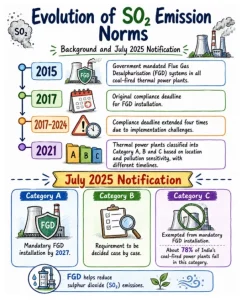
Background- Evolution of SO₂ Emission Norms
- 2015: The Government mandated the installation of Flue Gas Desulphurisation (FGD) systems in all coal-fired thermal power plants.
About Flue Gas Desulphurisation (FGD)
- FGD is an air pollution control technology installed in thermal power plants to remove sulphur dioxide (SO₂) from flue gases before they are released into the atmosphere.
- Working Principle: It uses alkaline absorbents, commonly limestone or lime, to chemically capture SO₂ and convert it into gypsum, which can be utilised in the cement and construction industries.
- Efficiency: Capable of removing up to 95% of SO₂ emissions from coal-fired power plants.
|
- 2021: Thermal power plants were categorised into Category A, B and C based on their location and pollution sensitivity, with different compliance timelines.
- July 2025 Notification:
- Category A: Mandatory FGD installation by 2027.
- Category B: Requirement decided on a case-by-case basis.
- Category C: Exempted from mandatory FGD installation; these plants constitute about 78% of India’s coal-fired power plants.
What is Sulphur Dioxide (SO₂) and Why is it a Concern?
- It is a colourless, reactive gas with a pungent odour, released mainly during the combustion of sulphur-containing fossil fuels, especially coal.
- It is a major air pollutant, causing respiratory and cardiovascular diseases, and contributes to acid rain, particulate matter (PM2.5) formation, and ecosystem degradation.
- India is the world’s largest emitter of SO₂, primarily due to its heavy dependence on coal-based thermal power plants.
- Precursor to PM2.5: Reacts in the atmosphere to form secondary fine particulate matter (PM2.5), a major contributor to urban air pollution.
Recommendations by CREA
- Universal FGD Installation: Reinstate mandatory FGD installation for all coal-fired power plants, irrespective of category.
- Greater Transparency: Make Continuous Emission Monitoring Systems (CEMS) data publicly available in real time.
- Regular Disclosure: Publish the operational status and compliance reports of FGD systems.
- Strengthen Air Quality Management: Improve monitoring and enforcement to reduce SO₂ and PM2.5 pollution, particularly in high-risk regions such as Delhi-NCR.
Click to Know UPSC Offline Courses
 15 Jul 2026